Electric bike charging station for garages
8 charging points powered from a single 230 V / 16 A circuit.
We mount ChargeGo Box on the wall of a garage, bike room or warehouse. Every charging point has its own energy meter and supervised power draw, and the building's administrator manages access to the station.
One station replaces the separate sockets that would otherwise be wired for individual users.
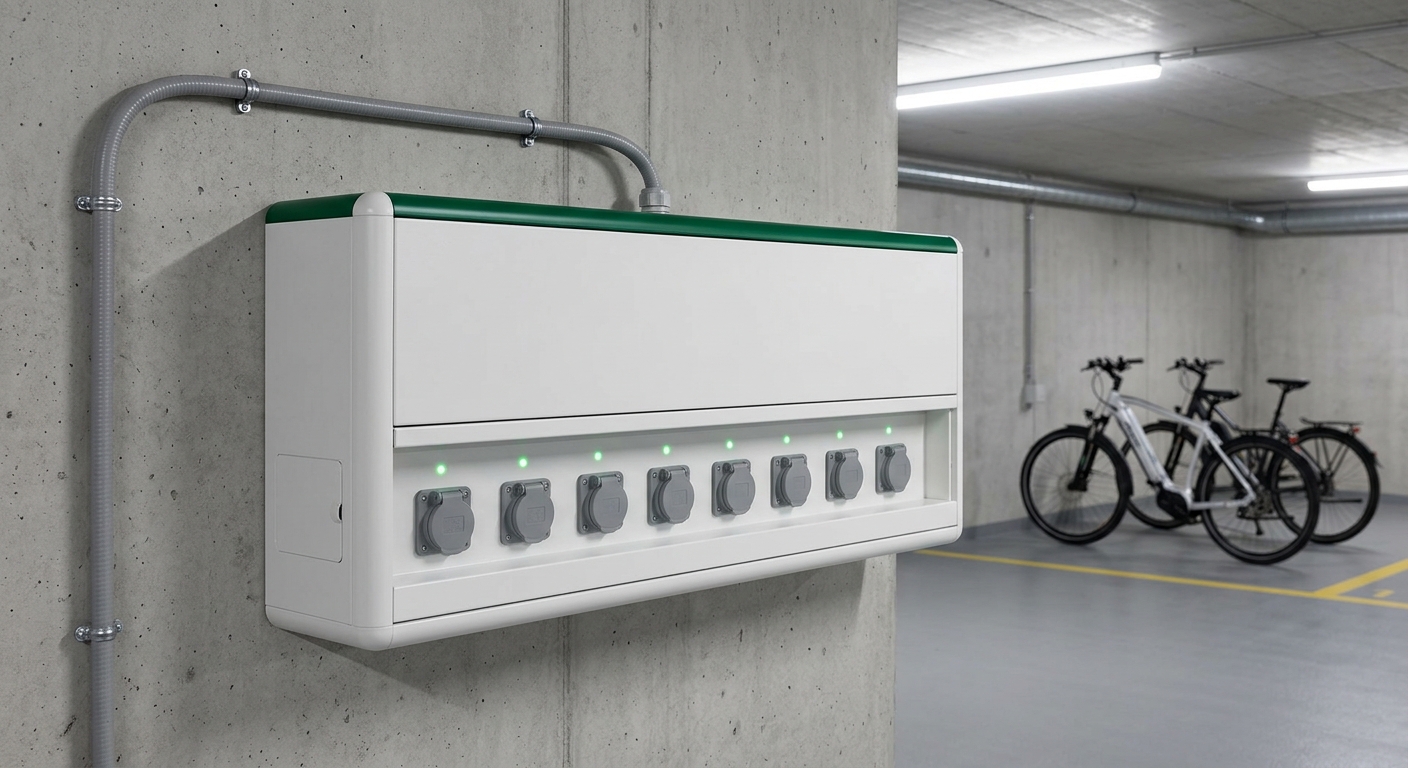
The limits of charging from shared sockets
Electric bikes have to be charged somewhere. In buildings with no infrastructure for it, users charge from whatever socket is to hand: a maintenance socket, one in a storage unit, one in a corridor.
Charging that way makes it hard to control who has access, cap the power several chargers draw at once, or attribute energy use to a specific user.
With a single bike this may not be much of a problem. Once several bikes are charging, access control and load management become a practical issue.
ChargeGo Box brings these functions into one device: a designated place to charge up to 8 electric bikes.
Racks, hooks and lockers solve parking in a bike room. Charging stays unresolved until someone runs power to the room and decides who gets to use it.
Installation requirements
The station needs a single 230 V / 16 A circuit. An electrician checks on site whether the circuit already exists in the garage and whether it is suitable for the installation. If there's no circuit, we run one ourselves, from the meter cabinet if needed.
Metering is built into the device and works separately for each of the eight charging points, so billing users needs no sub-meter in the switchboard. The metering feeds reporting and limits.
Power and sockets in an underground garage: the full guide8 charging points. One 16 A circuit.
Electric bike chargers draw little power, so eight ChargeGo Box charging points run on a single standard 230 V / 16 A circuit.
The station supervises the power draw on each charging point separately.
Safety built for a building's shared space
A socket in a garage gets used by many people, for years, so ChargeGo Box is built to a different standard than a power strip in a metal case.
The station measures the power draw on each charging point and disconnects one that goes over its allowed level.
The device also includes electrical protection, including residual-current and overcurrent protection.
Fire and smoke monitoring for the room
Electrical protection alone does not detect smoke or fire: overcurrent and residual-current devices react to faults in the installation, not to a battery burning at night in an unattended garage.
The station can therefore be extended with room monitoring: an alarm panel and a smoke detector that raise the alarm with no human and no internet involved.
- A detector in the roomA smoke detector. The number and placement depend on the size of the room and are set during the site survey.
- An alarm panel inside the station's enclosureA dedicated alarm panel, separate from the charging controller. The panel makes the decision and triggers the response.
- A sirenAn on-site alarm signal, so a hazard is audible throughout the building.
- 1DetectionThe detector picks up smoke in the room and signals the alarm panel.
- 2AlarmThe siren activates on site.
This whole path runs locally. It bypasses the internet, the cloud and the charging controller, so it works with the connection down or the server unreachable.
Where does ChargeGo Box fit?
Owners' associations and housing cooperatives
Residents buy electric bikes and want to charge them in the garage or bike room.
Instead of approving one individual socket after another, the building sets up a single shared charging point.
The administrator decides who has access, and energy use is attributed to each user.
- •one installation instead of many individual connections
- •no need to rely on maintenance sockets
- •the ability to bill actual energy use
- •one solution for current and future e-bike owners
Companies, office buildings and workplaces
If employees commute by electric bike, charging the battery during the day is a practical amenity.
The station can be mounted in a staff garage, bike room or warehouse.
A company can give the energy away as a perk or keep a record of it. The administrator sees the number of sessions and how each charging point is used.
New buildings
The easiest time to set up bike charging is while the building is still going up.
At the design stage it's enough to allow wall space for the station and a standard 230 V / 16 A circuit. No separate socket has to reach every bike space.
Once the building is handed over, the infrastructure is ready for residents or tenants to use.
Mounted on the wall of a garage or bike room
ChargeGo Box needs no dedicated room and no freestanding structure.
The unit measures 770 × 450 × 160 mm and mounts directly on a wall.
Power comes in through a single cable at the top. The sockets sit in one row along the bottom of the unit.
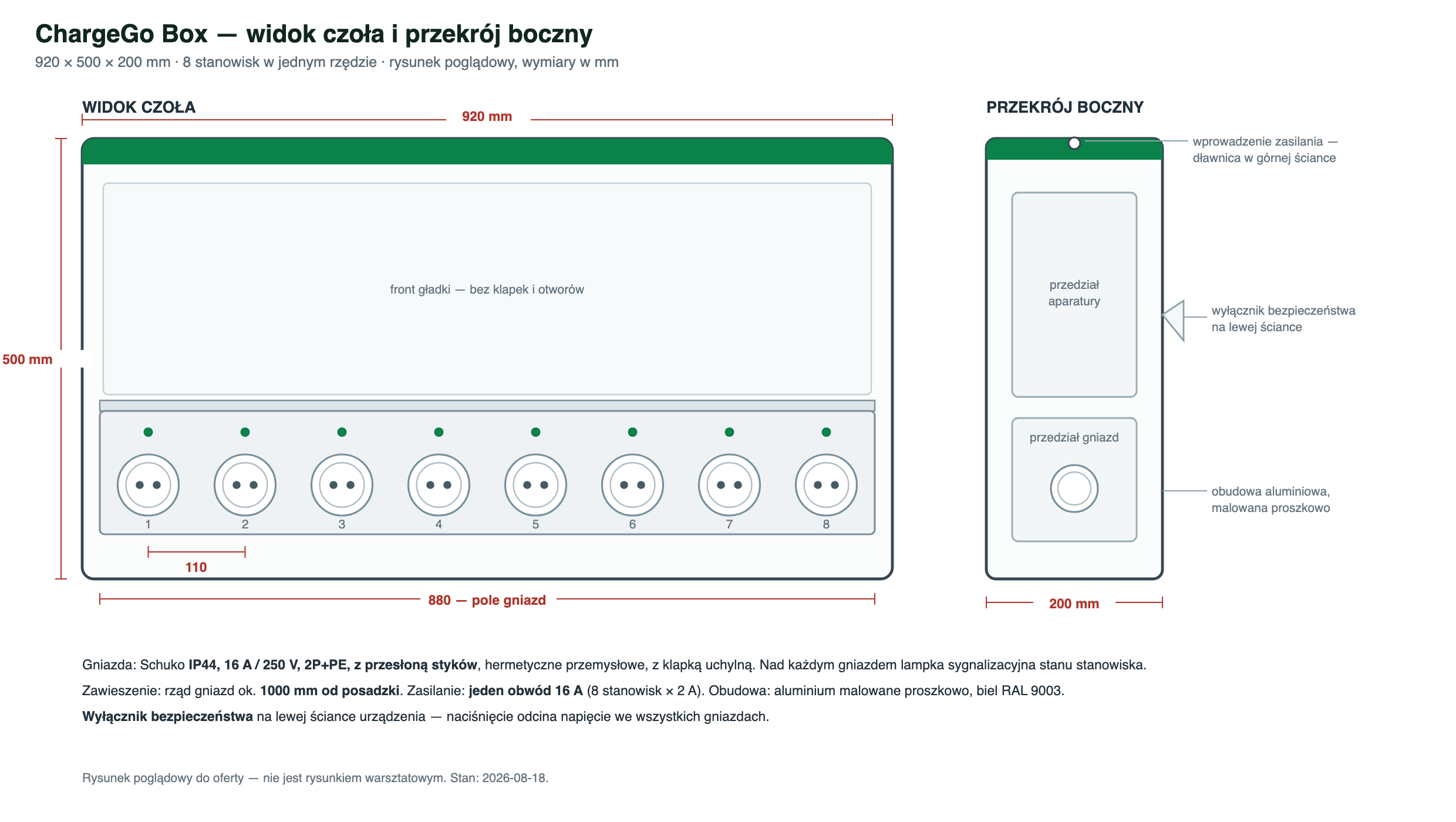
The installation site needs a 230 V / 16 A circuit. If it doesn't have one, we run it ourselves.
The user plugs in the bike and starts the charging point
The station works without handing out RFID cards or other credentials.
The user plugs their own charger into the socket and starts charging through ChargeGo.
Closed to residents, or open to everyone
Administrators switch between closed and open access in the panel. The same station supports both modes, and switching needs no new hardware and no service visit.
Only people the administrator has granted access charge: residents, employees, tenants. Every session is tied to a specific person, so usage can be billed.
The station is public: anyone who walks up can use it. Metering works the same way, so the building still knows how much the station uses and how.
By default the mobile app: the user picks a charging point and starts the session. Other methods are optional, and the building picks the ones that fit its users.
- Mobile appThe default method. Also works locally, with no signal in the garage.
- PIN codeFor users who don't want to install the app.
- Card or fobThe RFID add-on. Convenient wherever the building already issues access cards.
The methods combine: in one building, some people charge with a phone and others with a card.
There is a full range between the two modes. Access settings live in the panel, so a building can start with one model and change it as usage changes.
The administrator sees what's happening at the station
The ChargeGo panel runs in the browser, in Polish and English. The administrator can check:
- •which charging points are currently in use
- •who has used the station
- •how much energy a given charging point has drawn
- •session history
- •reported problems
- •the data needed for billing
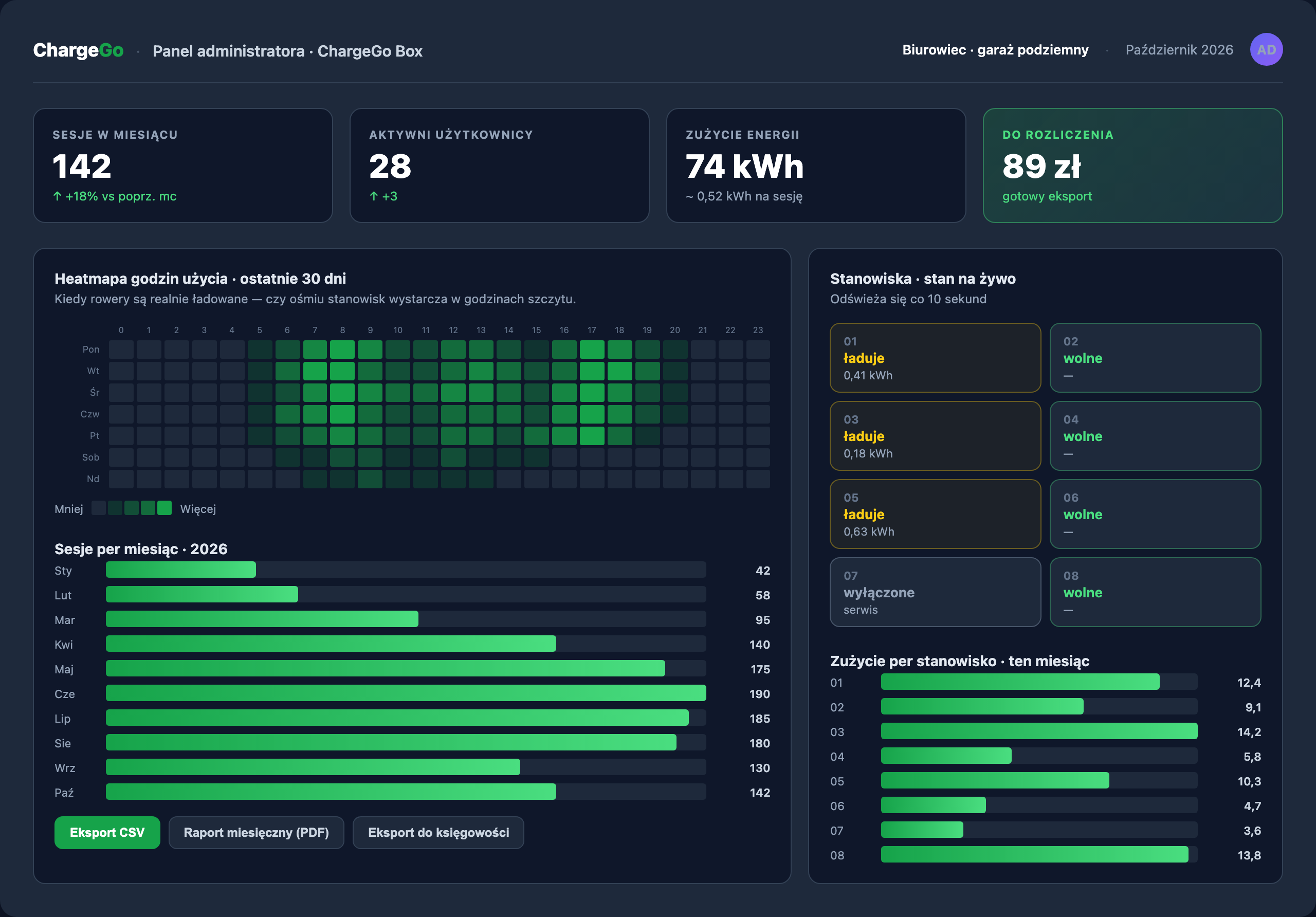
The administrator grants and revokes user access directly, with no need to contact ChargeGo support.
Energy can be free or billed
The billing model depends on where the station runs.
At a company charging can be a free perk. In a multi-family building the cost goes to a specific resident or tenant.
Whatever the billing model, the system can keep a record of each user's usage.
A wall-mounted station or a solar bike shelter?
Two solutions built for different settings.
Choose ChargeGo Box where the bikes already have somewhere covered to stand: a garage, bike room, warehouse or other indoor space.
The ChargeGo solar shelter fits outdoors, where charging has to come with racks, a roof and its own power source.
| ChargeGo Box | ChargeGo solar shelter | |
|---|---|---|
| Mounting | inside a building | outdoors |
| Power supply | 230 V / 16 A circuit | solar panels + battery |
| Bike parking | uses what's already there | built into the shelter |
| Roof cover | the existing building | part of the structure |
| Typical use | garage, bike room, warehouse | car park, company grounds, public space |
Configure your station
The base station is complete on its own. Pick what your site needs below, then send the configuration in for a quote.
One station, eight charging points on a single 230 V / 16 A circuit.
- Independent control of every socket
- Energy metering per charging point
- Starts from the mobile app or a PIN code
- Works offline, with no internet and no subscription
- Admin panel
- Cloud€10/month
Prices exclude VAT. Installation, commissioning and signage are quoted separately. See pricing. Shown in EUR at an indicative exchange rate; invoices are issued in PLN.
Send configuration for a quoteYour configuration is attached to the form, so you won't repeat your answers.
What ChargeGo Box costs
The unit's list price is €3,450 excl. VAT. Below: what that covers, what we quote separately and what the add-ons cost, so there are no surprises at the order stage.
- ✓ Station with 8 charging points, IP44 Schuko sockets with shuttered contacts
- ✓ Protection in the enclosure: residual-current, overcurrent and surge protection
- ✓ Energy metering on every charging point
- ✓ Management panel in Polish and English and a mobile app — no subscription, no end date
- ✓ Documentation in Polish, declaration of conformity, 5-year warranty
- ✓ White finish
Depends on the scope of work at your site.
- Installation and connection to a prepared circuit€420
- Commissioning, accounts and staff training€350
- Labelling the charging points and an instruction plate€140
- A colour from the RAL Classic palette€140
- 7-year warranty instead of 5€470
You need a wall to mount it on and a 230 V / 16 A circuit. If there's no circuit, we run one ourselves.
Charging control works with no subscription. The app and the local-network panel are included in the unit price, with no end date.
- Cloud: remote access, reports, notifications€10/mo
- Usage billing+€7/mo
Without the subscription the station still charges and still meters. What the subscription adds is remote monitoring.
The base station is complete on its own: it charges, meters and controls access, with no internet and no subscription. Add-ons go on when a site needs them, including later. Prices are per station.
- Fire and smoke monitoring+€240
An alarm panel, smoke detector and siren in the charging room. The alarm runs locally, not through the internet or the cloud.
- RFID cards+€240
Cards and fobs as an extra credential alongside a phone. The administrator issues and deactivates them in the panel; a lost fob switches off with one click.
- Access controlquoted individually
The bike room door on the same system: electric strike or magnetic lock, reader, door contact. The scope depends on the number of doors and what's already fitted.
Fire and smoke monitoring and access control share the same panel, so adding the second module costs less than ordering it on its own.
Prices exclude VAT. Delivery time is 8 weeks from order confirmation. These figures are not a binding offer under Article 66 §1 of the Polish Civil Code. We confirm a firm quote for your specific site within 1–2 business days.
Technical data for designers and installers
The ChargeGo Box data sheet holds the dimensions, electrical parameters and the information a design needs.
It covers the dimensional drawing, the mounting method, power specifications and how the station works.
Frequently asked questions
Want to install a station in your garage?
Tell us where the station would go and how many users it would serve.
Send a photo of the mounting location too and we can factor installation into the quote.
Second product
Got outdoor space instead?
Box assumes the bikes are kept inside a building. For a yard, driveway or courtyard with no grid connection, the shelter is the fit.
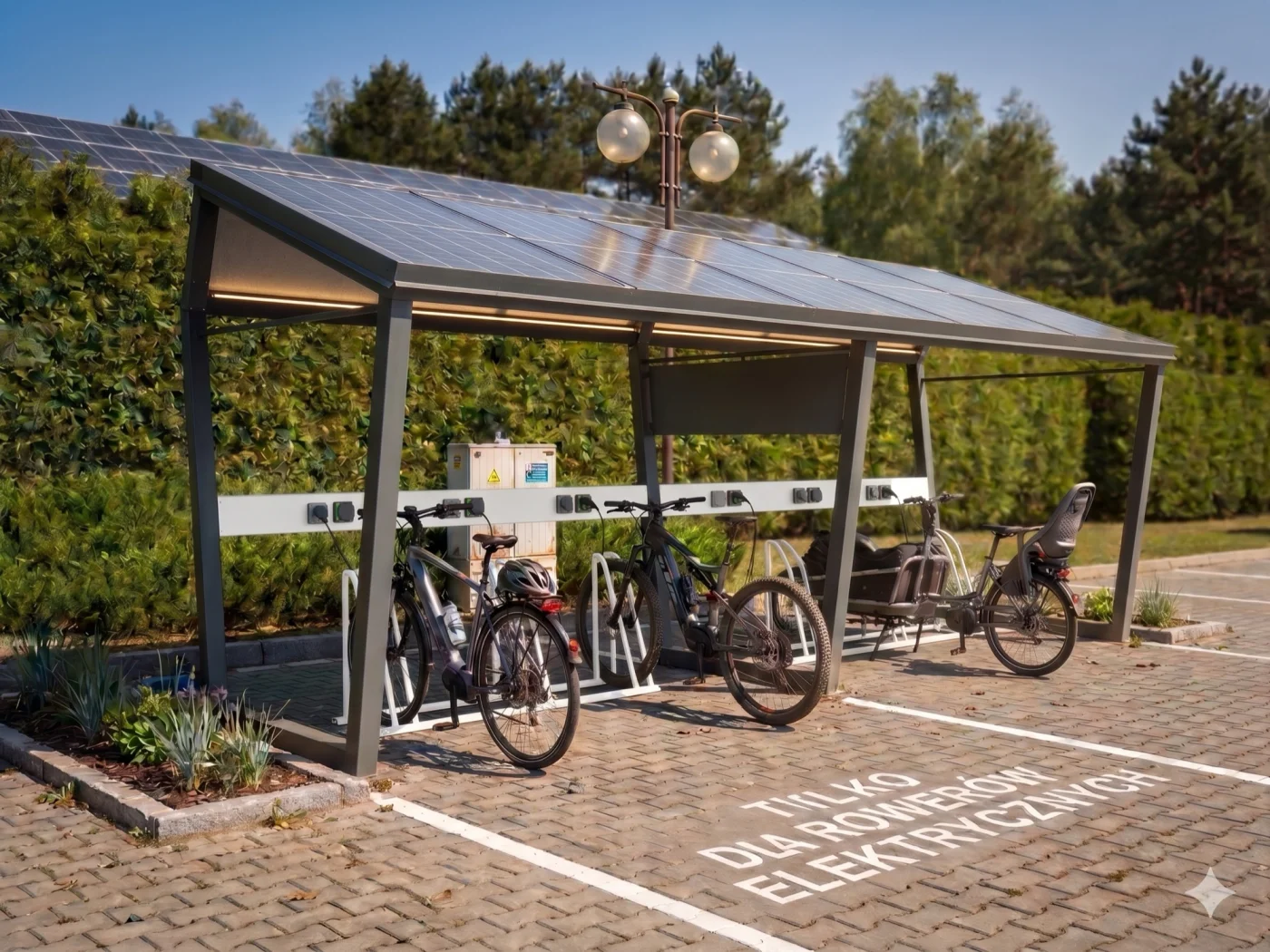
ChargeGo Shelter
A freestanding structure with rooftop solar and a battery. It runs with no grid connection: in a car park, in front of a hotel, on a housing estate or along a bike trail.
- 10 charging points (open), or a lockable Shelter with doors, locks and 3 or 6 charging points
- 1.74–3.48 kWp solar + LFP battery, 24/7 off-grid operation
- From €18,500 excl. VAT
ChargeGo Box
A wall-mounted station for an underground garage, bike room or hall. No structure or foundation to build; the unit mounts on an existing building's wall, typically without a building permit or notification.
- 8 charging points powered from a single 230 V / 16 A circuit
- IP44 sockets with covers, energy metering on every charging point
- Started from the mobile app, or optionally a PIN code or RFID card