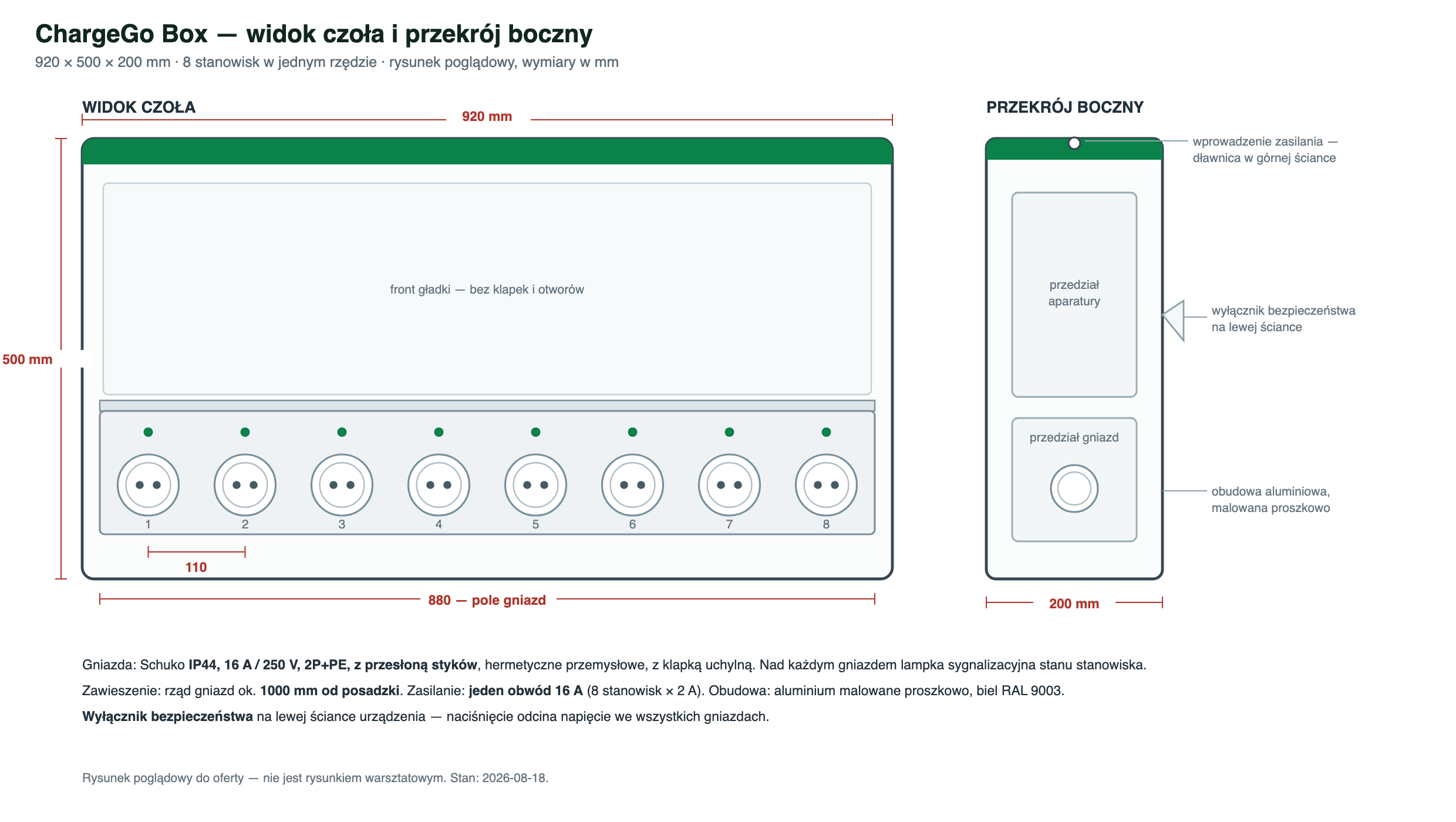
A request for a socket in an underground garage reaches the building manager in the same form: someone bought an electric bike and asks where to charge it. The answer settles three separate matters that are easy to confuse: where to get power, how to measure consumption and who pays for it.
Short answer
Power. One 230 V / 16 A circuit is enough for charging bikes. Whether it exists in the garage, and in what condition, is assessed by the electrician after inspection, who also sets the scope of work on the building side.
Metering. A sub-meter in the distribution board measures the total without saying who was charging. Metering per charging point answers both questions at once.
Cost. Scale is small: a full charge of a typical battery is about 0.5 kWh. What is missing is assignment of that cost to anyone.
Order. First the decision whether one place for everyone is created, then the electrician, then the unit. The reverse order ends in a series of exceptions.
Why a single socket keeps coming back
The simplest answer to a resident's request is agreeing to one socket by their parking space. It looks cheap and closes the matter for a week.
The problem appears with the second request. The building manager then has two bad options: agree again, accepting that private sockets without metering will multiply in the garage, or refuse and explain why the neighbour got one and this person did not.
Electricity from such a socket also comes from the common-area meter. With one bike the amount does not matter; with a dozen it becomes a point at a meeting nobody can answer.
Where to get power in an underground garage
Charging bikes does not need a connection or power the garage does not have. One 230 V / 16 A circuit is enough, i.e. a standard socket circuit.
Whether such a circuit exists, in what condition and what it is already loaded with is decided by the electrician after inspection, along with the scope of work on the building installation side. Electrical installations in an underground garage are often older than the problem itself, designed for lighting and the gate, and none of that can be judged from the plan alone.
If there is no circuit, it is run from the distribution board, and in an extreme case from the meter. That work is done once, and with one unit for the whole building the cost is spread across everyone rather than falling on one applicant.
One more point for a wall-mounted unit: mounting in a parking hall or bike room as a rule needs no permit or notification, because no structure or foundation is created. It is different in heritage buildings, in a conservation protection zone and where work includes reconstruction of the installation; confirm the scope with the authority.
How many chargers one circuit can handle
Bike chargers differ in draw several times over, so charger power decides the balance. Below are orders of magnitude converted to draw from a 230 V socket at assumed 90% efficiency.
| Charger | Draw from 230 V | Eight at once |
|---|---|---|
| Typical, 42 V / 2 A (~84 W) | ~0.41 A | ~3.3 A |
| More powerful, 36 V / 4 A (~145 W) | ~0.70 A | ~5.6 A |
| Most powerful on the market, 12 A | ~2.44 A | ~19.5 A, above circuit capacity |
The last row shows why the unit has a current limit per charging point: eight of the most powerful available chargers at once would exceed the circuit. Electronic limiting to 2 A per charging point closes the balance at 16 A regardless of what someone brings.
It illustrates orders of magnitude and is not a basis for selecting protections; 90% efficiency is an assumed conversion value. How many charging points may be connected to a specific circuit in a specific building is decided by the electrician or installation designer.
Sub-meter and consumption billing
The question about a sub-meter comes right after the question about a socket, and it is justified: without metering you cannot answer "how much", and without that answer you cannot introduce any fee.
A sub-meter in the distribution board solves half the problem. It measures all energy that went to that circuit without saying who drew it, which is not enough to bill a resident or employee.
Metering at each charging point answers both questions at once: how much went and to which charging point, and — if the session was started from the app or with a code — by whom. A separate sub-meter then stops being needed.
Metering in the station gives consumption per charging point and per session, assigned to the person who started charging. On that basis the property charges the user or keeps the cost knowing how much it is.
Who pays for electricity in the underground garage
That is the building manager's decision. In practice three models are seen.
- Free for authorised users, with records only. Cost stays with the property, but you know how much it is and who used it. The most common choice where the amount is small and the aim is to close the dispute.
- Records with cost passed on. Consumption assigned to a person or tenant goes into periodic billing.
- Payment per session or per kWh. Sensible where outsiders use charging.
Tell the board the scale plainly before the topic grows beyond its weight. A full charge of a typical battery is about 0.5 kWh. Without metering that cost cannot be assigned to anyone.
Who decides and in what order
The most common mistake is reversing the order: someone asks the electrician to quote a socket, then it turns out the decision belongs to the owners' association anyway and the whole thing should have been counted from the start.
- What gets built. One place for everyone, or a series of private sockets. Everything else follows from it, and it is the building manager's call, not the electrician's.
- Electrician's inspection. Whether there is a free circuit, what state the installation is in, what scope of work and what cost of bringing power.
- Formal path. You can apply to the owners' association or housing cooperative for installation, and they can adopt it by resolution. The building manager sets the procedure and its wording with their own advisers.
- Installation and commissioning. Only then does the unit come in.
What that looks like on the unit side and what it costs is described on the station for garage and bike room page. Cost split per unit and the board's perspective are on the for owners' associations and cooperatives page.
Frequently asked questions
Can a socket be installed in an underground garage?
Technically yes; installation condition and consent of the common-area owner decide. The electrician assesses the installation, and the building manager gives consent.
How much does installing a socket in a parking hall cost?
It depends on distance from the distribution board, how the route is run and the state of the installation. A quote follows the inspection.
Is a separate circuit needed?
For a station with several charging points yes, and that is an advantage: a dedicated circuit separates charging from the rest of the garage installation.
Where is an electricity sub-meter installed in a garage?
In the distribution board feeding that circuit. With a station that meters each charging point, a separate sub-meter usually stops being needed for billing users.
Does installation require a permit?
Mounting a wall-mounted unit in an existing room as a rule does not require a permit or notification. It is different in heritage buildings, in a conservation protection zone and when reconstructing the installation. Confirm scope with your authority.
If you are reading this as a resident rather than as the building manager, the topic can be opened without going into installation details: tell us about your building and you will receive a ready-made message to hand over, plus a template letter for the owners' association or housing cooperative.