Residents have electric bikes. Where do they charge them?
Today the answer is usually: in the apartment, from an extension cord in the storage unit, or from whatever outlet is nearby in the hallway. ChargeGo can be planned into the project from the start, or added to an existing development. The Box is designed for garages and bike rooms; the shelter for outdoor areas.
ChargeGo builds electric bike charging systems: a dedicated circuit, metering at every charging point, access controlled from a panel — restricted to residents or open to the public, depending on what the property decides. One line mounts on the wall of a bike room or garage; the other is installed on the development's grounds.
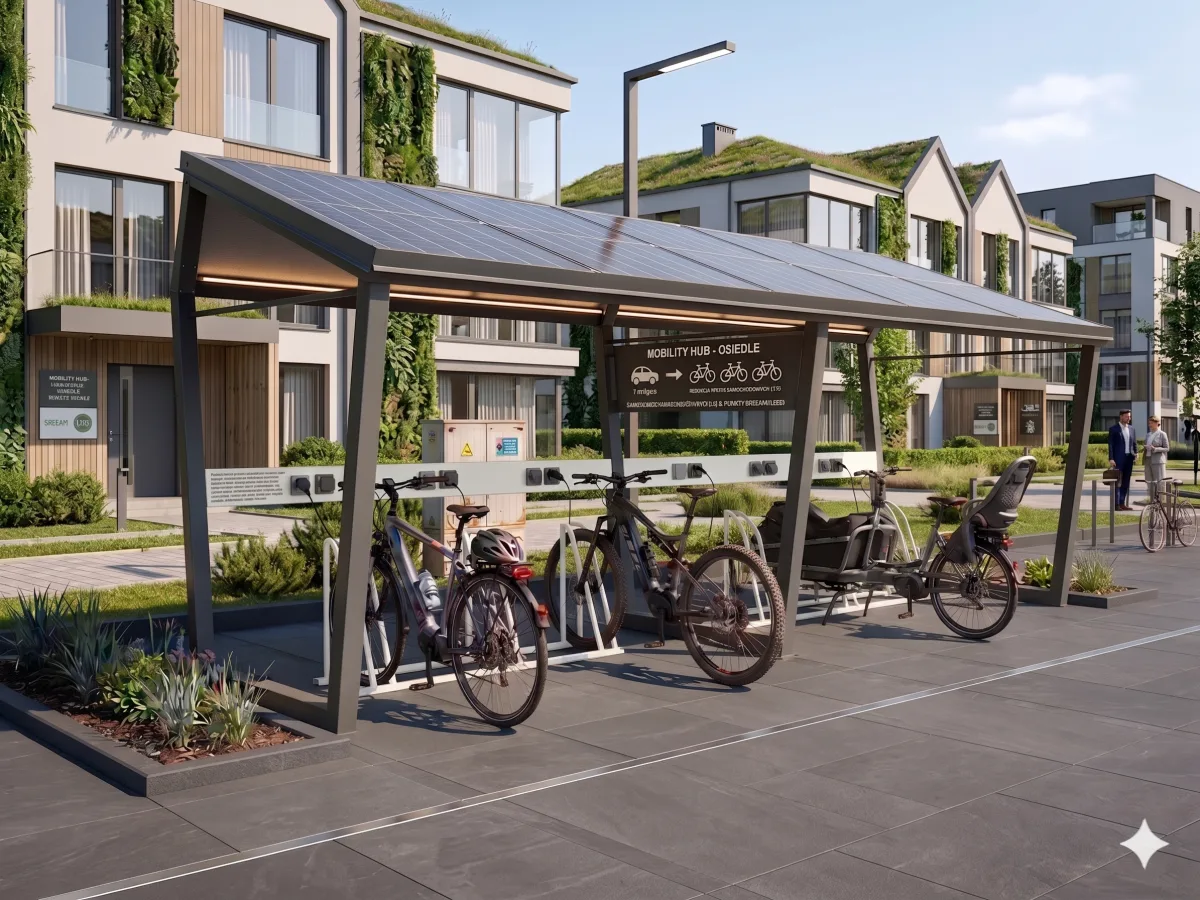
Where will bikes be parked in the development?
Where residents keep their bikes determines the right solution. A bike room is standard in new developments, and almost every multi-family building has an underground garage; if the bikes are kept there, the charging station mounts on the wall. Outdoors, you need a covered structure with its own power supply. The app, the admin panel and access management are the same either way; the hardware and power supply differ.
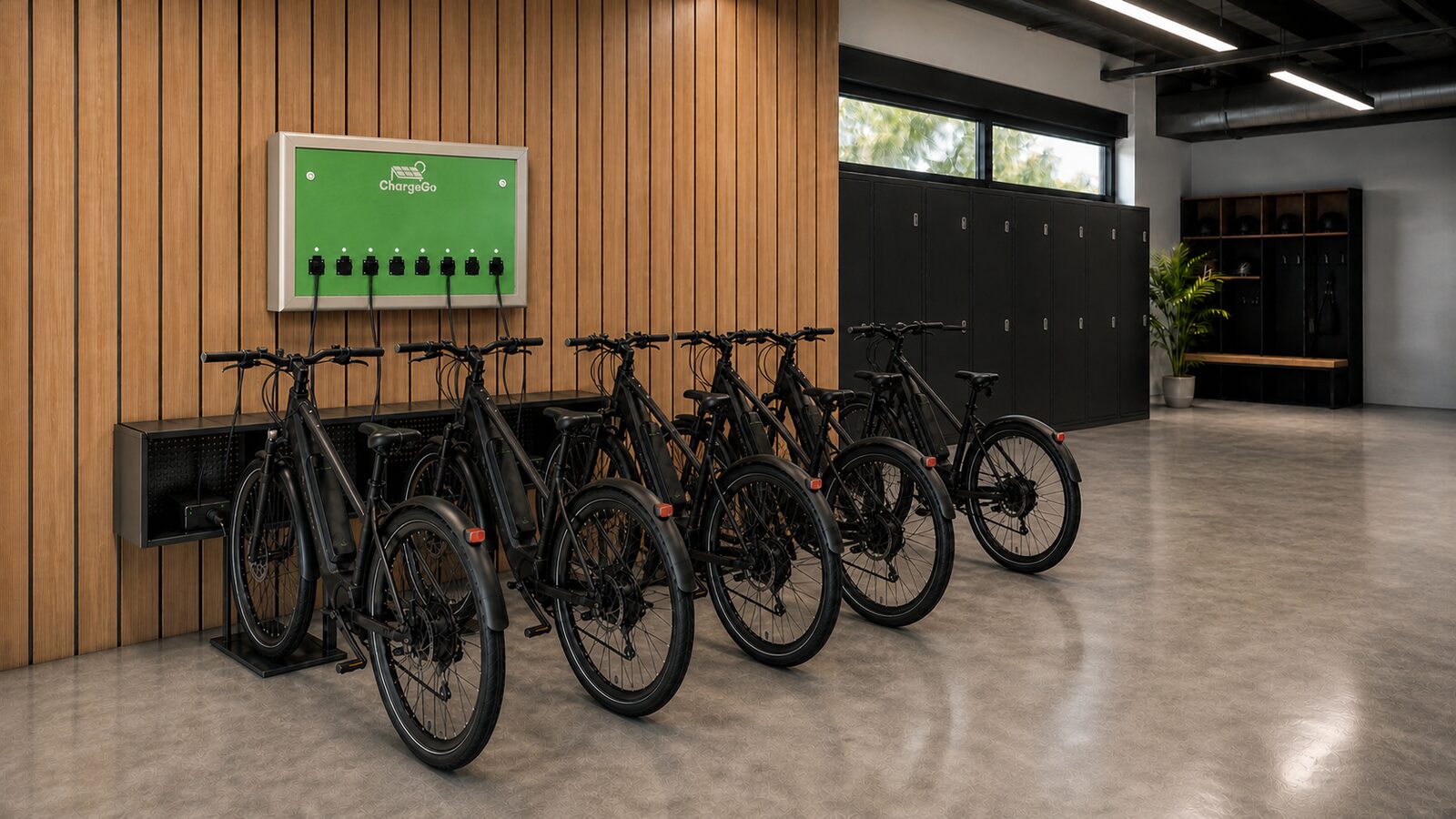
ChargeGo Box
A wall-mounted indoor charging station. It mounts on the wall of a room the development already has — no structure, no foundations, no extra land.
- 8 charging points from a single 230 V / 16 A circuit — existing, or run for you
- A 2 A (~460 W) limit per charging point, enforced electronically — going over it disconnects that one charging point and flags it in the app
- Schuko 16 A / 250 V sockets, IP44 with shutters, power metering on every charging point
- All the protection is in the unit's enclosure — an electrician sets the scope of work on the building's side
- 770 × 450 × 160 mm, white as standard
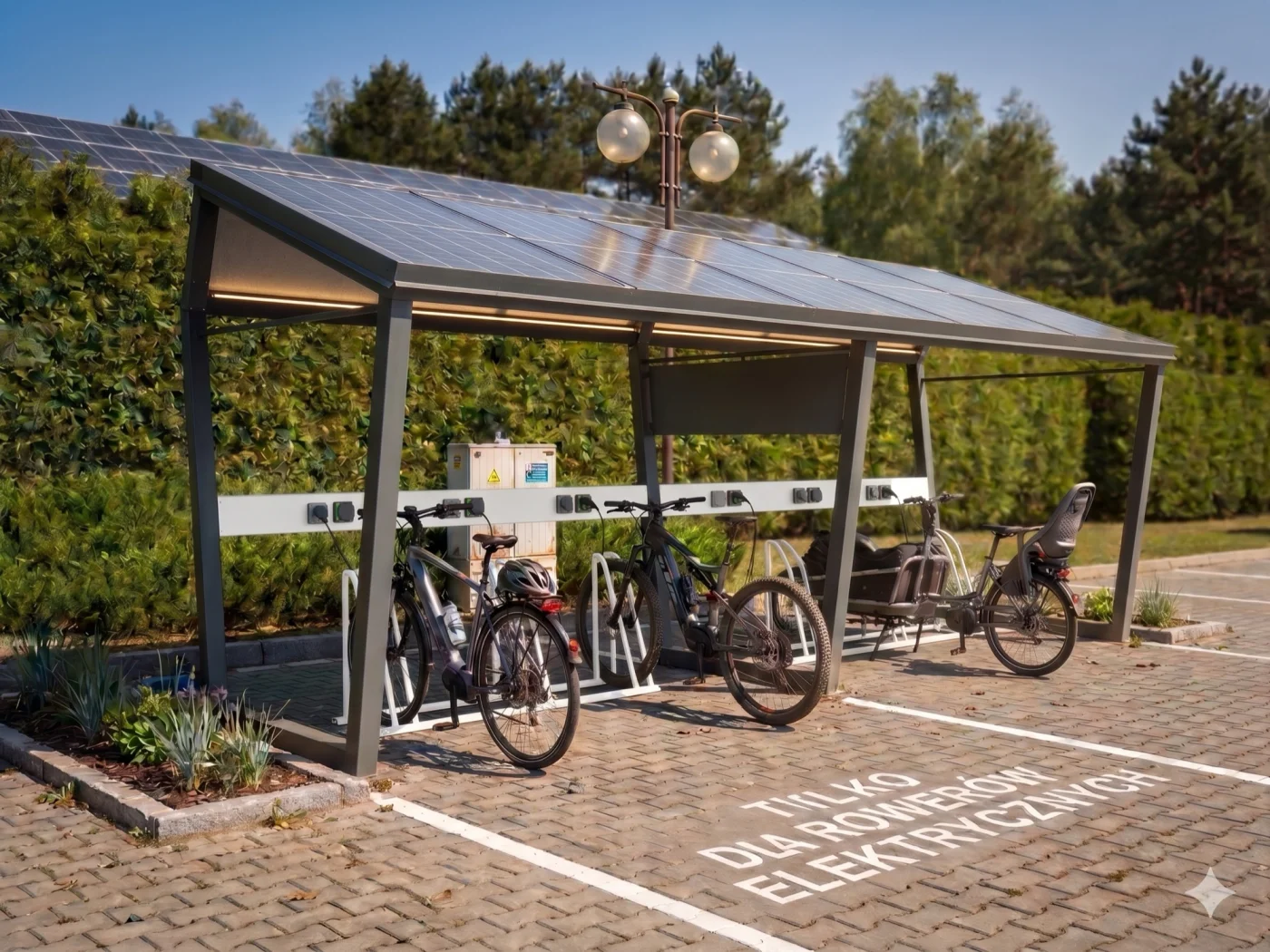
ChargeGo Shelter
A freestanding structure with solar panels on the roof and a battery. A covered bike parking area that needs no grid connection, which also suits sites where running power would be costly.
- Open shelter — 10 charging points; lockable shelter with doors and locks — 3 or 6 charging points
- 1.74–3.48 kWp of solar plus a ~1.8–6 kWh LFP battery, off-grid or hybrid operation
- 3 to 10 metered 230 V Schuko sockets; going over the set threshold disconnects that one charging point. Total output is capped by a 3,000 VA inverter
- 6.4 × 3.2 × 2.7 m, about 20 m² footprint — under the 35 m² threshold for the notification procedure
- Operates from −20 °C to +45 °C, battery heated by the BMS
On multi-building developments you can combine both lines: ChargeGo Box in each building's bike room, and a shelter as a covered bike parking area at the site entrance — for guests, couriers and residents who don't go down to the garage. Both lines are managed from a single panel.
Why electric bike charging is now part of the development plan
Cycling infrastructure is increasingly specified in new residential developments, and may also be required by local planning rules or certification schemes. The question is shifting from where residents park a bike to where they charge it. An electric bike with no charging point means a battery carried up to the apartment and charged from whatever outlet is nearby.
From a planning perspective, cycling infrastructure with charging solves several things at once: it meets the bike parking requirement (some local zoning plans require one bike space per apartment), it can support BREEAM/LEED points in the transport and mobility categories, and in the outdoor variant it lets you partially offset car parking spaces (typically at a 1:5 ratio). A shelter adds solar power on top of that — a renewable energy source at the building level.
The two lines differ in cost, and that difference is worth knowing early. Fitting a bike room with a ChargeGo Box is an expense in the thousands of euros per building, plus a single 230 V / 16 A circuit. That circuit is cheapest to run at the design stage, alongside the rest of the electrical installation. A shelter starts at €18,500 excl. VAT and gives you a standalone structure on the grounds, with its own power and no grid connection.
We deliver both lines turnkey — from choosing the right solution, through manufacturing and installation, to a working system with an app for residents and a panel for building managers. One supplier is responsible for the hardware, the installation and the software.
Bike parking, bike room, shelter — what each term means
In zoning documentation and development brochures these terms are sometimes used interchangeably. They differ in scope, though — and only the last two actually answer the question about charging.
The narrowest term. A marked area with racks, no roof and no electrics. It meets the zoning minimum, but it isn't enough for an electric bike — the resident still carries the battery up to the apartment.
A covered or enclosed room with racks — a basement, ground floor, or part of an underground garage. The bike is stored well, but charging still ends up back in the apartment or on an extension cord in the storage unit.
The same room plus 8 charging points on a single 230 V / 16 A circuit: IP44 sockets with shutters, a meter on every charging point, protection built into the enclosure, access via app or QR code. A dedicated, managed installation instead of whatever outlet is nearby.
An outdoor solution: a roof, racks, 3 to 10 metered 230 V sockets, solar panels, an LFP battery and the app. It runs with no grid connection, so it works on sites where running power would be costly.
BREEAM and LEED audits score covered, lit, secure bike parking with charging available — both a bike room with a station and a shelter address these criteria. Plain bike parking with no roof often doesn't meet the quality criteria, and a bike room without outlets doesn't address the charging part.
Do your architects need BIM, RAL, or a spec paragraph?
Materials for design offices live on a separate page — PDF technical data sheets for both lines, the RAL colour palette, a ready-made paragraph for technical specifications, shelter dimensions (10 / 3 / 6 charging points) and ChargeGo Box dimensions (770 × 450 × 160 mm), and a BIM/CAD request form.
What the two lines cost
The two lines sit at very different price points. Both are listed below, so you can compare them before getting in touch. An individual quote follows within 1–2 business days.
- ✓ A station with 8 charging points, Schuko sockets with IP44 shutters
- ✓ All the protection is in the enclosure — nothing to size in the building's switchboard
- ✓ Power metering on every charging point
- ✓ Panel and mobile app in Polish and English — no time limit, no subscription
- ✓ Documentation, declaration of conformity, 5-year warranty
We only add these when the development actually needs them.
- Installation and connection to a prepared circuit€420
- Commissioning, accounts and staff training€350
- Charging point labelling and an instruction plate€140
- A colour from the RAL Classic palette€140
- 7-year warranty instead of 5€470
The development provides a 230 V / 16 A circuit and a wall to mount the unit on. 8-week lead time from order confirmation.
Control works with no subscription at all. The app and the local-network panel are included in the unit price, with no time limit.
- Cloud — remote access, reports, notifications€10/mo
- Usage billing+€7/mo
Without a subscription the station still charges and still meters; remote viewing is what the subscription adds.
Shelter on the development grounds — price ranges
The ranges below cover only the outdoor line (the shelter). Charging in a bike room or underground garage is priced differently, per unit from the ChargeGo Box list price.
Mid-size development
- Lockable shelter + locks (3 charging points)
- App for residents
- Offsets ~1:5 parking spaces
- Development RAL branding
Large development
- 6 × 230 V
- ~3.6 kWh LFP battery
- Remote-controlled locks
- App + camera, 1h retention
- BREEAM documentation package
- Access-control system integration
Multi-building / mixed-use
- Multiple units
- Shared dashboard across both lines
- BREEAM/LEED certification package
- BIM/CAD on request
These are indicative ranges, based on 2025/2026 market prices for smart bike shelters. Final pricing is quoted individually within 1–2 business days. Shown in EUR at an indicative exchange rate; invoices are issued in PLN.
Get a quote for your locationPotential contribution to certification and property scoring
Electric bike charging infrastructure — a bike room with a ChargeGo Box or a shelter on the grounds — can support points in green-building certification schemes, active-transport scoring, and ESG benchmarks. Criteria for a renewable energy source at the building level are addressed only by the shelter, since only it has solar panels and a battery.
BREEAM
e-bike specificTra — Cyclist FacilitiesCriteria for bike spaces, lighting, security and support for low-emission vehicles (e-bike charging) can be addressed by both lines. The project assessor confirms the final score.
LEED v4.1
cycling infrastructureLT — Bicycle FacilitiesCycling facilities can support a credit. Requirements depend on the building type, access to the cycling network, and facilities (showers or changing rooms on some projects).
WELL v2
cycling infrastructureMovement — active mobilityIt supports strategies that promote active commuting and wellbeing. Mapping features to points depends on the WELL scorecard and the consultant.
DGNB
cycling infrastructureMobility InfrastructureA German scheme, popular in DACH markets and with institutional investors. It has the most categories covering mobility and e-mobility.
ActiveScore
e-bike specificActive transport in buildingsClass-A tenants increasingly expect it. Bike charging in a building's bike room addresses many ActiveScore criteria, and it also supports WELL, BREEAM, LEED and GRESB.
ModeScore
cycling infrastructureSustainable transport benchmarkIts scope is broader than ActiveScore: public transport, active travel and low-emission modes. Bike charging infrastructure is one of the components it covers.
GRESB
indirect / ESGESG benchmark for portfoliosDoesn't certify a single building — it assesses ESG practices across whole funds or companies. Infrastructure plus data (sessions, kWh) support a portfolio's score.
EU Taxonomy 6.13
e-bike specificGreen assetsPersonal mobility infrastructure (bicycles plus electric assist) is part of the green asset classification.
Note: the certificate is awarded to the building. ChargeGo supports the criteria, and an assessor or certification consultant confirms the final qualification.
Full system mapFor developers and boards
Some benefits are shared by both lines; others depend on where the unit is installed.
Supports BREEAM, LEED, WELL
Covered bike parking with charging can support points in the transport and mobility categories — as an outdoor shelter or as a bike room with a station. The project assessor confirms the final qualification.
A dedicated, managed installation
Instead of an extension cord and whatever outlet is nearby: a separate circuit, power metering at every charging point, and access limited to the users the administrator has authorised.
An app and a panel for building managers
The same mobile app, a QR code at each charging point, a management panel in Polish and English, and session history — whichever line you choose. Control keeps working locally even if the connection drops.
Eight charging points from one circuit
A bike room or garage only needs a single 230 V / 16 A circuit run to it. The per-charging point limits are fixed and enforced in the unit, and all the protection is built into the station's enclosure.
No structure, no extra land needed
The Box generally requires no permit or notification. Exceptions: listed heritage buildings, conservation zones, and cases involving rewiring the electrical installation — confirm the requirements with the local authority.
A 1:5 offset on parking spaces
A shelter with 10 charging points matches the requirement for 2 car spaces under many local zoning plans (a lockable shelter with 6 charging points — about 1 space). Less parking means a bigger budget for green landscaping. The plot's zoning plan decides the final qualification.
Solar power, no grid connection needed
The shelter brings renewable energy to the building and to each charging point, including on sites where running power would be costly. It works off-grid or in hybrid mode.
Turnkey, no subcontractors
Design, manufacturing, transport, installation, commissioning and staff training. One contractor, one point of contact, one warranty.
Working from day one
The first residents move into finished, working infrastructure.
A feature for the listing
Electric bike charging can be listed directly in the development description, alongside the lift, security monitoring or parking spaces.
Low upkeep cost for the owners' association
Metering at each charging point lets usage be attributed to an individual resident instead of being covered by shared costs.
Scales building by building
The next phase of a development is just another unit — a Box in the next building's bike room, or an additional shelter on the grounds. One shared panel covers every device.
Specifications — both lines side by side
Both solutions use the same rows, so you can compare them without switching pages. The next phase of a development is simply another unit, from the same line or the other one.
| Parameter | ChargeGo Box — indoor | Shelter — outdoor |
|---|---|---|
| Location | On the wall, indoors only | Freestanding, on the development grounds |
| Number of charging points | 8 | 10 (open) or 3 or 6 (lockable) |
| Power supply | A single 230 V / 16 A circuit from the building's installation | 1.74–3.48 kWp solar + ~1.8–6 kWh LFP battery, off-grid or hybrid |
| Draw limiting | A 2 A (~460 W) limit per charging point, enforced electronically | Current metering on every socket and automatic shutoff past the set threshold; total output capped by a 3,000 VA inverter |
| Sockets | Schuko 16 A / 250 V, IP44 with shutters, power meter on each | 3 to 10 × 230 V Schuko, current metering on each |
| Protection | All protection built into the unit's enclosure | Current metering and automatic charging point shutoff |
| Dimensions | 770 × 450 × 160 mm | 6.4 × 3.2 × 2.7 m, about 20 m² footprint |
| Operating conditions | Indoors only — garage, bike room, hall | −20 °C to +45 °C, battery heated by the BMS |
| Paperwork | Generally no permit or notification needed; exceptions: listed heritage buildings, conservation zones, rewiring the installation — confirm with the local authority | Under 35 m² and 5 m — usually just a notification; the exact procedure depends on the zoning plan and local authority |
| Warranty | 5 years; 7 years as an option (+€470) | Structure 10 years, solar panels 25 years (≥80% output), LFP battery 5 years at ≥80% capacity (4,000+ cycles), electronics 2 years |
| Price from | €3,450 excl. VAT per unit; installation €420, commissioning €350 | €18,500 excl. VAT (lockable 3 — €23,500, lockable 6 — €32,500) |
| Shared | Mobile app, a QR code at each charging point, a management panel in Polish and English, local operation if the connection drops, session history. Power metering is for reporting and enforcing limits. | |
Prices exclude VAT and are not a binding offer. We confirm a quote for your specific development within 1–2 business days.
FAQ — electric bike charging for residential developments
Questions asked by developers' technical teams and owners' association boards.
The same problem in a different segment
Options worth considering at the design stage
The station is complete without any of them: it charges, measures usage and recognises the user. The modules below are added when a site needs them, each at its own price.
Remote management from off-site: browser dashboard, session history, reports, fault notifications and remote updates. Without it the station keeps working locally.
Usage tracking per user and per tenant, billing reports, export to accounting.
An alarm control panel built into the station housing and a smoke detector in the charging room. Smoke triggers the alarm. Works locally, without internet.
An extra credential alongside the app and PIN code. You deactivate a lost card in the panel.
Controls entry to the bike room: electric strike or magnetic lock, reader and door contact. Priced after we have surveyed the site.
Add-on prices are per station, not per property. Hazard monitoring is an alarm control panel with a smoke detector in the charging room. Full pricing and configurator.
A quote for your specific development
Tell us where the bikes will be kept — bike room, underground garage or the grounds — how many units there are, and what the local zoning plan says. If you're not sure which line fits, just describe the situation. We'll reply within 1–2 business days.