Your employees ride e-bikes to work. Where do they charge them?
Usually from an extension cord in the garage or an outlet by the security desk — no metering, no limit, no oversight. ChargeGo turns that into a dedicated, managed installation: its own circuit, a current limit per charging point, metering on every socket, and a session history in the panel.
There are two solutions, and they differ in one thing: where the bikes are parked. For bikes kept inside the building there is the wall-mounted ChargeGo Box; for bikes kept outdoors, the shelter with solar panels.
Electric bikes are already in your company
As more employees commute by e-bike, informal charging spreads: an extension lead in the garage, a power strip in the bike room, an outlet in the corridor. Facilities teams usually find out once someone asks whether they "can charge here".
The problem isn't that people charge bikes. It's that they do it on an ad hoc installation: nobody knows how many bikes are charging on one circuit at once, nothing is metered, there's no current limit and no oversight. The fix is a dedicated, managed installation — a separate circuit, metering on every charging point, and protection built into the unit.
For management and HR, that's both a benefit employees notice every day and a source of data for ESG reporting. The system records sessions, kilowatt-hours and charging point utilisation, and exports them.
Where are your employees' bikes parked?
The installation location is the first criterion. The app, the management panel, QR-code access, energy metering and session history are the same across both lines — the only difference is whether the unit hangs on a wall inside the building or is a freestanding structure on the site.
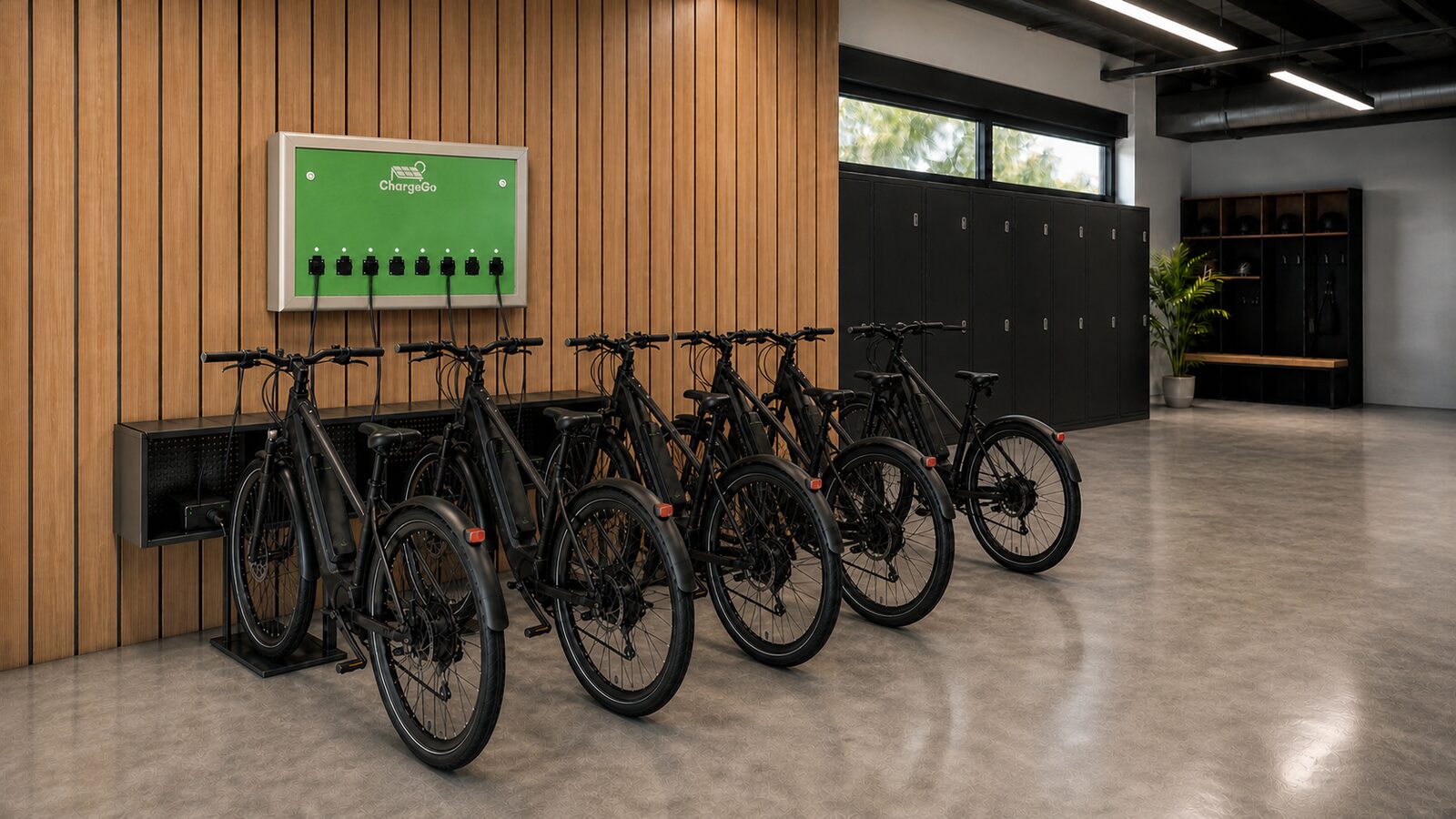
ChargeGo Box — wall-mounted station
An underground garage, a dedicated bike room, or a hall. The space already exists — what's missing is a place to charge. The unit mounts on the wall, with no structure and no site footprint.
- The office building has an underground garage, with bikes already parked at racks in a corner
- There's a dedicated bike room or utility room
- The plant has a hall or warehouse that employees ride into
- There's no outdoor space, or the site isn't owned by the company
- 8 charging points from a single 230 V / 16 A circuit — existing, or run for you by us
- A 2 A (~460 W) limit per charging point enforced electronically — exceeding it disconnects that one charging point and flags it in the app, while the rest keep charging
- Schuko sockets, 16 A / 250 V, IP44, with contact shutters, energy metering on every charging point
- A full set of electrical protection built into the enclosure — nothing to add in the building's switchboard
- 770 × 450 × 160 mm, white as standard; wall-mounted
Eight charging points from a single 230 V / 16 A circuit inside the building. No site footprint, no separate connection.
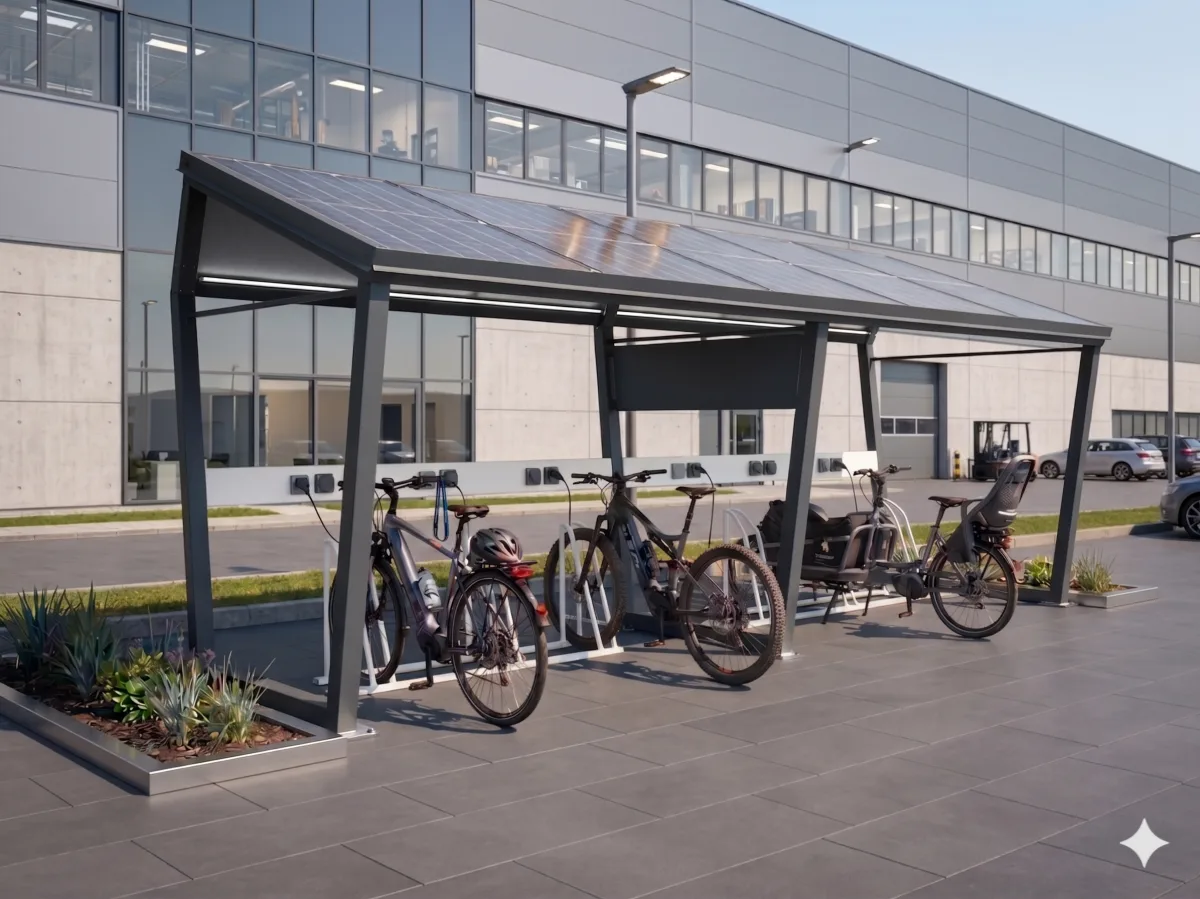
ChargeGo shelter — freestanding structure
A car park in front of the office, a yard by the plant, campus grounds. The shelter provides cover and charging at the same time, and does not require a power cable to be run to the site.
- Bikes currently sit in the rain at a rack or against a wall
- The company has its own site by the building and wants to use it
- There's no free wall indoors, or no garage at all
- You want the charging facility to be clearly visible at the entrance or car park
- Open shelter with 10 charging points, or a lockable shelter with doors and locks — 3 or 6 charging points
- 1.74–3.48 kWp of solar and an LFP battery of about 1.8–6 kWh, off-grid or hybrid operation
- 3–10 Schuko 230 V sockets with power metering on every charging point; exceeding the set threshold disconnects that one charging point. Total output is capped by a 3,000 VA inverter
- 6.4 × 3.2 × 2.7 m, about 20 m² footprint; operates from −20 °C to +45 °C with BMS heating
- Warranty: 10 years on the structure, 25 years on the solar panels (≥80% output), 5 years on the LFP battery at ≥80% capacity
The shelter is a structure on the site — the permit or notification scope is settled before installation.
If you're not sure which path fits, describe the location in the quote form — garage, bike room, yard, hall — and we'll recommend the right option. Sometimes both make sense at one company: a Box in the basement for daily commuters, a shelter by the entrance as a visible outdoor feature.
Bike charging and ESG / CSRD reporting
The unit logs data you can put in a report: the number of sessions, energy used, and charging point utilisation. Below is what that supports in each area.
Solar energy (Scope 2)
The shelter powers its charging points from its own solar panels, so that energy isn't bought from the grid — and the system measures that part. The Box runs on the building's own supply and doesn't contribute here. Commuting emissions (Scope 3) need separate company data on how employees travelled before.
Conditions for employees who cycle to work
Employees get a designated charging point instead of an outlet in the corridor. Access rights are set by an administrator, so it is clear who has access and how it is used.
CSRD / ESRS E1, S1
The panel shows the number of sessions, kWh used, and charging point utilisation, collected automatically by the unit, with no employee surveys.
What the unit contributes to the report
A shelter with 10 charging points has 3.48 kWp of solar, which at a yield of 950 kWh/kWp per year (PVGIS) works out to about 3,300 kWh a year. That charging energy then comes from solar instead of the grid; at the national grid mix emission factor of 610 g CO₂/kWh (KOBiZE), that's about 2 t CO₂e a year at full use of the output. The real figure depends on how much energy is actually used — and the panel shows that number. ChargeGo doesn't measure changes in employee commuting emissions; that needs separate data on how people got to work before.
What does this look like with the ChargeGo Box?
The Box runs on the building's own electricity supply, so it doesn't contribute the "renewable energy" part of the report or a Scope 2 reduction. Scope 3 works the same as with the shelter: an estimate that needs company data on how employees commute. What the Box measures directly is operational data: sessions, kWh and utilisation, metered at every charging point.
For facilities and HR teams
Some of these apply only to the outdoor line, some only to the indoor unit.
A benefit that works every day
No benefits app, no paperwork. An employee rides up, plugs in the bike, and rides home with a charged battery after work. It also reads well in job listings and on career pages.
A dedicated installation instead of an extension cord
A separate circuit, a current limit per charging point, metering on every socket, and protection built into the unit — instead of a power strip from the security desk that nobody tracks.
Sessions, energy and utilisation — in the panel
The panel shows the number of sessions, energy used and charging point utilisation, collected automatically, with no surveys or manual counting.
One app, one panel
A mobile app, a QR code at each charging point, a management panel, and session history. The unit keeps working locally even if the connection drops.
Energy from your own solar panels
Roof-mounted solar panels generate power for charging, and the LFP battery releases it in the evening. In off-grid mode the company buys no grid electricity for charging.
Works with no grid connection, even in winter
It runs off-grid or in hybrid mode, from −20 °C to +45 °C, with BMS cell heating. There is no need to run power to the far end of the car park.
Zero impact on the site
Eight charging points on the wall of an existing building — no foundations, no parking spaces lost, and as a rule no permit or notification needed (exceptions: listed buildings, conservation zones, or a rewired electrical installation).
Nothing to add to the switchboard
The main isolator, RCDs and circuit breakers, a surge arrester, and an emergency stop are all built into the enclosure. An electrician only needs to run one 230 V / 16 A circuit.
Common situations and what fits them
The label next to each heading is a starting suggestion; the site layout decides, and we go over it at the quote stage.
Corporate office building
Usually BoxIf the office has an underground garage — and it usually does — the bikes are already parked there. A ChargeGo Box on the wall by the racks handles eight charging points from one circuit; more bikes mean adding more units. A shelter makes sense when the company has its own land by the entrance and wants the charging facility to be visible.
Technology park
Shelter or BoxMultiple companies at one site. The site operator installs the infrastructure and tenants share it, with the panel showing usage per charging point so the cost can be split between tenants. A shelter works well in the yard between buildings; a Box works in each building's basement.
Factory / warehouse
Usually BoxShift workers ride onto the site and leave their bikes in the hall. A Box in the hall or a dedicated bike room gives 24/7 charging regardless of shift. If bikes stay outside the gate, a shelter with LED lighting fits better.
IT company / startup HQ
Shelter or BoxAn environment where commuting by bike is common, but the tenant usually has no control over the grounds around the building. A Box in the garage is then the right fit. If the company has its own premises with a car park, a shelter works.
Logistics centre
Usually shelterThese sites are often far from public transport, with a large plot and no bike room. The shelter runs with no grid connection, so there is no need to run a cable across the yard.
Coworking / hub in a building
Usually BoxThe operator leases floors and doesn't manage the grounds. A wall in the garage or bike room is the only place anything can be mounted — and it's enough.
Data for your ESG report
Assumptions: 80 sessions per year per regular user, 0.5 kWh per session, a yield of 950 kWh/kWp per year (PVGIS) and a national grid emission factor of 610 g CO₂/kWh (KOBiZE 2024). Assumptions and formulas.
The calculator covers the energy-related reduction: kWh from the shelter's solar panels instead of kWh from the grid. After the first year of operation, the estimate can be replaced with data from the installation.
Annual ESG report template
A 4-page PDF with conservative assumptions: annual KPIs, monthly data, and ready-to-copy paragraphs for CSRD/ESRS E1 and E5. The numbers in this template are calculated for a shelter with solar panels. Once your installation is running, you get an equivalent report with your company's actual data, whichever line you choose.
Download the template (PDF, 58 KB)Material for the CFO / controlling team
A 5-year TCO comparison for the outdoor line: ChargeGo shelter vs. a Multisport card (200 people) vs. a company gym. Arguments for the finance department: depreciation, EU Taxonomy, CSRD data, operating lease (on request).
Download the material (PDF, 35 KB)What your HR / ESG team sees
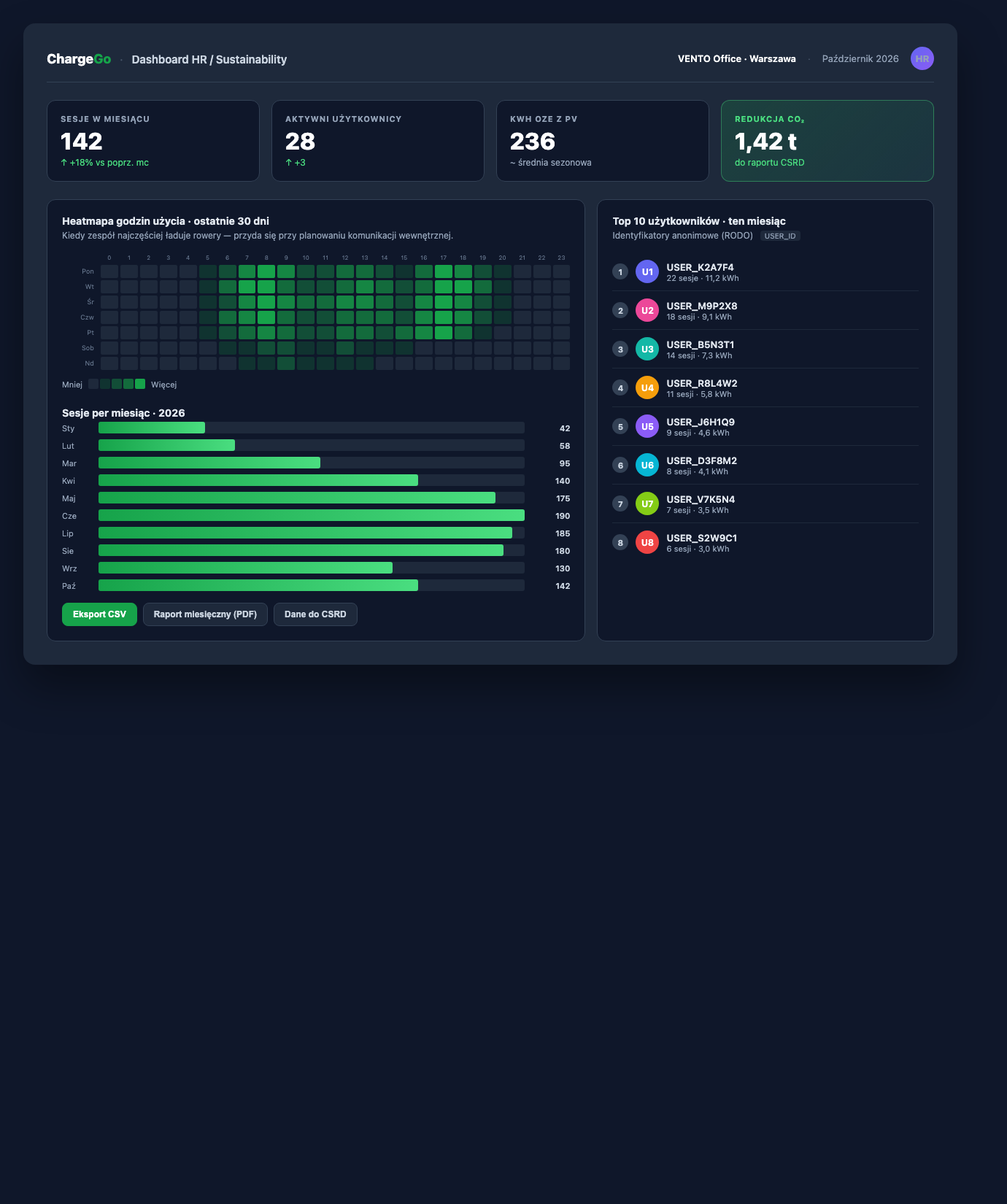
The Box and the shelter report to the same management panel. The mockup below shows monthly KPIs, a usage-hours heatmap, top users (anonymous codes, no names) and CSRD export.
What the ChargeGo Box costs
There is one unit: eight charging points from a single circuit. Scaling up means adding more units.
ChargeGo Box
Software, management panel and app are included in the price — no subscription, no time limit.
- Eight Schuko sockets, 16 A / 250 V, IP44, with contact shutters
- Energy metering on every charging point
- A full set of electrical protection built into the enclosure
- 770 × 450 × 160 mm, white as standard
- 5-year warranty as standard
Items quoted separately
- Installation€420
- Commissioning with staff training€350
- Signage€140
- Custom RAL colour€140
- 7-year warranty instead of 5€470
Amounts exclude VAT. The customer runs the 230 V / 16 A circuit to the installation point.
Subscription — optional
- Cloud€10/mo
- Billing+€7/mo
The unit keeps working without a subscription — the panel and app are included in the purchase price. Delivery in 8 weeks.
Usage data supports reporting and the enforcement of limits.
For more than eight bikes you add more units, each on its own 230 V / 16 A circuit. We size the number of charging points at the quote stage.
Get a Box quote for my buildingWhat a shelter costs when bikes are parked outdoors
These ranges cover the outdoor line. If your company's bikes are in an underground garage or a bike room, use the ChargeGo Box pricing above. An individual quote follows within 1–2 business days.
Small team
- Lockable shelter + locks (3 charging points)
- Mobile app
- Power metering
- LED motion sensor
Mid-size company
- 6 × 230V
- ~3.6 kWh LFP battery
- Remote-controlled locks
- App + HR dashboard
- RAL branding
- Camera, 1-hour retention (option)
Enterprise · Class A office building
- Two networked units
- Shared ESG dashboard
- CSRD documentation package
- Corporate branding
These are indicative ranges, based on 2025/2026 market prices for smart bike shelters. Final pricing is quoted individually within 1–2 business days. Shown in EUR at an indicative exchange rate; invoices are issued in PLN.
Get a quote for your locationEmployer programmes and ESG reporting
Charging infrastructure plus usage data are ready-made arguments for ESG reports and cyclist-friendly employer programmes. Requirements around solar panels and power generation are met only by the outdoor line (the shelter); requirements around secure parking and charging are met by both.
Cycle Friendly Employer (ECF)
cycling infrastructureEU · employer standardThe European Cyclists' Federation certifies cyclist-friendly employers. The requirement for secure parking and e-bike charging is met by both lines — a Box in a bike room or garage, a shelter on site. It carries weight with Class A office buildings and technology parks.
CSRD / ESRS
indirect / ESGEU · mandatory reportingCSRD requires reporting on specific actions under E (environment) and S (social). Both lines give measured data: number of sessions and kWh used. A Scope 3 (commuting) reduction is an estimate — it needs extra company data on how employees get to work. Renewable energy and a Scope 2 reduction come only from the shelter.
EU Taxonomy 6.13
e-bike specificEU · green assetsPersonal mobility infrastructure (bikes, electric assist) can sometimes qualify as a green asset under taxonomy reporting. Final qualification is confirmed by the reporting advisor.
ActiveScore
e-bike specificClass A office buildingsCorporate tenants increasingly expect it. It assesses a building's cycling infrastructure, including indoor parking and charging, which is where the indoor line fits.
WELL v2 / Fitwel
cycling infrastructureEmployee wellbeingBoth schemes treat active commuting and movement infrastructure as part of a building's wellbeing strategy, and bike parking appears in both, indoors and on site.
BREEAM In-Use
e-bike specificCertification renewalThe Transport (Tra) category covers secure parking and support for low-emission vehicles. It supports the case for raising a certification level, and an assessor confirms the qualification.
Note: the certificate is awarded to the building. ChargeGo supports the criteria, and an assessor or certification consultant confirms the final qualification.
Full system mapFAQ — electric bike charging at a company
Storing and charging electric scooters at the workplace
An e-scooter is used for commuting more often than a bike, and it goes deeper into the building, because it fits in a lift and under a desk. That produces a familiar picture: a charger plugged in at a desk, a cable running along a walkway, and a health-and-safety question about whether that's allowed.
From the station's point of view, a scooter is no different from a bike. The same 230 V charger, the same current limit per charging point, the same usage metering. One designated spot in a hall, a garage or by the changing rooms takes charging away from the workstations.
For the employer, charging stops being an improvised arrangement at a desk and becomes a charging point you can name in a policy and show during an inspection.
Options you can add
The station is complete without any of them: it charges, measures usage and recognises the user. The modules below are added when a site needs them, each at its own price.
Remote management from off-site: browser dashboard, session history, reports, fault notifications and remote updates. Without it the station keeps working locally.
Usage tracking per user and per tenant, billing reports, export to accounting.
An alarm control panel built into the station housing and a smoke detector in the charging room. Smoke triggers the alarm. Works locally, without internet.
An extra credential alongside the app and PIN code. You deactivate a lost card in the panel.
Controls entry to the bike room: electric strike or magnetic lock, reader and door contact. Priced after we have surveyed the site.
Add-on prices are per station, not per property. Hazard monitoring is an alarm control panel with a smoke detector in the charging room. Full pricing and configurator.
A quote for your workplace
Tell us where the bikes are parked — an underground garage, a bike room, a hall, or a yard in front of the building — how many there are, and what your ESG team needs. We'll reply within 1–2 business days.