Trails, parks, agritourism, holiday resorts

An off-grid bike shelter for recreational sites

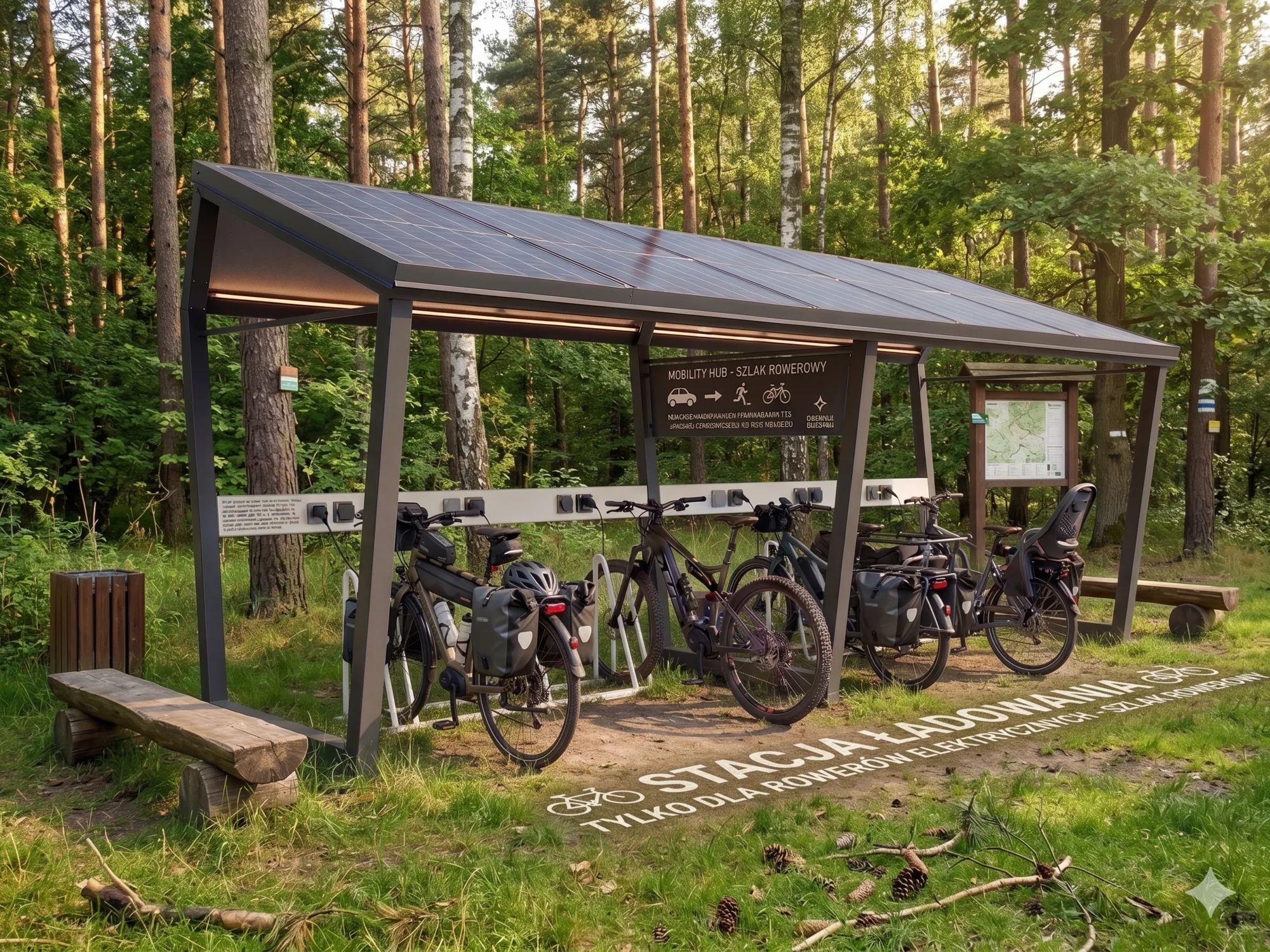
The shelter runs with no grid connection, powered by roof-mounted solar panels and an LFP battery. It fits locations where bringing in power would mean building a connection from scratch: cycling trails, landscape parks and agritourism farms.

ChargeGo solar bike shelter on a forest cycling trail — off-grid e-bike charging station with an E-Bike Charging Station sign

Why a solar shelter for recreational sites

There's one main reason: these locations usually have no practical grid connection nearby, and the shelter doesn't need one.

Fully autonomous operation (off-grid)
Solar panels and an LFP battery power the shelter, so it works on a trail, in a forest or in a landscape park where no grid connection is available.
A charging point along the route
An electric bike needs charging partway through a longer trip. The shelter gives riders a place to do that without asking staff for a socket.
Funding programmes
Shelters are sometimes funded through regional programmes and grants (LGD local action groups, KPO, micromobility programmes). The funding level and which costs qualify are set by the rules of each specific call, so check them before applying.
A secure parking space
The shelter is covered and lit (LED with a motion sensor), with an optional camera. A bike stays under the roof, protected from rain, and the lockable variant further reduces the risk of theft.

Types of recreational sites

Cycling trails and Velo routes
The shelter works as a stop along routes such as Velo Baltica, Green Velo and EuroVelo 9, with a charging break every 30–50 km. Off-grid operation is often the only option in these places.
Landscape parks and Natura 2000 sites
Running with no grid connection means no trench for a power cable, and screw-in foundations need no concrete. The regional environmental authority (RDOŚ) decides the scope of environmental approvals required for the site.
Agritourism farms
A lockable shelter with 3 charging points is installed next to the guest house. Doors with locks keep a guest's bike secure even when nobody is watching it.
Holiday resorts by lakes or in the mountains
At seasonal sites, the shelter can handle intensive use during the six-month peak season. It can also be paired with an on-site bike rental.

How off-grid mode works

The shelter needs no external connection: power from the roof-mounted solar panels feeds the LFP battery, and the bikes charge from that.

3.48 kWp of solar panels: about 29 full e-bike charges on a sunny summer day
A 500 Wh e-bike battery needs about 0.5 kWh to charge. Output on a sunny summer day is about 16.5 kWh; after accounting for losses, that gives about 29 full charges, plus a buffer from the battery. Modelled for central Poland from PVGIS data: assumptions and formula.
6 kWh of storage: a buffer for cloudy days and evenings
The heated LFP battery operates down to −20 °C and keeps the LED lighting and charging available after dark. The actual buffer depends on sunlight at the specific site and the season.
Remote monitoring over LTE
The shelter reports battery state, faults and usage statistics. A SIM card is included in the price, so you can check the station remotely without a site visit.
Market price ranges · 2026

Indicative budget for a site

These are ranges for typical configurations; we prepare an individual quote within 1–2 days. Off-grid is the standard setup on trails and at agritourism farms.

a stop along the route

Cycling trail · off-grid

€18,500–28,000excl. VAT
Lockable Shelter 3 (3 charging points) · PV 1.74 kWp
  • Doors + locks (no supervision on the trail)
  • Off-grid operation
  • No grid connection
  • LED with motion sensor
  • LTE connectivity
Most popular
mid-size properties

Agritourism · guesthouse

€18,500–28,000excl. VAT
Lockable Shelter 3 (3 charging points) · PV 1.74 kWp
  • Lockable shelter + locks
  • App for guests
  • RAL colour choice
  • Technical description for trail catalogue applications
large properties

Holiday resort

€26,000–39,000excl. VAT
Lockable Shelter 6 (6 charging points) · PV 3.48 kWp
  • 6 × 230V
  • Remote-controlled locks
  • ~3.6 kWh LFP battery
  • Camera, 1-hour retention
  • Admin dashboard
  • Guest materials

These are indicative ranges, based on 2025/2026 market prices for smart bike shelters. Final pricing is quoted individually within 1–2 business days. Shown in EUR at an indicative exchange rate; invoices are issued in PLN.

Get a quote for your location

Cycling tourism and funding programmes

Programmes and standards that sometimes take covered, secure charging points into account. Qualification and the exact requirements are set by the rules of each programme.

EuroVelo

cycling infrastructureEU · international route network

Sites on EuroVelo routes (in Poland, including EV2, EV9, EV13) are featured in the network's catalogue. Requirements for a site are set by the route operator.

Green Velo

cycling infrastructurePL · eastern route

MPR standards apply to sites on the Green Velo route (5 voivodeships in eastern Poland). The shelter addresses requirements for secure parking and for supporting cycling tourists.

Bike-Friendly Place (MPR)

cycling infrastructurePL · regional programmes

The Polish MPR standard is voluntary and free to join. The shelter helps meet requirements for secure parking and weather protection, and supports cycling tourism at the site.

Bett+Bike / Accueil Vélo

cycling infrastructureDE/AT/FR · accommodation

International quality marks for bike-friendly accommodation, valuable for agritourism farms and guesthouses hosting foreign tourists.

LGD · local action groups

indirect / ESGRegional PROW programmes

The shelter can form part of projects that develop cycling tourism in rural areas. Check the current call at your local LGD.

NFOŚiGW + KPO

indirect / ESGFunds targeted at renewables

An off-grid shelter (solar panels plus battery) fits renewable energy programmes. The funding level depends on the specific call.

e-bike specific — covers charging and electric assistcycling infrastructure — parking, lighting and securityindirect / ESG — supports strategy or reporting

Note: the certificate is awarded to the building. ChargeGo supports the criteria, and an assessor or certification consultant confirms the final qualification.

Full system map
FAQ

Questions from site operators

Yes. In off-grid mode the shelter runs purely on roof solar panels and an LFP battery. The lockable shelter with 3 charging points has 1.74 kWp of solar panels and about 1.8 kWh of storage, which covers typical trail traffic. The shelter with 10 charging points has 3.48 kWp of solar panels and 6 kWh of storage for heavier tourist traffic (a dozen or so sessions a day in season), with extra buffer for cloudy days and evenings. For a specific location we estimate solar output and battery size from PVGIS data.

A quote for your location

Tell us where the shelter goes and how many charging points you need, and we'll put together an off-grid configuration within 1–2 business days.

Your configuration

This decides which product line applies.

0/2000
See also

Resources you might find useful

Charging Bikes on Trails and in Parks | ChargeGo