A solar bike shelter with integrated PV and battery storage
ChargeGo is a Polish-made solar bike shelter in two variants: the open shelter with 10 charging points, and the lockable shelter with 3 or 6. It combines 1.74–3.48 kWp of roof-mounted solar, an LFP battery of about 1.8–6 kWh and 3 to 10 230 V sockets for charging electric bikes. It runs around the clock off-grid, with no connection to the power grid. For hotels, cities, developers, companies and recreational sites.
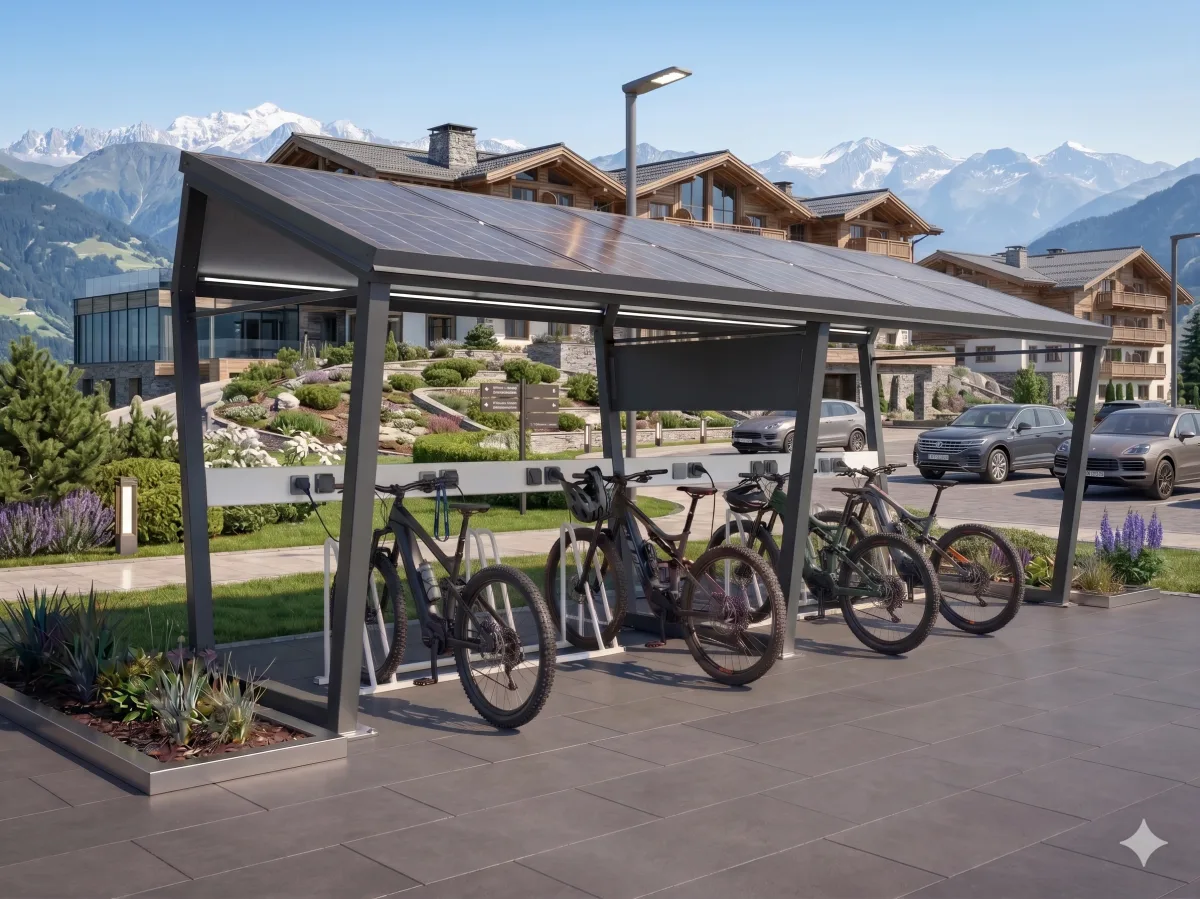
The ChargeGo solar bike shelter, element by element
The full technical specification in one table.
| Element | ChargeGo specification | Why it matters |
|---|---|---|
| Configuration and capacity | Open shelter: 10 · Lockable shelter + locks: 3 or 6 | The lockable shelter has integrated doors and locks, so bikes can be secured inside. The open shelter costs less and fits more charging points. |
| Dimensions and footprint | 6.4 × 3.2 m, ridge height 2.7 m, ~20 m² footprint | Stays under the 35 m² threshold that decides the permit procedure (row below). Designers need the footprint at the site-planning stage. |
| 230 V Schuko sockets | With a PE pin, power metering per socket | Each guest uses the charger that came with their bike, so the site keeps no chargers of its own. |
| Draw limit and metering | Current metering on every socket · a charging point switches off once it crosses the configured threshold · a 3,000 VA inverter caps the combined power of all charging points | We set the threshold per installation and state it in the quote. A typical e-bike charger draws 0.4–1.2 A. Metering feeds reporting and the limits. |
| Solar output | 1.74–3.48 kWp (depending on variant) | About 1,650–3,400 kWh a year in Poland (PVGIS) depending on the variant, or roughly 3,300–6,800 full e-bike charges (0.5 kWh each). Suitable for sites with seasonal peaks while remaining operational year-round. |
| Battery | LFP (LiFePO4) ~1.8–6 kWh with a BMS (depending on variant) | High thermal stability and a lower risk of thermal runaway than many other common lithium-ion chemistries. 4,000+ cycles, 5-year warranty at ≥80% capacity. |
| Operating mode | Off-grid (default) / hybrid with a grid connection | No grid connection needed, making it suitable for rest areas, cycling routes and mountain hotels. |
| Battery heating | Active, controlled by the BMS · operates from −20 °C to +45 °C | Without heating, the LFP's BMS won't charge below 0 °C and charging would be down for most of the winter, about 3–5 months. |
| Steel structure | Hot-dip galvanised + powder-coated RAL finish | 25+ years of durability, colour matched to the site's branding (anthracite RAL, wood tone, corporate colours). |
| Mobile app | iOS + Android | The guest scans a QR code at the charging point and starts charging. The operator sees sessions, energy use and alerts in the dashboard. Nothing is handed out or collected at reception. |
| Connectivity | LTE included, Wi-Fi / LAN optional | The shelter works where there's no grid connection and no site network. The modem and data plan are included as standard. |
| Touchscreen | 10", optional (kiosk with branding) | Users start charging without a phone or an account, which is useful at tourist sites where visitors may not have the app. The screen can carry the site's branding. |
| LED lighting | 4 × 12 V, dimmable, ~4000 K · motion sensor or schedule | Usable after dark, with a neutral ~4000 K colour that doesn't clash with the surroundings. The light runs off the battery, so it works off-grid. |
| Ingress protection and certifications | IP67 (sockets, sensors) · IP44 + UV resistance (electronics enclosure) · CE, RoHS, EU declaration of conformity | These ratings and conformity documents can be included directly in tender or design documentation. |
| Design brief / tender specs / CAD / BIM | Technical data sheet, RAL palette, sample tender text, BIM on request | Ready for design offices and public procurement, so the documentation doesn't have to be written from scratch. |
| Installation and foundation | Screw piles (no concrete) or anchor foundations | Installation takes 1–2 days. Screw piles allow the shelter to be dismantled or relocated later. |
| Permit procedure | Notification (shelter under 35 m² and under 5 m) | No building permit needed. The authority has 21 days to object, and no objection means approval. The plot decides the exact procedure; guide: /pozwolenie-czy-zgloszenie. |
| Price (indicative) | €18,500–39,000 excl. VAT (open shelter with 10 charging points / lockable shelter with 3 or 6) | Configurator and extra costs: /ile-kosztuje-wiata-rowerowa. |
| Case study | Hotel Ostaniec (Kraków–Częstochowa Upland, since May 2026) | Configuration, timeline and results: /realizacje/hotel-ostaniec. |
Solar bike shelter vs a plain bike shelter
The term "bike shelter" is used to sell both a plain roof with racks and a charging station with its own power supply. Two different products, and price isn't the only difference.
- Just a roof + racks
- No electrics, so no charging for electric bikes
- Price: €950–4,200 per bike space
- No operational data, no monitoring
- No charging, so it doesn't count toward certification criteria for e-bike charging
- Roof + solar panels + LFP battery + 3 to 10 230 V sockets
- A complete electric bike charging station
- Price: €18,500–39,000 excl. VAT (open shelter / lockable shelter)
- Mobile app, remote monitoring, ESG data
- Charging points count toward BREEAM and LEED transport criteria
Photos from a real installation
Hotel Ostaniec, a pre-production variant. The shelter in operation after dark.
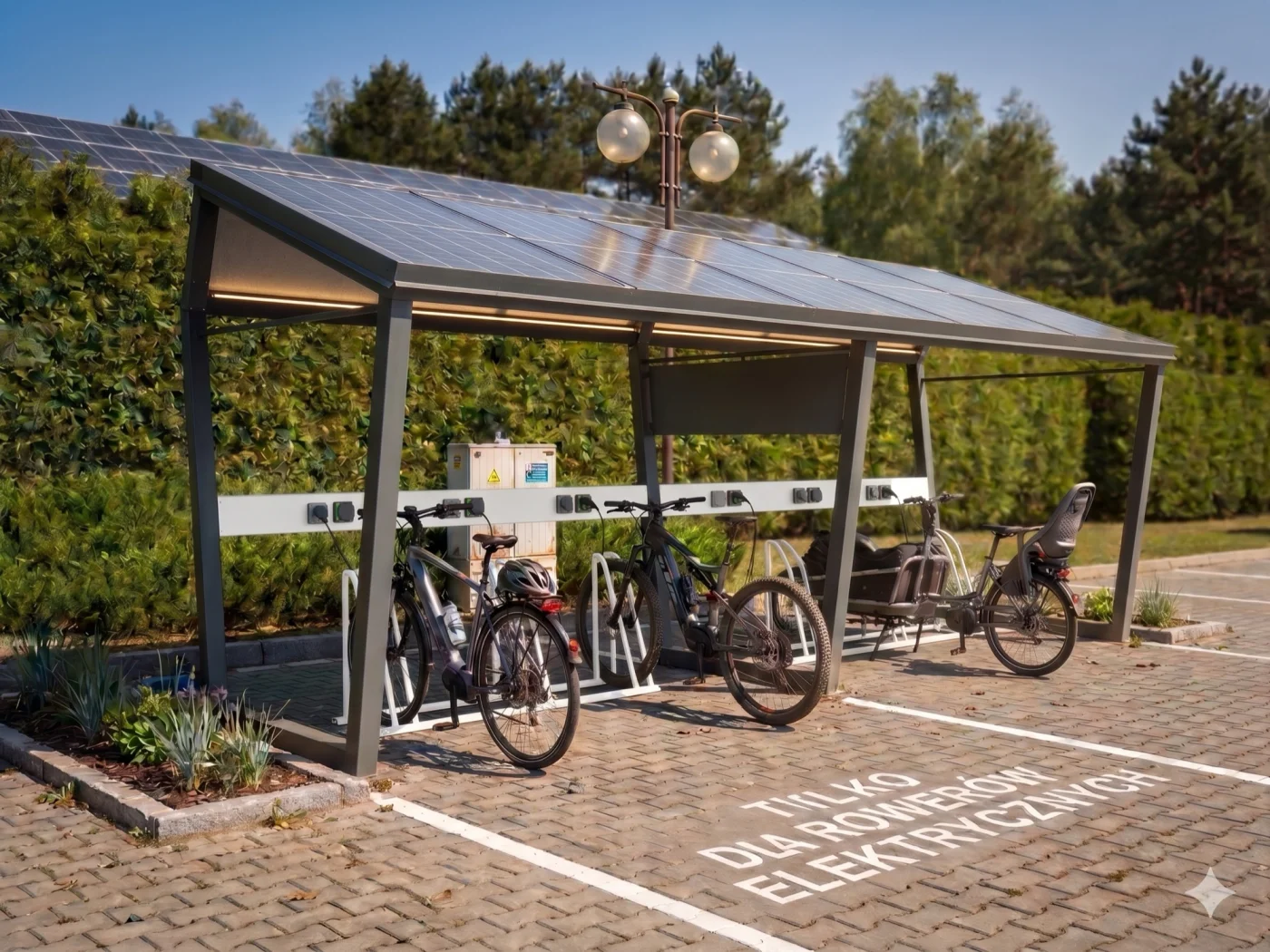
In operation — Hotel Ostaniec
Running since May 2026 · 8 charging points · powered by roof-mounted solar panels · controlled from the ChargeGo app.
- ~3 kWp solar panels
- Battery (inside the cabinet)
- 8 × 230 V sockets
- Bike racks
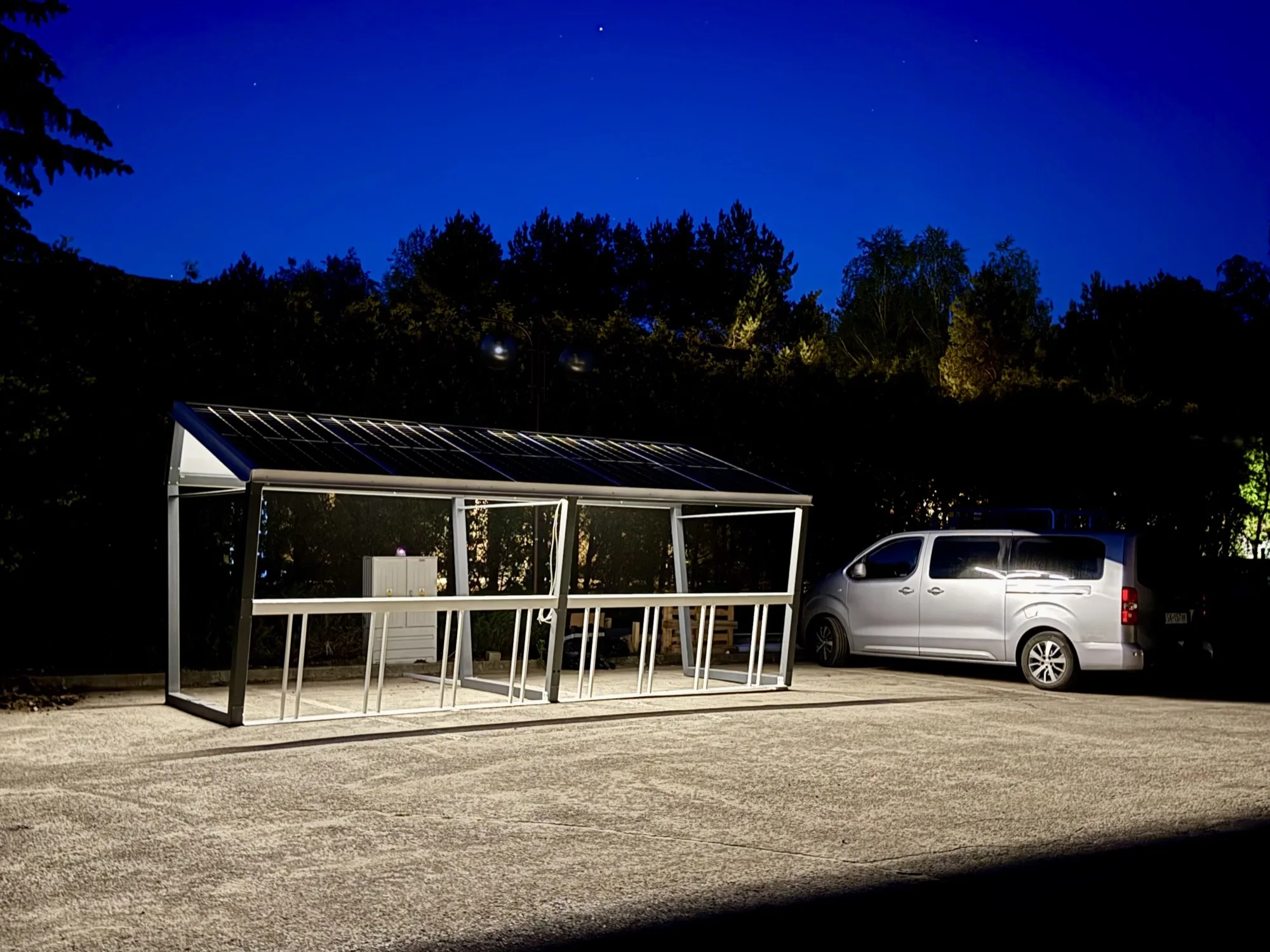
At night with LED lighting
The dusk-triggered LED switches on automatically, drawing minimal power from the battery.
- Automatic dusk-triggered LED
- ~5 kWh battery buffer
- The shelter runs 24/7
You can see the ChargeGo Box, the app and the admin panel at our workshop in Dąbrowa Górnicza.
Camera, metering and data protection
The shelter stands outdoors and runs unattended, so it watches itself: a camera and current metering on every socket. Neither leaves behind data the site would have to manage.
Day and night mode, IP67 enclosure. A view of the charging points and structure at any hour, with no separate site surveillance system.
By default the camera takes snapshots and deletes them automatically after an hour, in line with GDPR data minimisation. Sites that need longer retention can set it.
Automatic shutoff of a charging point on a short circuit or overload. Metering feeds reporting and the limits.
What kind of sites a solar bike shelter suits
Configuration (charging points, solar output, battery) follows the type of site. Details per segment below.
Frequently asked questions about the solar bike shelter
Resources you might find useful
Get a quote for a solar bike shelter
Tell us the location and how many charging points you need. Quote and configuration go out within 1–2 business days.