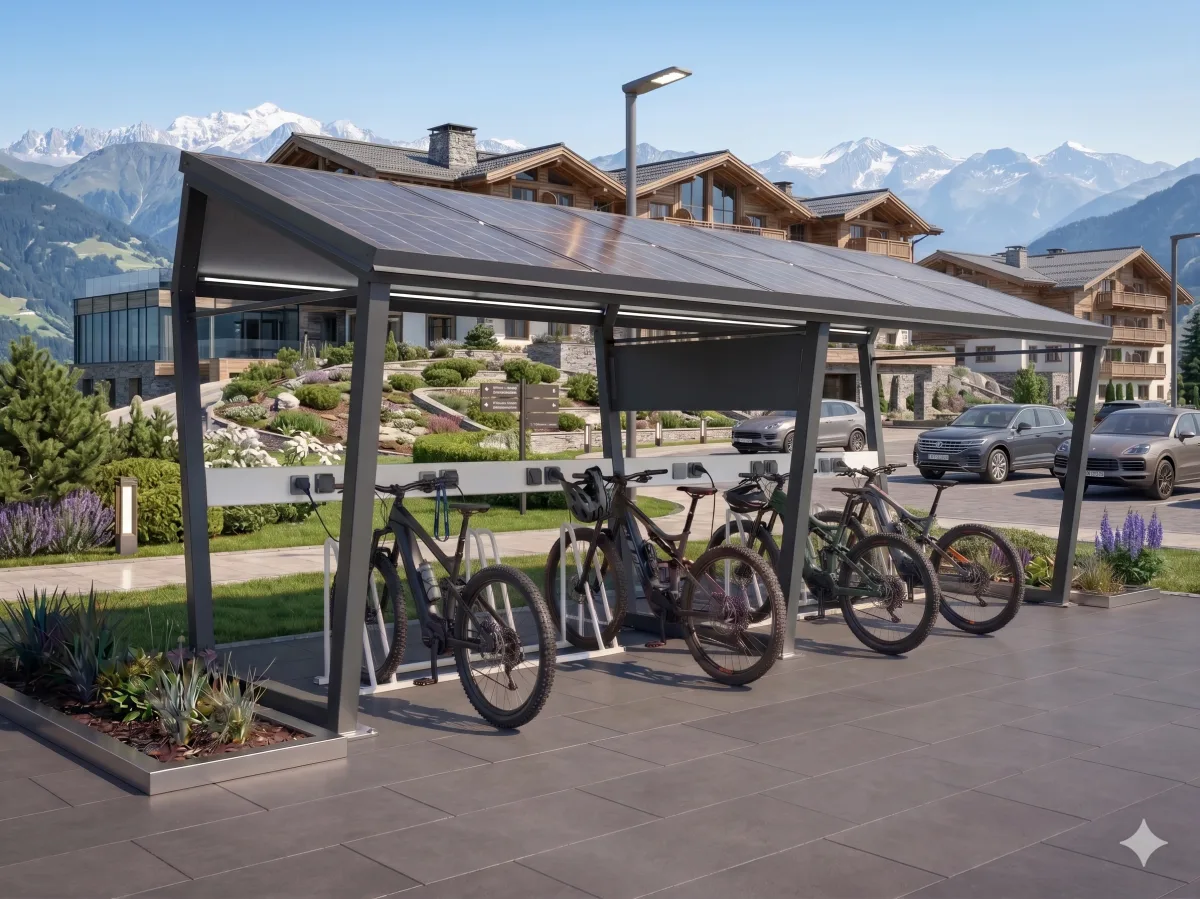
A solar bike shelter is an autonomous micro power plant that charges e-bikes. From outside it looks like an ordinary shelter; inside, a full energy installation fits into slim structural profiles: photovoltaics on the roof, storage in one column, inverter in another, controller with LTE modem, metering at every socket.
Price ranges, product map and installation formalities are in a separate article: e-bike charging station — types, price, installation.
What a solar bike shelter consists of
A typical ChargeGo solar shelter has seven layers, from the roof down:
- Photovoltaic panels 3.48 kWp — 6 monocrystalline modules at 580 Wp each, at approx. 8–15° for optimal annual yield.
- Steel structure hot-dip galvanised, powder-coated in client-selected RAL. Carries the roof and PV array, routes cables, resists vandalism.
- Solar inverter + MPPT charger converting DC from PV to DC for storage, and to 230 V AC for sockets.
- LFP (LiFePO4) energy storage 6 kWh, with active heating for operation down to –20 °C.
- BMS (Battery Management System) — protects storage against deep discharge, overcharge and operation outside the temperature range.
- Electrical distribution board with RCD, overcurrent breakers, SPD II and current meters per socket.
- Controller with LTE modem — sends data to the cloud, receives commands from the app, has an emergency timer and local offline mode.
All of this fits in a shelter of approx. 16–20 m² and 2.5 m height, within the notification procedure and without a building permit.
3.48 kWp photovoltaics — why this size
PV capacity follows from the station's annual energy demand:
A full e-bike charge takes 0.5 kWh (500 Wh battery plus ~10% charging losses). In season, a 10-point shelter typically handles 20–30 charges per day, so 10–15 kWh per day at peak.
Annual PV yield in Poland for a 3.48 kWp installation at optimal tilt is 3,100–3,650 kWh (source: PVGIS, Poland average 900–1,050 kWh/kWp/year). Monthly distribution is very uneven, from approx. 58 kWh in December to 520 kWh in June.
| Month | PV yield 3.48 kWp (kWh) | Charges per day |
|---|---|---|
| December | 58 | ~4 |
| March | 290 | ~19 |
| June | 520 | ~35 |
| September | 310 | ~21 |
Roof area limits the array (6 panels × 2 m² ≈ 12 m²), and real peak demand is lower anyway: 4 kWp extra on a 10-point shelter in July produces energy we cannot use during the day and cannot export (off-grid). 3.48 kWp is the compromise between yield and cost.
LFP energy storage and heating
Storage does two jobs: it buffers PV energy for the night and smooths short demand peaks when 8–10 bikes charge at once, each up to 500 W at session start.
Storage chemistry is LiFePO4 (LFP) rather than NMC or lead-acid:
- Safety — LFP has high thermal stability and lower risk of thermal runaway than many other popular lithium-ion chemistries. For public infrastructure this is almost a regulatory requirement.
- Durability — 4,000–6,000 charge cycles (vs ~1,500 for NMC), realistically 10–15 years of operation.
- Temperature range — storage operates from –20 to +60 °C; LFP performs well at low temperatures, NMC loses capacity faster.
- Energy density is lower than NMC, but weight does not matter in a shelter.
6 kWh follows from the night balance: in season roughly one-third of charges fall in the evening and night (approx. 6 kWh), and the buffer has to serve them until the next day. Larger storage costs more without proportional benefit; smaller risks an evening guest finding an empty station.
Winter heating
This is the design detail most often omitted in cheap imported shelters. An LFP BMS does not allow charging cells below 0 °C, because of the risk of permanent damage. In a Polish winter a shelter without heating therefore stops charging from the sun through most frosts.
ChargeGo has an active storage heating system: a temperature sensor monitors the cells, and below +2 °C a heater powered from reserve energy switches on. Heating draws a few percent of the stored energy, so the system stays self-sufficient.
Inverter and the 230 V path
Energy from photovoltaics flows in order: panels → MPPT (tracks maximum power point) → DC bus → BMS storage charger. For sockets: DC bus → inverter → 230 V AC bus → sockets.
A typical inverter for a 10-point shelter has 1.5–3 kVA capacity. Real peak demand is 4 chargers × 300 W ≈ 1.2 kW, rarely above 1.5 kW even at full occupancy. A 3 kVA inverter gives headroom for 8–10 simultaneous sessions and for scooters, which briefly draw more.
Not all sockets run at full power at the same time. The ChargeGo controller uses "dynamic power sharing": with all 10 sockets connected, the system queues sessions or limits current at each socket. The approach comes from EV wallboxes, adapted for micromobility.
Energy balance over 24 hours
A typical August day in central Poland, 10-point shelter at a mountain hotel:
- 5:00–8:00 — storage at approx. 60% after night charging. Controller wakes and listens for QR codes.
- 8:00–12:00 — PV production rises to ~2 kW. First guests head out on routes, charging evening batteries (~3 kWh). Storage continues filling.
- 12:00–16:00 — production peak, storage full to 95% (the BMS avoids 100% to extend life). Surplus goes to sockets or is lost, since off-grid cannot export.
- 16:00–20:00 — guests return, socket load peaks. Energy flows from PV and storage at once, and storage drops to approx. 70%.
- 20:00–5:00 — evening sessions, storage drops to approx. 40–50%. Controller in low-power mode, LED lighting 5%, LTE modem sleeps every 10 min.
In winter PV produces 5–10× less, storage supplies most of the energy, and traffic is lower anyway. That is why the shelter runs year-round on 6 kWh instead of 50 kWh.
Seasonal balance — which properties it covers
Seasonality decides the sizing. A 3.48 kWp + 6 kWh shelter covers:
- Mountain hotel with 20–30 rooms and May–October season — 100% without limitations.
- 200-person office building with year-round commuting — December–February may need hybrid mode (brief overnight grid top-up).
- MOR along a Velo route — fully autonomous in season; off-season traffic is low and storage stays at baseline.
- City shopping centre — hybrid with mall roof PV, where available, as a winter supplement.
For properties with intensive year-round traffic, hybrid mode with guaranteed grid access is the better configuration.
Control and metering — what the operator sees
Inside the controller is a small computer (RPi 4 + custom firmware) with LTE modem and 4–8 GB offline data storage. Every minute it collects:
- Storage SoC (state of charge)
- Cell and enclosure temperature
- Current PV power
- State of each of 10 sockets (off / idle / charging / fault) and current at each
- Modem status and LTE network RSSI
- Service door opening (tampering)
- Controller cabinet temperature
The operator sees this in the ChargeGo app or web panel:
- Daily session count and duration
- Energy consumption daily/monthly/yearly — for CO₂ and ESG reporting
- Point utilisation — which are most popular, how long they are occupied
- Alerts — storage below 30%, socket reports fault, no LTE connectivity >15 min
- Audit logs — who charged when and how much (for billing or reports)
Operating modes: autonomous, hybrid, emergency
A solar shelter has three operating modes:
Autonomous mode (off-grid)
No connection to the power grid; all energy comes from PV and storage. Suits MORs, Velo routes, parks and mountain hotels without nearby grid access.
Hybrid mode (on-grid)
Shelter connected to the 230 V grid in backup mode: PV and storage remain the primary source, and the grid tops up storage in deficit. Suits office buildings and estates with intensive year-round traffic.
Emergency mode
Storage drops below critical SoC, typically 10%. The controller shuts all sockets and maintains only storage heating (in winter) and status reporting. Normal operation returns when PV charges storage above 25%.
Technical FAQ
Does LFP storage age? After how many years must it be replaced?
LFP has a lifespan of 4,000–6,000 full cycles to 20% capacity loss. A shelter performs 200–250 cycles per year, most of them partial. After 10 years storage retains approx. 80–85% of nominal capacity, so replacement falls after 12–15 years.
What happens when PV panels are covered with snow?
PV produces 0 W and the shelter runs from storage. 6 kWh covers approx. 12 charges, usually 2–3 days at winter traffic levels. The roof pitch is 8–15°, so snow slides off on its own at temperatures >0 °C.
Does the shelter require maintenance?
Minimal. PV panel cleaning once every 1–2 years, RCD and breaker check once a year (recommended PN-IEC 60364-6), service visit every 5 years for BMS, connections and earthing. Everything is documented in the operator app.
What about lightning?
The structure has earthing per PN-EN 62305, two-stage surge protection (SPD I + II) on the distribution board, and lightning protection on shelters over 2.5 m high. A PV module damaged by lightning is covered by the panel manufacturer's warranty, usually 10–25 years.
Can I add a camera, LED lighting, or monitoring?
Yes. ChargeGo standard supports an IP camera (RTSP), 12 V LED lighting with motion sensor, touchscreen with property advertising, and an RFID reader for a closed user group such as estate residents. All are optional and can be added later.