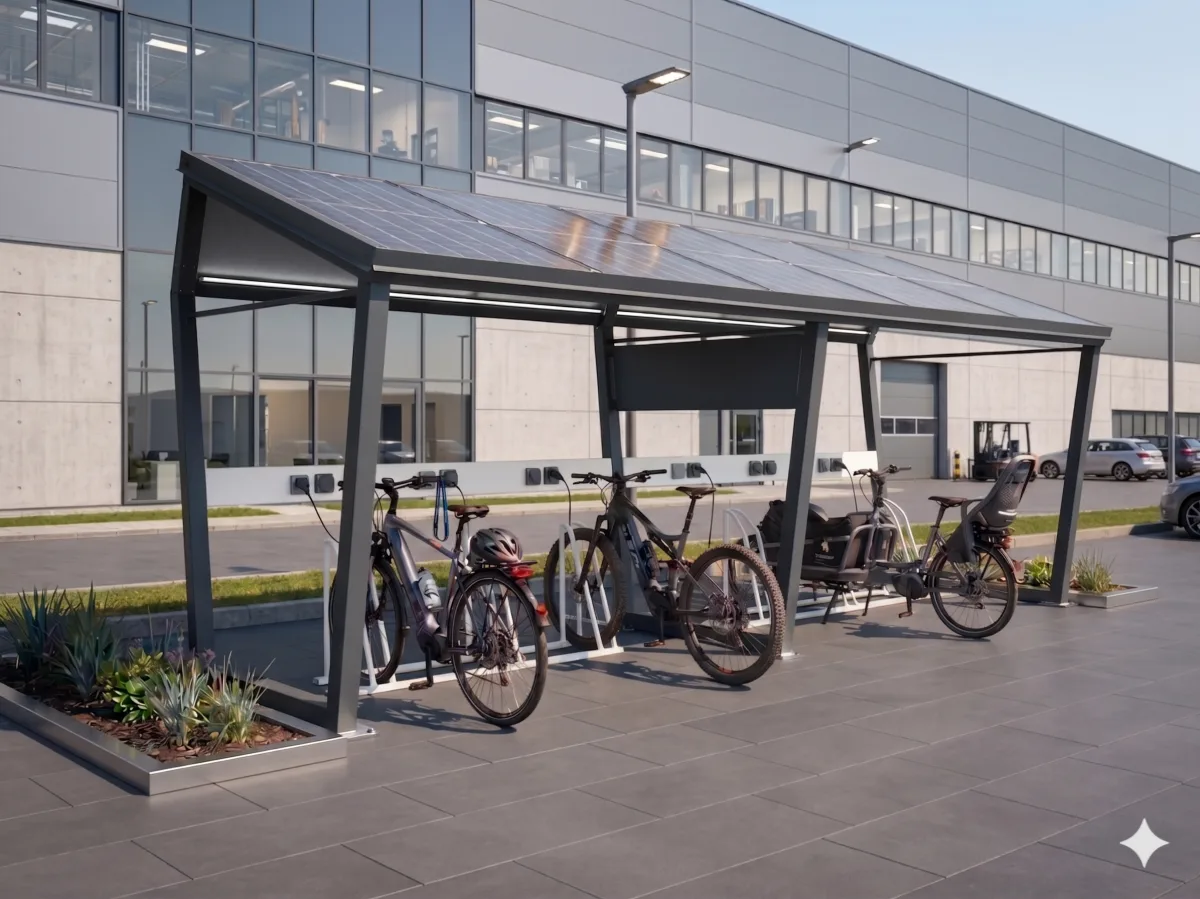
A full charge of a typical electric bike battery (500 Wh) uses about 0.5 kWh and costs €0.07–0.12 from the electricity grid, or €0 when the energy comes from photovoltaics. A full cycle takes 3–5 hours; a typical top-up from 30–80% is ~0.28 kWh and costs ~€0.07.
Below are the figures, formulas and comparisons for typical properties: hotel, office building, municipality.
Short answer — 0.5 kWh and €0.07–0.12
A full charge of a typical electric bike battery (500 Wh) uses ~0.5 kWh from the socket, including ~10% charging losses.
Cost from the electricity grid in 2026: €0.07–0.12, at G11 tariff rates for households in Poland.
With your own photovoltaics no energy is purchased, so the marginal cost of the next charging session is €0. Photovoltaics and storage still need upfront investment, independent of the number of sessions; the three types of cost are separated below.
Charging time: 3–5 hours for a full cycle, 1–2 hours for a 30–80% top-up.
How the numbers work — battery, efficiency, time
Energy used to charge an electric bike = battery capacity × depth of discharge / charging efficiency.
Example: 500 Wh battery, discharged to 0%, charger efficiency 90%:
- Energy stored in the battery to full: 500 Wh = 0.5 kWh
- Energy from the socket (including losses): 0.5 kWh / 0.9 = ~0.56 kWh
- Charging time with a 2 A × 36 V = 72 W charger: 500 Wh / 72 W ≈ 7 hours (from 0% to 100%)
- 36/48 V chargers with "fast charging": 4 A × 36 V = 144 W → ~3.5 hours
Real sessions are shorter, because users rarely run the battery down to 0%. A typical session at a hotel or office shelter is a 30–80% top-up: ~250 Wh = 0.28 kWh from the socket, over 1.5–2.5 h.
Typical e-bike batteries and their capacity
| Battery type | Capacity (Wh) | Full charge (kWh from socket) | Charging time (~4 A charger) |
|---|---|---|---|
| Small urban (Decathlon, Cannondale Quick) | 300–400 | 0.33–0.44 | 2–3 h |
| Standard trekking (Bosch Performance Line, Shimano STEPS E5000) | 500 | 0.56 | 3.5 h |
| Large touring / e-MTB (Bosch PowerTube 625, Shimano BT-E8035) | 625–750 | 0.69–0.83 | 4.5–5.5 h |
| Maxi (Bosch PowerTube 1000, dual batteries) | 900–1250 | 1.00–1.39 | 6–8 h |
| Electric scooter (e.g. Xiaomi 1S) | 275 | 0.30 | 2 h |
| Premium electric scooter (e.g. Segway Ninebot G2) | 500–700 | 0.56–0.78 | 3–5 h |
Market average in Poland 2026: approx. 500 Wh for electric bikes, most of them trekking or city models, and ~350 Wh for scooters. On average a full charge is 0.5 kWh.
Cost of charging from the grid (2026)
Current (April 2026) electricity prices in Poland for households on the G11 tariff:
- Active energy price: ~€0.18 / kWh
- Distribution and other charges (after 2024 reform): ~€0.04 / kWh
- Total cost: ~€0.22 / kWh
For a 500 Wh battery (full charge 0.56 kWh):
- Energy cost: 0.56 × 0.22 = ~€0.13 per full charge
- For a 30–80% top-up (0.28 kWh): ~€0.07
On business tariffs C11 (office buildings, hotels) prices are lower, €0.13–0.17 / kWh in total, so a full charge costs ~€0.07–0.10.
Charging from photovoltaics — three types of cost
Zero charging cost from photovoltaics holds for one of three definitions of cost. Separating them keeps purchasing decisions honest:
- Cost of purchasing energy from the grid — what the property pays the supplier for kilowatt-hours used for charging. In an autonomous configuration this line item does not exist.
- Marginal energy cost — what one additional session costs on an installation already running. In an autonomous configuration it is zero: the installation is there anyway and solar energy is not billed.
- Total infrastructure cost — investment in the shelter, photovoltaics, storage and controller, spread over years of operation. This is the largest line item and exists regardless of the number of sessions.
Example for the last item: a 6-point lockable Shelter from €32,500 excl. VAT, spread over 10 years, is approx. €3,250 per year. At 2,200 sessions per year that is approx. €1.50 per session, many times more than grid energy alone. A station buys infrastructure: a designated place, consumption metering, access control and operation without a grid connection.
Annual cost for typical properties
Three scenarios with numbers:
Mountain hotel, 25 rooms, lockable Shelter with 3 charging points
- April–October season: ~3 sessions/day × 200 days = ~600 sessions
- Off-season: ~0.5 sessions/day × 165 days = ~80 sessions
- Annual consumption: ~680 sessions × 0.5 kWh = 340 kWh
- Energy cost from grid (C11 tariff): 340 × 0.16 = ~€54 per year
- Energy cost from own photovoltaics: €0, excluding the installation itself
Office building, 200 employees, lockable Shelter with 6 charging points
- Average 8–12 sessions per day × 220 working days = ~2,200 sessions
- Annual consumption: ~1,100 kWh
- Energy cost from grid (C11 tariff): 1,100 × 0.16 = ~€180 per year
- Energy cost from own photovoltaics: €0
Municipality, bike hub on a cycling route, open Shelter with 10 charging points
- Season: ~12–20 sessions per day × 180 days = ~3,000 sessions
- Off-season: minimal ~100 sessions
- Annual consumption: ~1,550 kWh
- Energy cost from grid (C11 tariff): 1,550 × 0.16 = ~€250 per year
- Energy cost from own photovoltaics: €0
Annual energy costs for e-bike charging are small even from the grid. What photovoltaics deliver is independence (off-grid, no grid connection required), ESG narrative and scalability; energy bills were never the decisive item.
What it costs with a dozen or more users
The calculations above close the topic where one or two bikes are charging. From a dozen users onwards, the electricity bill stops being the most expensive line item and three others take its place.
- Access to sockets. An extension lead from the corridor serves one bike. With ten bikes people start queueing for sockets, charging in rooms and running cables through circulation areas.
- Safety. Lithium batteries charged in common areas are a problem the property manager solves once, by designating a place with a separate circuit and the ability to cut power.
- Billing. At 340 kWh per year nobody counts who used how much. With several properties and hundreds of sessions, the question arises whether energy goes on common costs or on the user.
The answer depends on where the bikes are parked. In a garage or bike room a wall-mounted unit is enough: see electric bike charging station in a garage. Outdoors, without a grid connection, a solar bike shelter with photovoltaics and energy storage does the job. Both approaches are compared with parameters and prices on the electric bike charging station page.
CO₂ emissions from charging — comparisons
Polish energy mix 2026: approx. 0.65 kg CO₂ / kWh, after a rapid drop from 0.9 kg in 2020 thanks to growth in renewables and decommissioning of some coal units. Full methodology and data sources: /metodologia.
| Mode of transport | CO₂ emissions / km |
|---|---|
| Electric bike — from photovoltaics | 0 g |
| Electric bike — from PL grid (2026) | ~3.3 g (0.005 kWh × 650 g) |
| Conventional bicycle | 0 g |
| Passenger car — diesel | ~140 g |
| Passenger car — petrol | ~150 g |
| Electric car — from PL grid 2026 | ~95 g (~150 Wh × 650 g) |
| City bus (per passenger) | ~80 g |
An electric bike is 40–50× less emissive than a combustion car per kilometre. A shelter with photovoltaics reduces that figure to zero.
Comparison with other modes of transport
Cost of travelling 100 km, from the user's perspective:
| Mode of transport | Energy cost / 100 km |
|---|---|
| Electric bike (from own photovoltaics) | €0 for energy |
| Electric bike (from home, grid) | ~€0.13 (0.56 kWh, one full charge for ~100 km range) |
| Electric scooter (from grid) | ~€0.17 (0.76 kWh) |
| Electric car (from PL grid) | ~€4 (17 kWh × €0.22) |
| Combustion car (petrol 5 l/100 km) | ~€7 (5 l × ~€1.40) |
| Public transport — ticket | ~€1.20–1.90 (depending on city) |
Energy for an electric bike is orders of magnitude cheaper than car fuel over the same distance. The infrastructure remains the cost item, as the three definitions above show.
Frequently asked questions
Is charging a bike at night more expensive?
On the G12 (two-zone) tariff the night rate is approx. 30% lower, so a full charge at night costs ~€0.09 instead of €0.13. For shelters operated by owners' associations or companies, the C11 (single-zone) tariff is neutral on time of day.
Does the station use electricity when nobody is charging?
A small amount: controller, LTE modem and LED lighting draw ~5–10 W continuously, i.e. ~50–90 kWh per year. In off-grid mode that energy comes from PV and storage and generates no bill. In hybrid mode it is ~€12–19 per year from the grid.
Can I charge users for consumption?
Yes, the ChargeGo app supports billing per consumption (kWh) or per session. Typical market rate: €0.19–0.35 / kWh, with an operational margin over energy cost, or €0.50–1.20 per session. For shelters run as an employee or residential benefit, users are usually not billed.
Is charging a bike safe for the battery?
Yes, with the factory charger. The station provides a 230 V socket, and charging is controlled by the charger and the bike battery BMS, which ends charging at 100%, so overcharging is not possible. The shelter controller additionally ends the session when it detects the current drop that signals end of charging.
How long can a bike be left in the shelter after a full charge?
The app ends the session automatically. After that the cyclist can collect the bike whenever they want: the charger draws no energy and the socket is switched off. In a time-based billing model, for example at bike hubs, a fee may apply for blocking a charging point beyond e.g. 4 h.