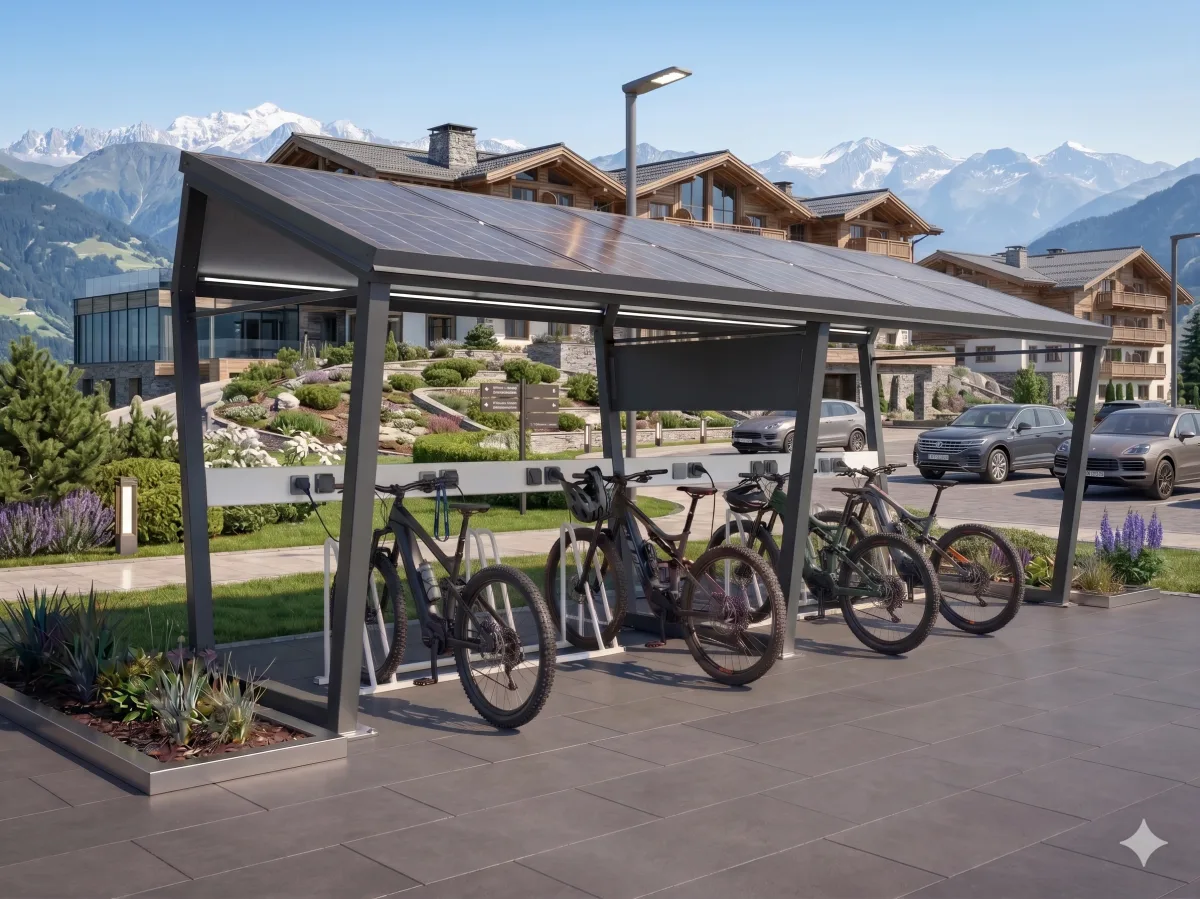
An e-bike charging station is one of the fastest-growing categories of micromobility infrastructure in Poland, and one of the most often confused with a charger accessory, a wall socket or an EV wallbox. This guide covers what a station is, what types the market offers, what each costs and what formalities installation requires.
What is an e-bike charging station
The term has no single legal definition. We use it for publicly or semi-publicly accessible infrastructure that charges several e-bike batteries at once (most often 36 V or 48 V), plus electric scooters and other micromobility devices. Three features distinguish it from a single socket:
- Multiple charging points — minimum 2, typically 4–16.
- Metering and control — the station records who used how much energy and can end a session safely. A socket without metering and a switch does neither.
- Power standard suited to e-bikes — in Poland and the EU this is a 230 V AC socket with PE pin (Schuko), into which the user plugs the factory charger supplied with the bike.
A station is often confused with an e-bike charger: a 36/48 V power supply bought for one specific battery (Bosch, Shimano, Bafang, Yamaha — each with its own connectors and BMS communication protocols). At a station, many users with different bikes plug their own chargers into a shared energy source.
E-bike charging station = several 230 V sockets in one place, with metering and protection, open to different users with different bikes. A charger, a single socket and an EV wallbox are three separate things.
Types of charging stations — indicative breakdown
"Charging station" covers products ranging from a simple rack with a socket to an intelligent solar station, at very different price points. The market has no official classification; the six categories below are our working framework for comparing offers.
Single rack with sockets
A rack for 1–4 bikes with a built-in 230 V socket, sometimes USB. No roof, no photovoltaics, usually powered from a socket in a nearby building. Works where a roof already exists and only a charging point is missing. Price: €470–1,200 per point.
Bike shelter without charging
Roof and racks, no electrics. Still common in municipal infrastructure (MOR, cyclist service points), where the user can park but not charge. Price: €240–4,200 per point depending on material.
Low-cost PV shelter — DIY / import
Steel or aluminium structure with a modular photovoltaic roof, imported from China or assembled by local installers. Works only while the sun shines: no storage, no remote control, no app. Price: €1,850–4,200 per point.
MOR / standard public shelter
Professional shelter used in municipal infrastructure and along Velo routes, most often EU-funded. Solid steel structure, often without charging or with symbolic PV and no storage. Price: €2,350–7,000 per point.
Solar shelter with charging — mid segment
Steel structure with PV roof, 2.5–5 kWh energy storage, 4–10 × 230 V points with current metering. Operates 24/7 autonomously, without a mobile app or remote management. Price: €12,000–35,000 for a full shelter; fixed costs dominate, so this figure is per shelter rather than per point.
Intelligent solar station (premium)
Full package: 1.74–3.48 kWp photovoltaics, LiFePO4 storage with winter heating, 3 to 10 × 230 V points with per-socket metering, mobile app with login, touchscreen, camera, Polish electronics, remote monitoring, site branding. Price: €18,500–39,000 excl. VAT (open Shelter from €18,500 excl. VAT, 3-point lockable Shelter from €23,500 excl. VAT, 6-point lockable Shelter from €32,500 excl. VAT). This is the segment where ChargeGo operates alongside competitors such as Seedia and Stacjomat.
Technical standards and safety
Unlike EV wallboxes, an e-bike charging station has no communication standard of its own. The battery market is fragmented: every manufacturer (Bosch, Yamaha, Shimano STEPS, Bafang, Brose) has its own BMS and its own charger supplied with the bike, so no single public charger can talk to every BMS.
The de facto standard is therefore a 230 V AC Schuko socket with protective earth (PE). Every factory e-bike charger has a 230 V plug, so the station only has to provide the socket.
Minimum safety requirements for a station:
- RCD (residual-current device) type A 30 mA on each socket circuit.
- Overcurrent breaker per socket (typically B16) or shared with programmable current limiting.
- Enclosure rating minimum IP44 for sockets (PN-EN 60529), in practice IP54–IP66.
- Current metering per socket — enables automatic session end, protection against leaving a dead battery connected, and abuse detection.
- Surge protection class II (SPD II) on the entire distribution board.
- Shelter and structure earthing in accordance with PN-EN 62305 (lightning protection, especially for PV shelters).
The key operational parameter is current metering per socket. With one meter for the whole module you cannot tell who used how much, or whether someone left a dead battery connected overnight just to hold the charging point. An intelligent station sees each socket separately and ends the session when full charge is detected (typically: current drops below 0.1 A for 3 minutes).
Price — market ranges by type
The ranges below are indicative for a typical site (flat ground, crane/HDS access, anchor foundations) and in most cases gross including installation; they do not cover complex grid connections or extra works. Exception: "Intelligent solar station (premium)" ChargeGo prices in the table are the manufacturer's list prices excl. VAT.
| Station type | Points | Price (EUR) |
|---|---|---|
| Single rack with sockets | 1–4 | 470–4,650 |
| Shelter without charging | 4–20 | 950–18,500 |
| Low-cost PV shelter (DIY) | 4–8 | 7,000–18,500 |
| Standard MOR shelter | 4–10 | 9,500–23,500 |
| Solar shelter with charging (mid) | 4–10 | 12,000–35,000 |
| Intelligent solar station (premium) | 3–10 | 18,500–39,000 excl. VAT |
Full analysis of seven price factors, configuration calculator, and 5-year TCO: /ile-kosztuje-wiata-rowerowa.
Installation and formalities
Formal procedures for an e-bike charging station depend mainly on the built-up area and height of the structure. Everything below is current under Polish construction law after the 2024 amendments.
Shelter up to 35 m² and 5 m high — notification
Most bike stations fall within this range; a typical 10-point ChargeGo Shelter is approx. 20 m². A notification to the county office or city hall is sufficient, without a building permit (Art. 29(1)(2) of the Construction Law). The authority has 21 days to object; no objection = tacit approval.
Shelter over 35 m² or 5 m — permit
Large shelters (a dozen or more points, double multi-span) require a full building permit: construction design, site manager, construction log. Timeline: 1–3 months. Both the 10-point ChargeGo Shelter and the lockable Shelter (3 or 6 points) fit the notification threshold; a permit becomes necessary when several units are combined into one larger structure.
What else to check
- Local development plan (MPZP) — whether the plan allows complementary development on the plot. Without an MPZP, a zoning decision is required.
- Historic conservation zone — within a protected area, every structure requires approval from the regional conservator.
- Road corridor — if the shelter stands next to a public road, consent from the road administrator is required (Art. 39(3) of the Public Roads Act).
- Setback from boundaries — minimum 3 m from the plot boundary for buildings with a roof slope facing the boundary (technical conditions).
- Grid connection — a station running off-grid (PV and storage only) needs none. This matters for MORs, parks and Velo routes, where grid access is usually unavailable.
Full procedural guide: /pozwolenie-czy-zgloszenie.
Applications across segments
Details for each segment are on the linked pages.
- Hotels and tourism properties — charging for guests travelling by e-bike, without burdening reception, 24/7 operation. Selling point for Booking.com and Pokoje.pl listings.
- Developers and housing communities — BREEAM/LEED credits (Tra 03/Tra 03a), parking space conversion at 1:5, estate infrastructure that increases property value.
- Cities and local government — element of micromobility strategy, climate funds, participatory budget, MORs along routes.
- Companies and office buildings — employee benefit, ESG reporting (CSRD), emissions report data, bike parking with charging.
- Universities and campuses — micromobility infrastructure for students and staff, green building in new investments.
- Shopping centres — longer visit duration, attraction for customers arriving by bike.
- Recreation facilities and trails — MORs, Velo, landscape parks, holiday resorts, where off-grid operation without a grid connection is the deciding feature.
Grants and funding
The funding sources below were available in 2026. Call conditions, budgets and deadlines change every year — verify current status with each institution before applying:
- FEnIKS 2021–2027 (European Funds for Infrastructure, Climate, Environment) — climate and transport actions; for local government and public institutions.
- NFOŚiGW — Mój Prąd / Clean Air (for local government) — supplementary support for the PV component.
- Regional operational programmes (RPO) — regional programmes, usually under "sustainable transport" or "climate adaptation" axes.
- Participatory budget — in almost every city above 100,000 residents and many smaller ones. An e-bike charging station is a strong project: visible and easy to explain. Ready application template: participatory budget — template.
- Corporate ESG funds — developers and office buildings increasingly include a shelter in sustainable investment plans reported under CSRD.
ChargeGo as a product example
ChargeGo is one example from the premium category above:
- Structure — steel shelter, Polish construction, powder-coated RAL, 25+ years durability.
- Points — 3 to 10 × 230 V with per-socket metering (open Shelter: 10, lockable Shelter with locks: 3 or 6).
- Energy — 1.74–3.48 kWp photovoltaics, LFP storage ~1.8–6 kWh with active heating (operation down to –20 °C), autonomous or hybrid grid mode.
- Software — mobile app, remote monitoring, ESG/BREEAM data, Polish electronics and Polish app.
- Deployment — first shelter in operation at Hotel Ostaniec in the Kraków-Częstochowa Upland from May 2026.
Product page with full details: ChargeGo e-bike charging station. Technical datasheet for download: karta-techniczna-chargego.pdf.
Frequently asked questions
Can an e-bike charging station operate without a grid connection?
Yes, in autonomous (off-grid) mode. Energy comes from photovoltaics on the shelter roof, with an LFP storage buffer as backup. This matters for MORs, Velo routes and landscape parks where the nearest connection may be hundreds of metres away.
Do I need a dedicated charger for each user?
No. The station provides 230 V sockets. Each user plugs in their own charger supplied with the bike, the same one they use at home, so the operator keeps no collection of chargers for different brands.
How many sockets do I need for my property?
Rule of thumb: for a hotel, number of sockets ≈ number of rooms serving cycling guests in season ÷ 3. For an office building ≈ 5–10% of employees. For a residential estate ≈ 1 socket per 8 flats. Configurator available at /ile-kosztuje-wiata-rowerowa.
Does a station require staffing?
An intelligent station with an app does not. The user scans a QR code at the point and starts charging, and the operator sees everything remotely. Stations without an app require a key or card issued by reception or an administrator.
How much electricity does one e-bike charge use?
A typical 500 Wh e-bike battery uses approx. 0.5 kWh for a full charge. At 2026 electricity prices that is €0.07–0.12 from the grid, €0 from photovoltaics. Full cost calculations for typical properties: how much electricity e-bike charging uses.
What documentation should I receive from the supplier?
Minimum: CE declaration of conformity, structural material certificate, LFP storage safety data sheet, electrical installation schematic, PL user manual, warranty card (recommended: 2 years full, 10–25 years on structure), service manual, final acceptance protocol. For public procurement additionally: OPZ compliance document and leakage current measurement performed on site.