E-bike charging for owners' associations and cooperatives
One designated spot in the shared garage or bike room, instead of extension cords and one-off approvals for individual outlets.
The ChargeGo Box mounts on the wall of a common area. Eight charging points run from a single 230 V / 16 A circuit, each charging point has its own power meter, and the administrator grants resident access in the panel.
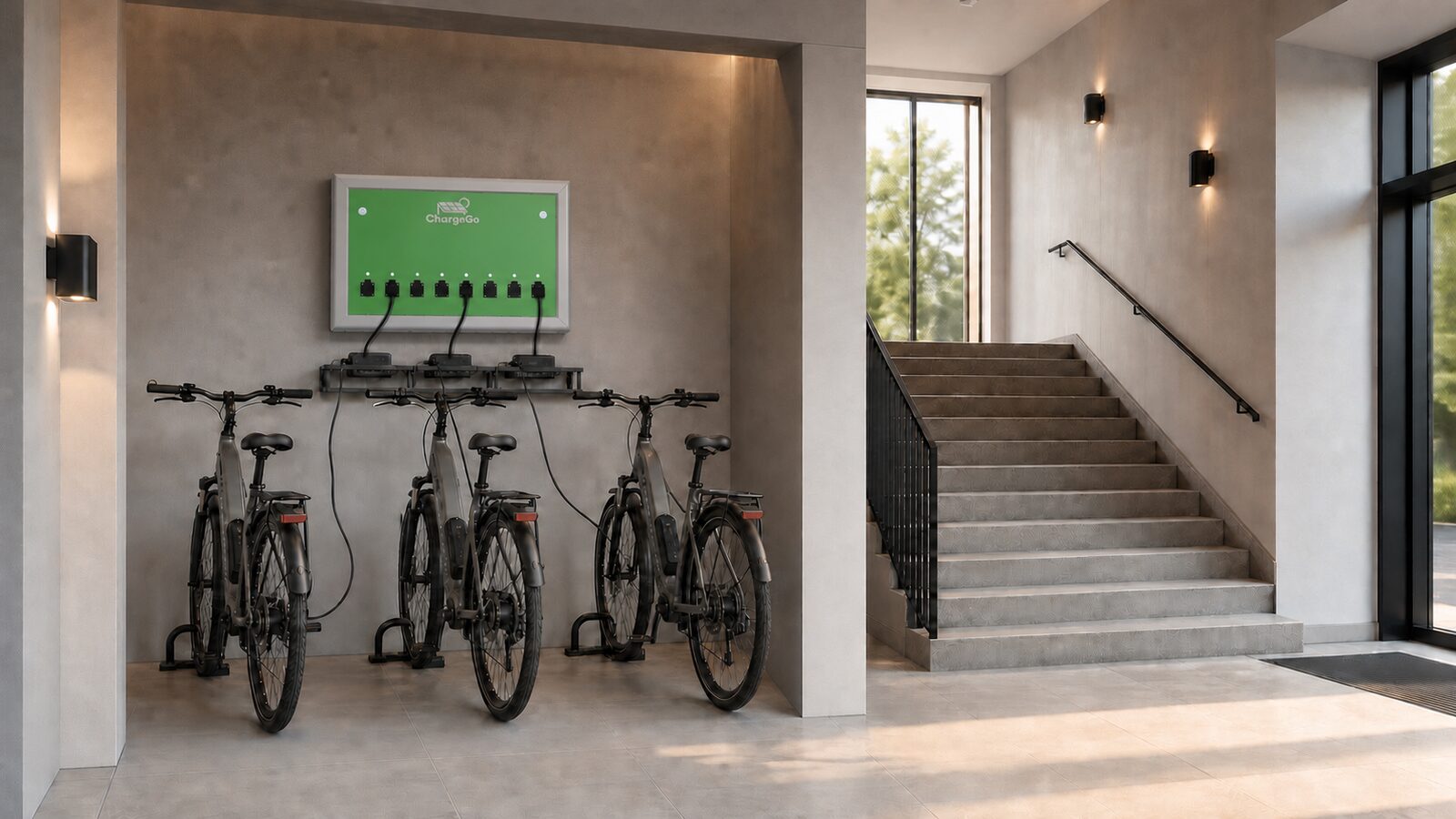
ChargeGo Box in a building's common area, 8 charging points
E-bikes with nowhere designated to charge
Many buildings already have e-bikes but no designated place to charge them. Without a shared charging point and charging rules, residents each work something out on their own.
Without a shared installation, the board usually ends up settling this case by case — another request for a private connection, another letter, another item on the meeting agenda.
One dedicated, managed installation for the whole building
We mount the ChargeGo Box on the wall of a shared garage, bike room or other common-area space: one place instead of several makeshift charging points, on its own circuit, with metering and a full set of protections built into the unit's housing.
If the building is new, a room for bikes and strollers already exists by law. It's worth knowing what the regulation doesn't say about power in that room.
A resident plugs in their own charger and starts a charging session from the app, by scanning the QR code at the socket, or locally over Bluetooth when there's no signal in the garage.
Who pays for the electricity
This question needs settling before the resolution. The association picks one of three models and can change it later.
In all three, usage is metered separately at every charging point and tied to a specific user; what differs is who covers the cost.
Per-charging point, per-user metering is what makes billing residents possible. The association sets the rate and writes it into the station's usage policy, like any other common-area charge.
Charging and metering themselves run with no subscription. Remote monitoring, reports and notifications come as a cloud package at €10/month, and the usage-billing module adds €7/month.
Bikes in the stairwell and the basement
This is often how the issue first reaches the building manager. Someone reports that bikes are blocking a passage, or that a neighbour is charging a bike from a corridor outlet. A bylaw ban solves the first half of the problem and leaves the second.
Bikes end up in the stairwell because there is nowhere else to put them. Until there is, a ban just pushes the problem into the basement, a storage unit, or an apartment.
The report usually comes from a neighbour, sometimes from the caretaker, and sometimes from the cyclist asking where they are allowed to park. Residents who want to report bikes in the stairwell come to you first, since you are responsible for the common areas. A resident who wants to raise the issue can report the building and get a sample letter.
A request to install a station can go to the owners' association or housing cooperative, which can approve it by resolution. The building manager sets the exact procedure and wording with their own advisers.
Instead of "where's it not allowed", the answer becomes "here". Charging moves out of the corridors into one place, on its own circuit, with metering per charging point.
Discussions also come back to fines for bikes in the stairwell. From the board's perspective, that's a last-resort, awkward tool: it requires identifying the bike's owner, starts a neighbour dispute, and doesn't create the space that's actually missing. A designated spot removes the basis for the dispute instead of trying to settle it.
If the building is new, a room for bikes and strollers already exists by law. The next question is what may be kept in it and where the power comes from, since the regulation names the room but not its equipment. We covered that in a piece on what you can keep in a stroller room and why it has no sockets.
What happens at night, when no one's there
This is the question a board, a property manager, and the assessor preparing the building's fire safety instructions ask about charging in an enclosed room. "We have electrical protection" doesn't answer it: an overcurrent breaker reacts to current, not to smoke.
That's why the station can be extended with room monitoring: an alarm control unit built into the station's housing, a smoke detector, and a sounder.
The detector picks up smoke in the charging room.
The sounder activates on site, in the building.
The path from smoke detection to the alarm runs locally. It doesn't go through the internet, the cloud, or the charging controller, so it still works if the connection drops or the server is unreachable.
Ban charging, or designate a charging point
The question of whether an owners' association can ban e-bike charging comes up in every building where a few of these bikes appear, usually from a resident who was turned down. From the building manager's side, the problem looks different.
The board isn't looking for a way to say no. It's looking for a way to say yes without taking on the risk itself.
Charging e-bikes in an underground garage has no dedicated regulation of its own under Polish law. In the regulations we reviewed we found neither a ban nor requirements that address two-wheelers directly. What governs it is the building's electrical design and its own house rules, so the decision is yours to make.
- Takes the topic off the meeting agenda
- Doesn't change the fact that the bikes are still parked somewhere
- Pushes charging into basements, storage units and apartments
- Leaves power drawn from the common area unmetered
- Comes back at the next complaint
- Charging happens in one known location
- A separate circuit with full protection built into the unit
- You know who used it and how much they drew
- The board can revoke someone's access without touching the wiring
- The topic comes off the agenda for good
A request to install a station can go to the owners' association or housing cooperative, which can approve it by resolution. The building manager sets the exact procedure and wording with their own advisers.
On our end we prepare what that conversation usually needs: the scope of work, the cost per unit, and a description of what goes on the wall.
What to sort out before the station goes up on the wall
The scope is smaller than for an outdoor structure, because nothing gets built on the plot — the unit mounts on the wall of the existing building.
Mounting a wall unit inside an existing room generally requires no permit or notification — no structure or foundation is built.
It can be different for buildings on the historic register, in a conservation zone, or where the installation involves rebuilding the electrical system.
Confirm the exact paperwork for your specific building with your local authority.
- •a wall in the chosen spot in the garage or bike room
- •a 230 V / 16 A circuit run to the installation point
- •naming the person who will act as administrator in the panel
The full set of protections is built into the unit's housing, and the electrician determines the scope of work on the building side after a site visit.
Owners' association — the board prepares the scope, offers, and a draft resolution, which the owners vote on. The required majority follows the Act on the Ownership of Premises.
Housing cooperative — the decision sits with the board as part of the maintenance plan; larger outlays need a decision from the general meeting.
Preparing the resolution is easier with a technical data sheet showing dimensions, power specs and how the station works — download the ChargeGo Box technical data sheet (PDF).
What it costs from the maintenance budget
This is a one-off expense, usually planned from the renovation fund or the common property's maintenance budget. Below is what's included in the unit price and what we quote separately, so the resolution rests on a complete figure.
- ✓ Eight charging points, IP44 Schuko sockets with shuttered contacts
- ✓ Full protection built into the housing — residual-current, overcurrent, surge arrester
- ✓ A power meter on every charging point
- ✓ A management panel and mobile app — no time limit, no subscription
- ✓ Documentation, declaration of conformity, 5-year warranty
We only include these when the building actually needs them.
- Installation and connection to the prepared circuit€420
- Commissioning, accounts and staff training€350
- Charging point labelling and an instruction plate€140
- A colour from the RAL Classic range€140
- A 7-year warranty instead of 5€470
What stays on the building's side is running the 230 V / 16 A circuit and preparing the wall for mounting.
Control and metering work with no subscription. The app and the local-network panel are included in the unit price, with no time limit.
- Cloud — remote access, reports, notifications€10/mo
- Usage billing+€7/mo
Without the subscription the station still charges and still meters; the subscription adds remote monitoring.
Prices exclude VAT and are not a binding offer. We confirm a quote for a specific building within 1–2 business days, and the board can use it to prepare a draft resolution.
Frequently asked questions from administrators and boards
Add-ons the association can include
The station is complete without any of them: it charges, measures usage and recognises the user. The modules below are added when a site needs them, each at its own price.
Remote management from off-site: browser dashboard, session history, reports, fault notifications and remote updates. Without it the station keeps working locally.
Usage tracking per user and per tenant, billing reports, export to accounting.
An alarm control panel built into the station housing and a smoke detector in the charging room. Smoke triggers the alarm. Works locally, without internet.
An extra credential alongside the app and PIN code. You deactivate a lost card in the panel.
Controls entry to the bike room: electric strike or magnetic lock, reader and door contact. Priced after we have surveyed the site.
Add-on prices are per station, not per property. Hazard monitoring is an alarm control panel with a smoke detector in the charging room. Full pricing and configurator.
A quote for your building
Tell us where the station should go and how many residents will use it. We reply within 1–2 business days — the quote is ready to attach to the draft resolution.
If you attach a photo of the wall in the garage or bike room, we'll factor in the installation right away.