You have an e-bike, but nowhere to charge it in your building?
You don't need to run a separate cable from your apartment to the garage. A shared bike room can run on one power feed, with separate access for each resident.
You'll get materials to hand to the building manager right away. Sending us your building details doesn't commit you to anything.
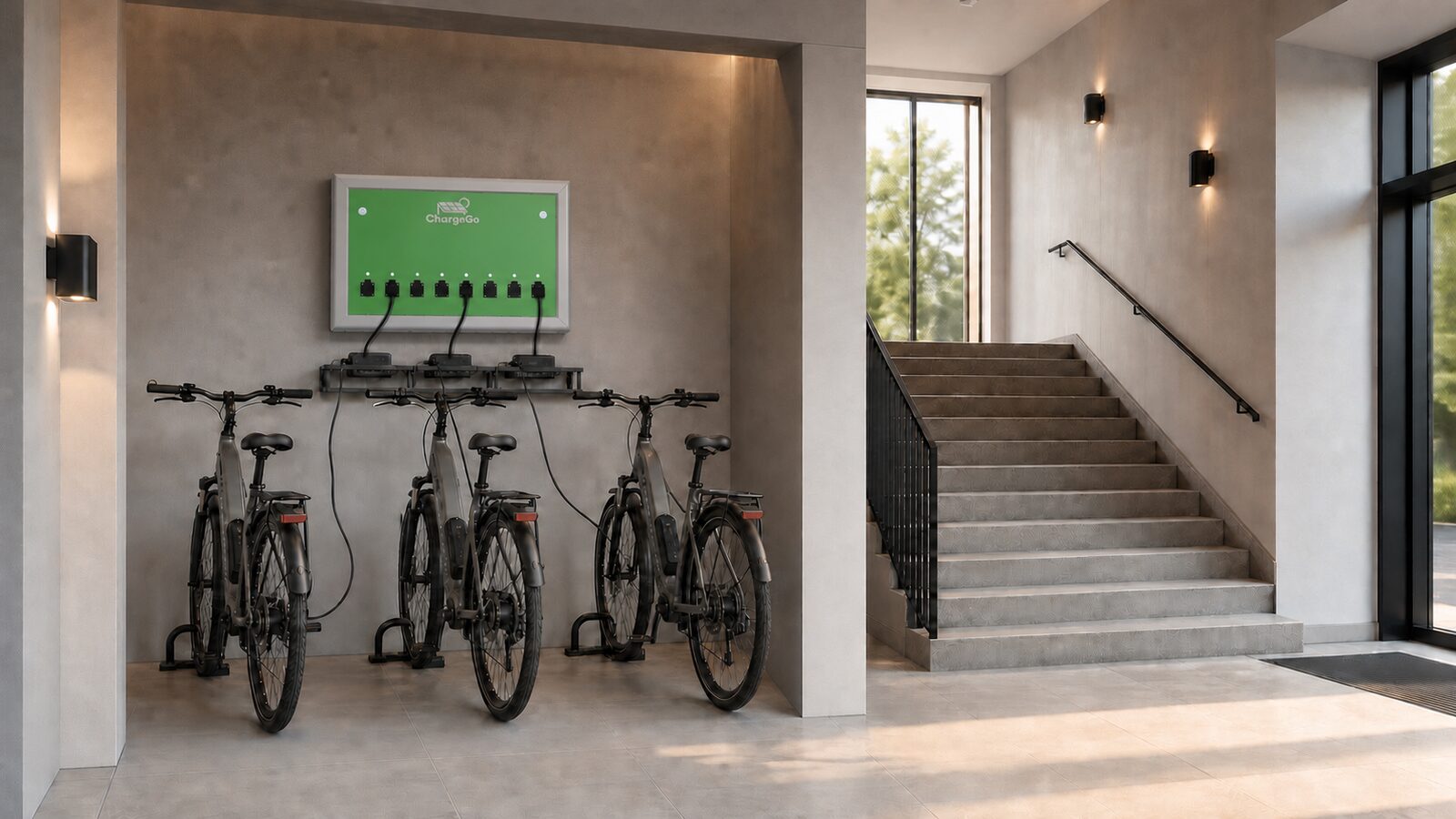
Why charging an e-bike in a block is often a problem
The room exists, but there's no socket. Residents end up carrying the battery up to the apartment or down to the basement.
Approving an individual connection means another cable running through the shared areas.
Without metering, usage can't be attributed to one person, so the cost ends up in the shared-area bills.
It's unclear who should raise it, who to raise it with, and what to bring.
One installation can serve several residents
You don't need a separate cable run from each apartment. If the building's electrical setup allows it, the ChargeGo Box runs on one shared circuit, and each user gets their own access with their energy use metered separately.
Every apartment means a separate wiring job, a separate approval, and another cable through the shared areas.
ChargeGo Box
A wall-mounted station for shared e-bike charging in multi-family buildings. Made in Poland — construction, electronics and software.
- charging points
- 8
- Power supply
- one 230 V / 16 A circuit
- Per charging point
- 2 A (~460 W)
- Sockets
- Schuko with contact shutters
- Dimensions
- 770 × 450 × 160 mm
- Mounting
- wall-mounted, indoors
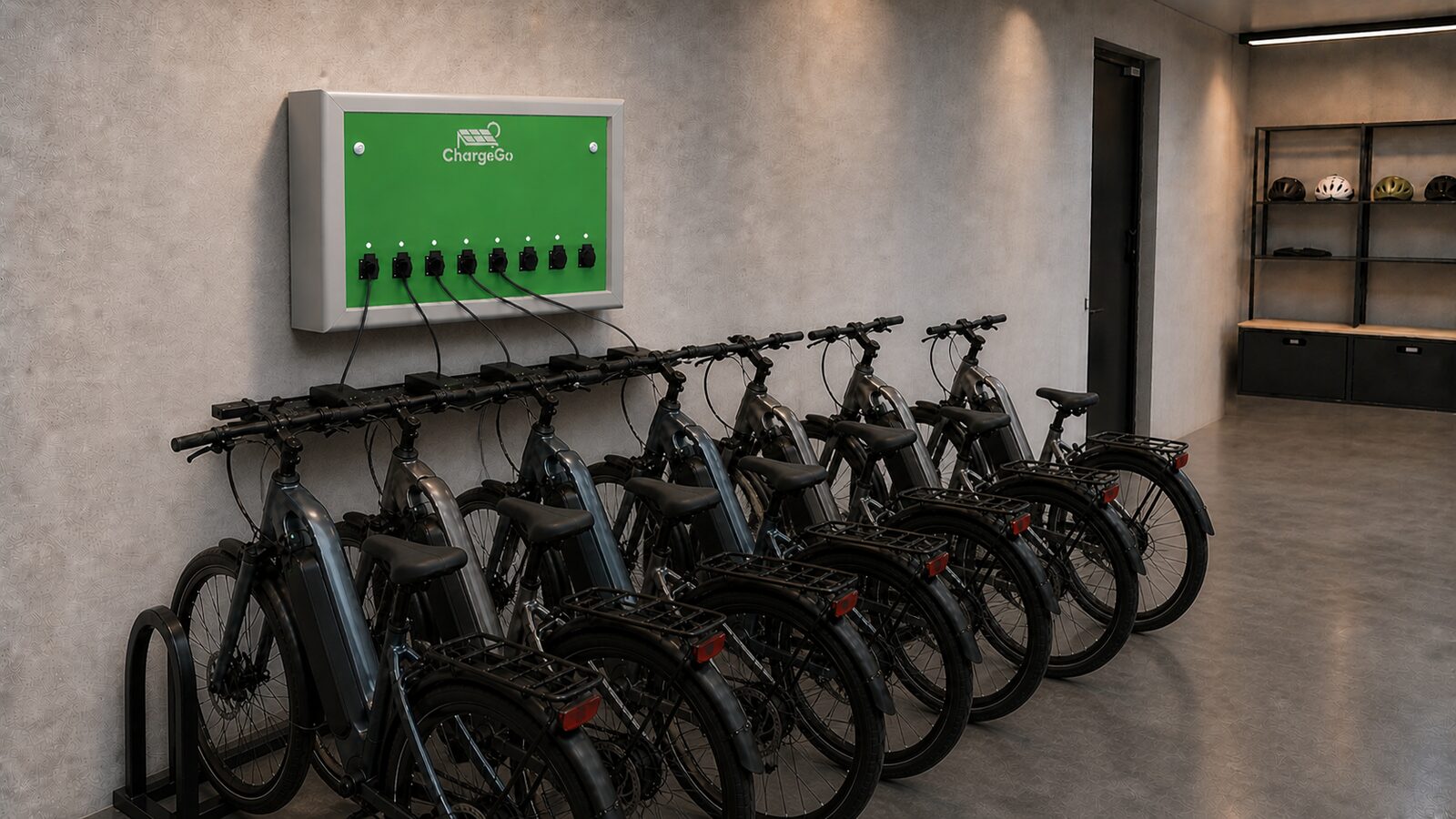
How you use the station
The same one you use at home. No new equipment to buy.
From the phone app, or with a code at the socket.
In the designated spot, on the building's dedicated circuit.
Separately for your charging point and your account.
Access to a charging point is granted to one specific person.
Measured separately at every charging point and for every user.
The building can leave charging free, or bill for the energy used.
Enforced electronically at every charging point.
Residual-current, overcurrent and surge protection inside the enclosure.
Who has access, what's happening at the station, and how much energy was drawn.
For owners' associations and housing cooperatives
What will the owners' association ask?
You don't have to convince the board of a specific device on your own. The materials you get after sending us your building details answer the questions they'll ask.
The State Fire Service recommends charging with the original charger and advises against extension cords and power strips.
Here, charging runs on a dedicated circuit, with protection built into the unit's enclosure and a fixed power limit at every charging point. An alarm panel with a smoke detector can be added as an option.
What happens after you send us the details
- 1Send us a few details about your building
You answer five simple questions. No installation documentation needed.
- 2We send you the materials
A ready-to-send message for the building manager, a sample letter as a PDF, and a data sheet.
- 3You hand them to the building manager
By email from your own address, or as a letter.
- 4The building manager decides whether to look into an installation
The decision and the timeline are up to the board or the administrator.
- 5We handle the paperwork with the building manager
If they get in touch with us, we work out the technical terms and prepare a quote.
Note: we don't contact your building manager on your behalf. You hand over the materials yourself, and they can get in touch with us directly.
Is my building suitable?
Usually it's enough that the building has a shared bike room or a section of the garage where charging points can be set up. The options depend on the existing electrical installation and site conditions.
You don't need the building's connected power capacity or its electrical documentation to send us the details.
- •Whether there's a room or a designated area in the garage.
- •How many residents actually want to charge bikes.
- •What electrical supply needs to be brought to the installation point.
- •What to hand the building manager so they can make a decision.
Tell us about your building
Five questions you can answer from memory.