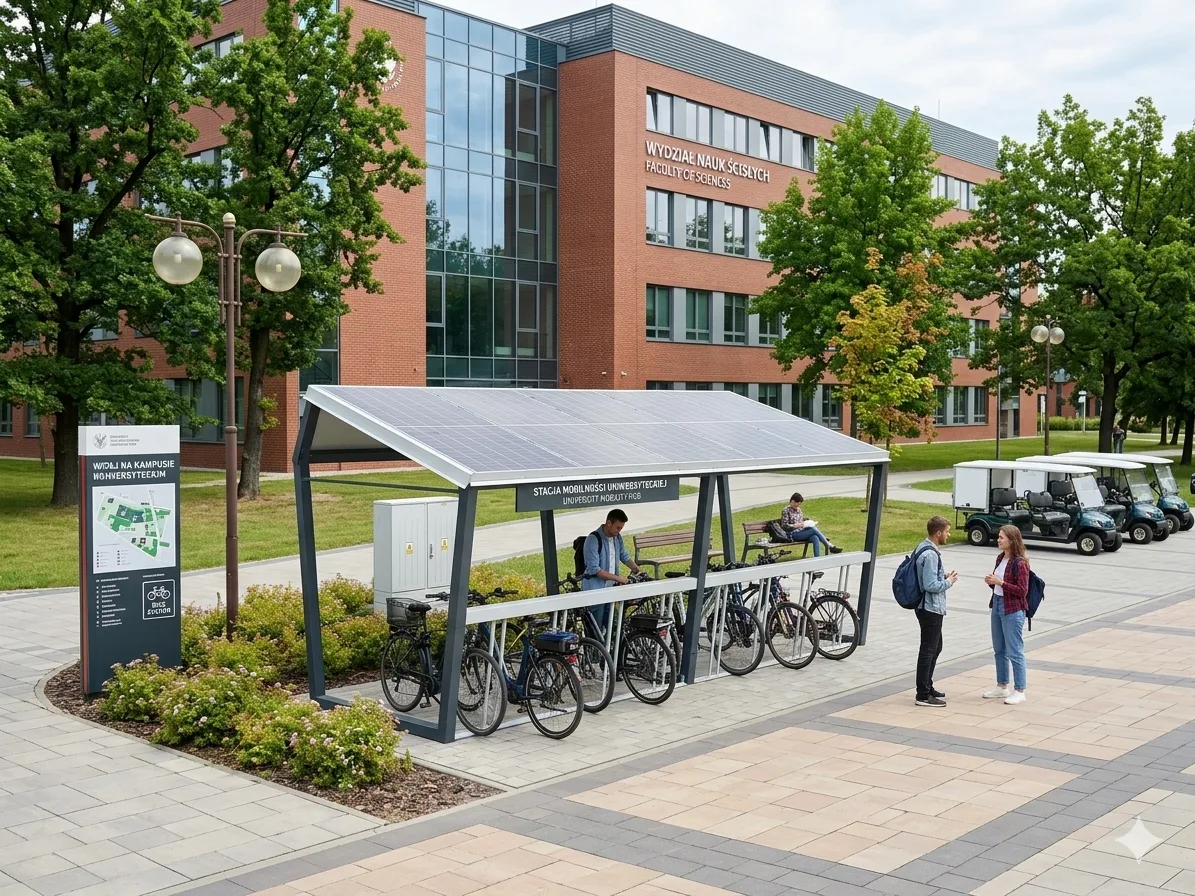
Where are the bikes kept on your campus?
Everything else is the same in both cases: a mobile app, a QR code at each charging point, a management panel, usage metering at every charging point, and session history.
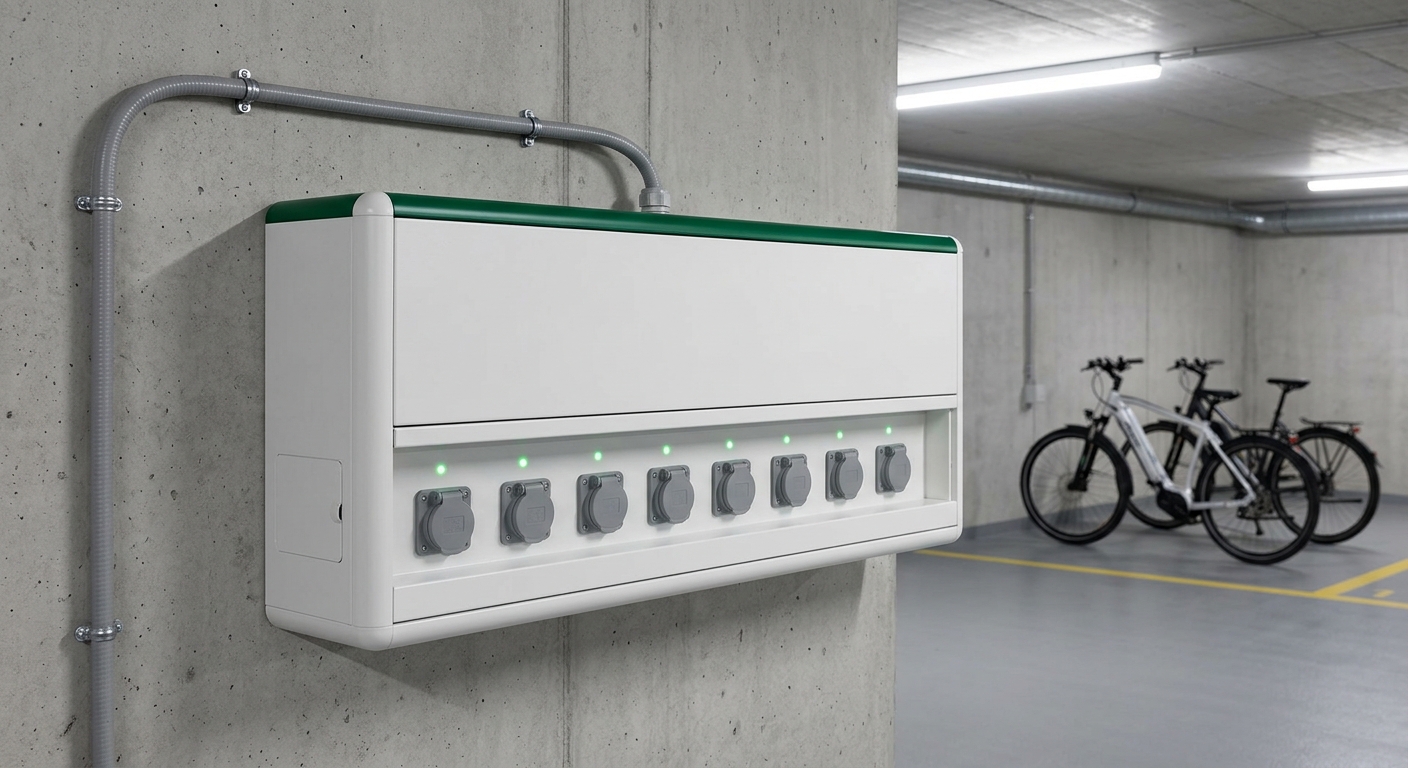
ChargeGo Box
A wall-mounted station. No structure or foundation to build — the unit mounts on the wall of a room where the bikes already are.
- 8 charging points from a single 230 V / 16 A circuit — existing, or run by us
- A 2 A (~460 W) limit per charging point; going over it disconnects that one charging point and flags it in the app, while the others keep charging
- A full set of electrical protection built into the enclosure — nothing to add to the dorm's switchboard
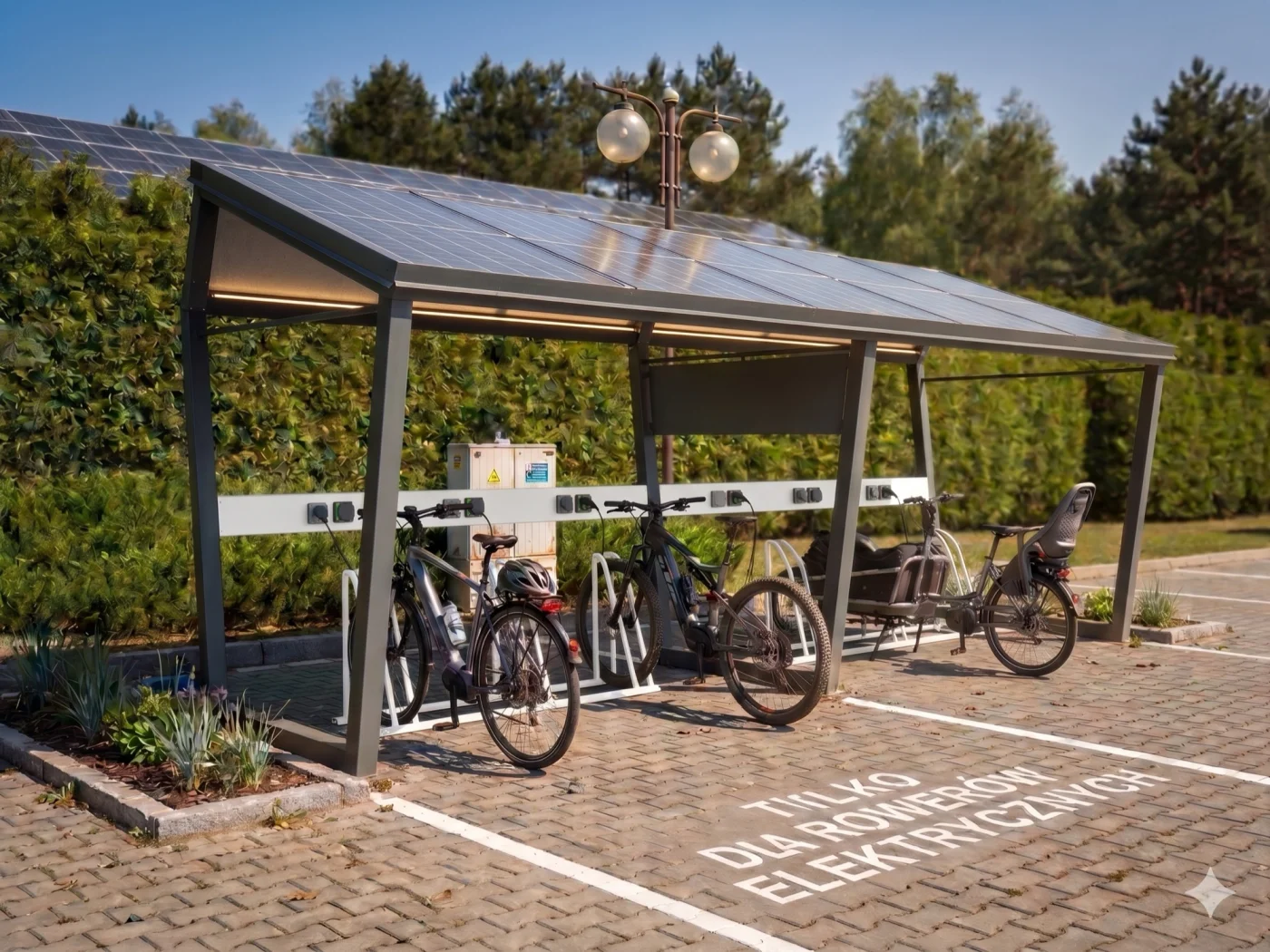
ChargeGo Shelter
A freestanding structure with solar panels on the roof and a battery. It runs with no grid connection, so there's no need to run power to the middle of campus.
- An open shelter with 10 charging points, or a lockable variant with doors and locks — 3 or 6 charging points
- 1.74–3.48 kWp of solar panels and an LFP battery of about 1.8–6 kWh; runs off-grid or in hybrid mode
- 230 V Schuko sockets with power metering at every charging point; going over the set threshold disconnects just that one charging point. Total power drawn across all charging points is capped by a 3,000 VA inverter
A Box in the dorm, a shelter by the main building
Dorm residents' bikes are kept in the bike room, so the ChargeGo Box goes there: a wall and a locked room are already in place. Bikes of people commuting from the city stay outdoors at the entrance to the teaching building, so the shelter goes there and needs no grid connection. A single panel covers both units, so the university does not run two separate systems. You can start with one dorm and add locations later.
For campus facilities teams
Where this goes on campus
These are the places on campus where universities most often start.
Access, the app, and billing
Both linesThe software layer is shared across both lines — a dorm with a Box and a campus with a shelter are managed from the same panel.
Integration with the university's own access-control system (a student ID card, for example) is worked out individually with the IT department — we confirm the scope before quoting.
What it costs on campus
The two lines are priced differently. The Box has a list price per unit; the shelter has a range that depends on configuration and the number of locations.
ChargeGo Box — bike room or garage
ChargeGo BoxFor the unit: 8 charging points, software, the management panel and the app — no subscription, no time limit. On the university's side: a wall and a 230 V / 16 A circuit run to it.
Optional subscription: Cloud €10/month, Billing +€7/month. Without it, the station keeps working — the subscription covers remote access and billing.
- Installation€420 excl. VAT
- Commissioning with staff training€350 excl. VAT
- Charging point signage€140 excl. VAT
- RAL colour instead of white€140 excl. VAT
- 7-year warranty instead of 5€470 excl. VAT
A typical dorm: one Box per bike room. Additional rooms mean additional units — one shared panel, with no per-user fees.
The shelter on campus grounds — price ranges
These ranges apply to the outdoor line only. An individual quote follows within 1–2 business days.
Lockable shelter by a dorm
- Doors and locks — the bike stays overnight
- Power metering at every socket
- App, QR code and panel
Open shelters by buildings
- Runs off-grid or in hybrid mode
- One shared panel for all locations
- Per-user session history
Campus or tech park
- A mix of open and lockable variants
- One panel for the whole campus
- Technical data for certification documentation
These are indicative ranges, based on 2025/2026 market prices for smart bike shelters. Final pricing is quoted individually within 1–2 business days. Shown in EUR at an indicative exchange rate; invoices are issued in PLN.
Get a quote for your locationCertifications and programmes for universities
If a university building is certified under BREEAM or LEED, the bike-facility criteria can be addressed by either line — a Box in the building's bike room, and a shelter on the grounds. Only the shelter contributes a renewable energy source, since it is the only one with solar panels and a battery. The project's assessor confirms the actual score.
BREEAM (Tra)
e-bike specificNew and renovated buildingsCyclist Facilities for students and staff: the ratio of bike spaces to users, lighting, security, e-bike charging. Facilities inside a building are covered by the Box, outdoor ones by the shelter.
LEED v4.1
cycling infrastructureLT — Bicycle FacilitiesSupports the credit for buildings targeting LEED. The requirements cover access to the bike network and facilities for building users — a parking space with charging counts, whether it's indoors or outdoors.
ActiveScore
e-bike specificActive transport in buildingsRelevant for teaching buildings and dorms, where the facilities inside the building are assessed. A bike room with charging is a direct fit for the ChargeGo Box.
Cycle Friendly Employer
cycling infrastructureBike-friendly employerThis applies to the university as an employer of academic and administrative staff. Charging infrastructure in the garage under a building, or by the entrance, supports the certification.
Municipal SUMP
cycling infrastructureCity collaborationCampuses in city centres fit into municipal sustainable mobility plans — charging points are part of the shared cycling infrastructure.
Sustainability reporting
indirect / ESGPublic universitiesThe panel provides data: session counts and energy use per charging point, and for the shelter, solar output as well.
Note: the certificate is awarded to the building. ChargeGo supports the criteria, and an assessor or certification consultant confirms the final qualification.
Full system mapQuestions from campus estates teams
A quote for your university
Tell us where the bikes are kept today — a dorm bike room, a garage under a building, or outdoors — and how many locations you're considering. We'll reply with a specific setup within 1–2 business days.