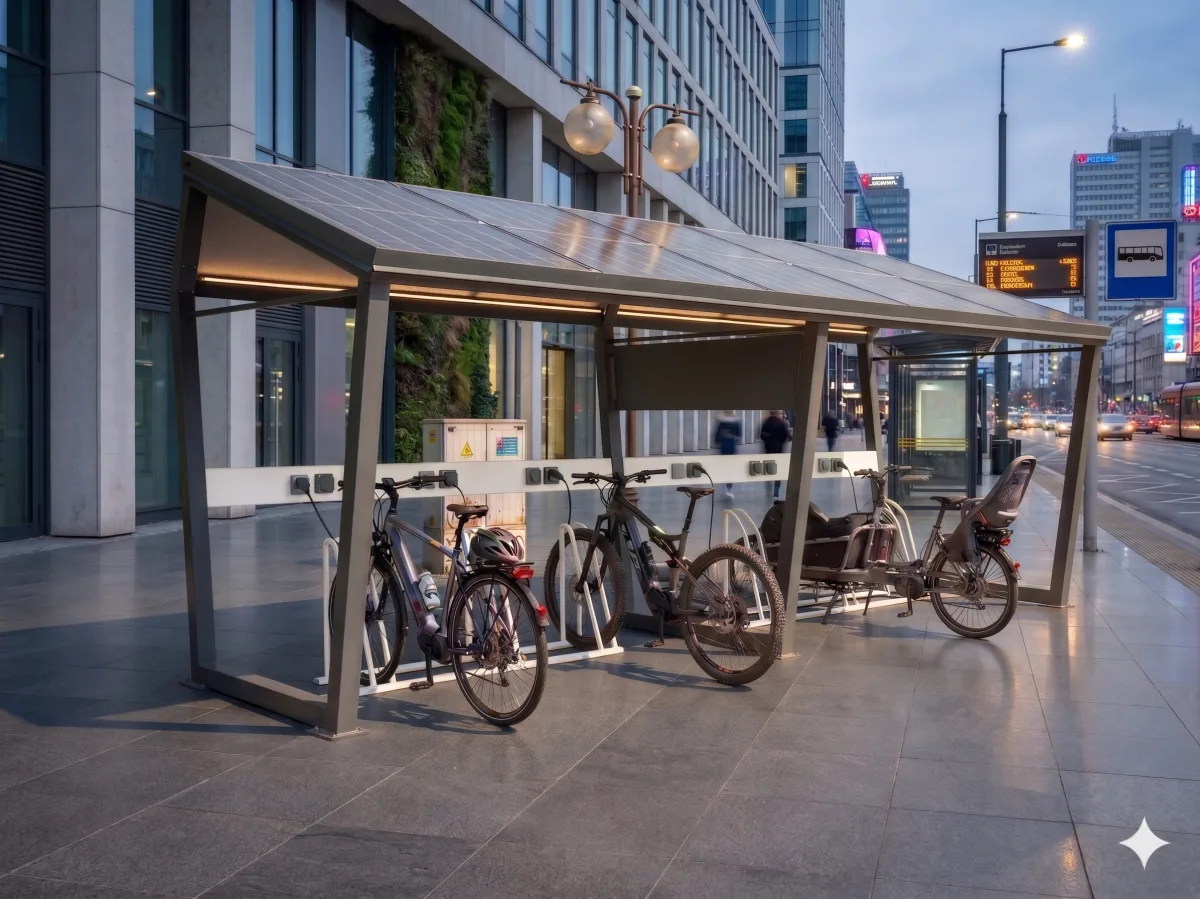
A bike shelter for cities — a charging station open to the public
A solar bike shelter as public infrastructure. In the standalone configuration it runs on its own solar panels and battery, so it needs no grid connection and no energy supply contract. Administrators set access in the panel: open to everyone, or limited to named users.
The case for a municipal shelter
Covered charging points are cycling infrastructure, so they fit into municipal mobility plans and climate documents. A shelter can go by a transit stop, in a park, or along a trail — including places with no grid connection.
Residents also submit shelters to participatory budgets, and we have a ready participatory budget project template covering what such an application has to include. Rules differ between cities, so check your city's current rulebook before you file.
Running costs on the city's side are low. In the standalone configuration there is no energy bill and no contract with a grid operator. Users operate the shelter through the app, so staff hand out and collect nothing. What remains is inspection and panel cleaning.
What programmes can fund a bike shelter?
A shelter spans two categories: cycling infrastructure and renewable energy. The rulebook of a specific funding round decides eligibility. Programmes that fund this kind of infrastructure:
FEnIKS (EU Funds for Infrastructure, Climate, Environment)
Covers urban mobility and cycling infrastructure. Funding up to 85% of eligible costs for projects that fit into SUMP (Sustainable Urban Mobility Plans) — the level and availability depend on the currently open funding round, so check current terms.
Regional Operational Programme — climate and mobility measures
Each Polish voivodeship runs its own funding rounds. A bike shelter qualifies as part of a micromobility system and CO₂ emission reduction.
Mój Klimat (National Fund for Environmental Protection)
A programme for Polish municipalities on climate action. A shelter with solar panels fits both the renewable-energy category and cycling infrastructure — the eligible cost scope is set by the funding round's rulebook.
National Recovery Plan — green transition component
Poland's National Recovery Plan includes funds for e-mobility and micromobility. The scope of eligible spending depends on the specific funding round — check the current documentation.
City participatory budget
A shelter can be submitted as a resident project. Rules differ between cities — check the funding cap, the requirement that the site sit on municipal land, and how maintenance costs are treated in your city's current rulebook.
Information current for 2026, based on publicly available programme documents. Before applying, we recommend consulting your municipality's EU funds office or an advisor.
Benefits for municipalities
No grid electricity cost in standalone mode
In the standalone configuration, the shelter powers its charging points from its own solar panels and battery, so the city buys no power for the station and signs no contract with a grid operator.
Lower CO₂ emissions
Charging with solar power instead of grid power cuts the CO₂ tied to that charging — the exact amount depends on the carbon intensity of the national energy mix that year and the shelter's solar capacity.
Suitable for sites without a grid connection
It needs no grid connection, so it can go by a trail, in a park, or on the edge of a neighbourhood, wherever there is no grid infrastructure.
Public e-bike charging infrastructure
This is a visible investment in public space, available to residents who cycle. Shelters can also be submitted as a participatory budget project if they meet the local rulebook's requirements.
Public information display and city branding
The touchscreen displays city announcements, a cycling route map and city branding. The shelter also works as a channel for communicating with residents.
Data for strategic documents
The panel supplies indicators for reporting under the EU's "100 Climate-Neutral Cities" mission, Climate City Contracts and SECAPs.
Low running costs
No on-site operator is required. Standalone operation avoids grid electricity costs, and the panels only need periodic cleaning.
Modular — easy to expand
You can start with one pilot shelter and grow into a network across the city. The app manages every location at once.
Siting a shelter in public space
Location determines how useful it is. Typical sites for a solar bike shelter in a city:
By train stations and park-and-ride stops
The shelter works as part of a park-and-ride system: residents leave their bike and continue by public transport, and charging runs through the working day.
In city parks and green spaces
A hub for cycling tourism and leisure, with a touchscreen route map and LED lighting for the evening.
Along cycling trails outside the city
A fully autonomous shelter that needs no grid connection. It can be installed at the edge of a forest or along a tourist trail, with no cable to run.
By public buildings
Municipal offices, libraries, sports centres — places where residents spend time and are happy to leave a bike for an hour or two.
In new municipal housing developments
Infrastructure delivered together with the development — an incentive to cycle instead of drive.
By secondary schools and universities
Suitable for campuses and halls of residence with heavy bicycle traffic.
FAQ — bike shelter for cities and public bodies
What programmes fund cycling infrastructure in cities?+
The main sources: EU Funds for Infrastructure, Climate, Environment (FEnIKS), the National Fund for Environmental Protection's "Mój Klimat" programme, Regional Operational Programmes under mobility and climate protection, and funds from the National Recovery Plan's green transition component. Some municipalities fund shelters from their participatory budget — a solar bike shelter is sometimes submitted as a resident project.
Can a bike shelter double as a municipal info point?+
Yes. The shelter's touchscreen displays city branding, announcements for residents, a cycling route map and event information. It runs autonomously and communicates over LTE, so it can be installed where there is no electrical grid: on the edge of the city, along trails, in parks.
Does a bike shelter help a city meet its climate policy goals?+
A shelter is both cycling infrastructure and a source of renewable energy, so it fits both categories in municipal climate documents and mobility plans.
Does the shelter need to be operated by city staff?+
No. The shelter runs autonomously on solar power, controlled by the mobile app, and residents use it on their own. Staff issue no cards and handle no money. Remote monitoring covers status (occupancy, faults), and the solar panels need cleaning once a year, which a standard cleaning contractor can handle.
How much does a bike shelter cost for a city?+
The price depends on the configuration — number of charging points, solar capacity, optional extras (camera, screen, branding). We prepare a quote for a specific location within 1–2 business days. For municipalities we also offer an operating lease — a shelter with no upfront investment, paid monthly from the operating budget.
Indicative budget for a city
Ranges for typical configurations. An individual quote follows within 1–2 business days.
Pilot
- A single unit
- LTE connectivity
- Mobile app
- City branding, RAL colours
City zone
- Placed across a network
- Shared city dashboard
- SUMP integration
- City identity branding
Full infrastructure
- A city-wide network
- Management panel
- Data for SUMP and taxonomy reporting
- Communication materials for residents
These are indicative ranges, based on 2025/2026 market prices for smart bike shelters. Final pricing is quoted individually within 1–2 business days. Shown in EUR at an indicative exchange rate; invoices are issued in PLN.
Get a quote for your locationMobility plans and programmes a shelter fits into
A shelter, as micromobility infrastructure, fits into cities' Sustainable Urban Mobility Plans (SUMP) and qualifies under several funding programmes. Rounds and funding levels depend on the current call, so check before applying.
SUMP
cycling infrastructureSustainable Urban Mobility PlanA shelter as micromobility infrastructure, complementing cycling routes and integrating with public transport and interchange points. It fits into cities' strategic plans.
EU Taxonomy 6.13
e-bike specificEU · green assetsA shelter qualifies as infrastructure dedicated to cycling (including e-bikes). A green asset in a municipal portfolio — valuable for reporting and financing.
FEnIKS 2021–2027
indirect / ESGTransport / climatePoland's largest EU programme, covering low-emission transport and urban mobility. The maximum funding level for public bodies depends on the specific round.
National Recovery Plan — green transition of cities
indirect / ESGBGK loanFinanced from Poland's National Recovery Plan. A shelter counts as part of the green transition of municipal infrastructure.
Regional Operational Programmes
indirect / ESGUrban mobility — ITIMeasures under Regional Operational Programmes (example: EU Funds for Pomerania — "Urban mobility — ITI"). Requirements and allocations depend on the voivodeship.
NFOŚiGW · micromobility programmes
indirect / ESGTargeted fundsDedicated calls for cycling infrastructure and renewables. We help with the shelter's technical description for the application — check the current call first.
Note: the certificate is awarded to the building. ChargeGo supports the criteria, and an assessor or certification consultant confirms the final qualification.
Full system mapQuestions from municipal offices
Ready for a pilot in your city?
Describe your needs, location and funding programme — we'll prepare materials for your application.