Solar charging station for electric bikes
Stands where there is no power. Charges two bikes from its own panel.
ChargeGo Pole is a free-standing unit 2.8 m tall. A photovoltaic panel on the mast, a LiFePO₄ battery inside the body, two 230 V sockets and four USB ports on the door. The service version adds a tool set on a steel cable and a compressor rated to 8 bar.
Installation means anchoring it to a foundation. No grid connection, no connection conditions, no contract with a distribution operator. Price from €4,600 excl. VAT.
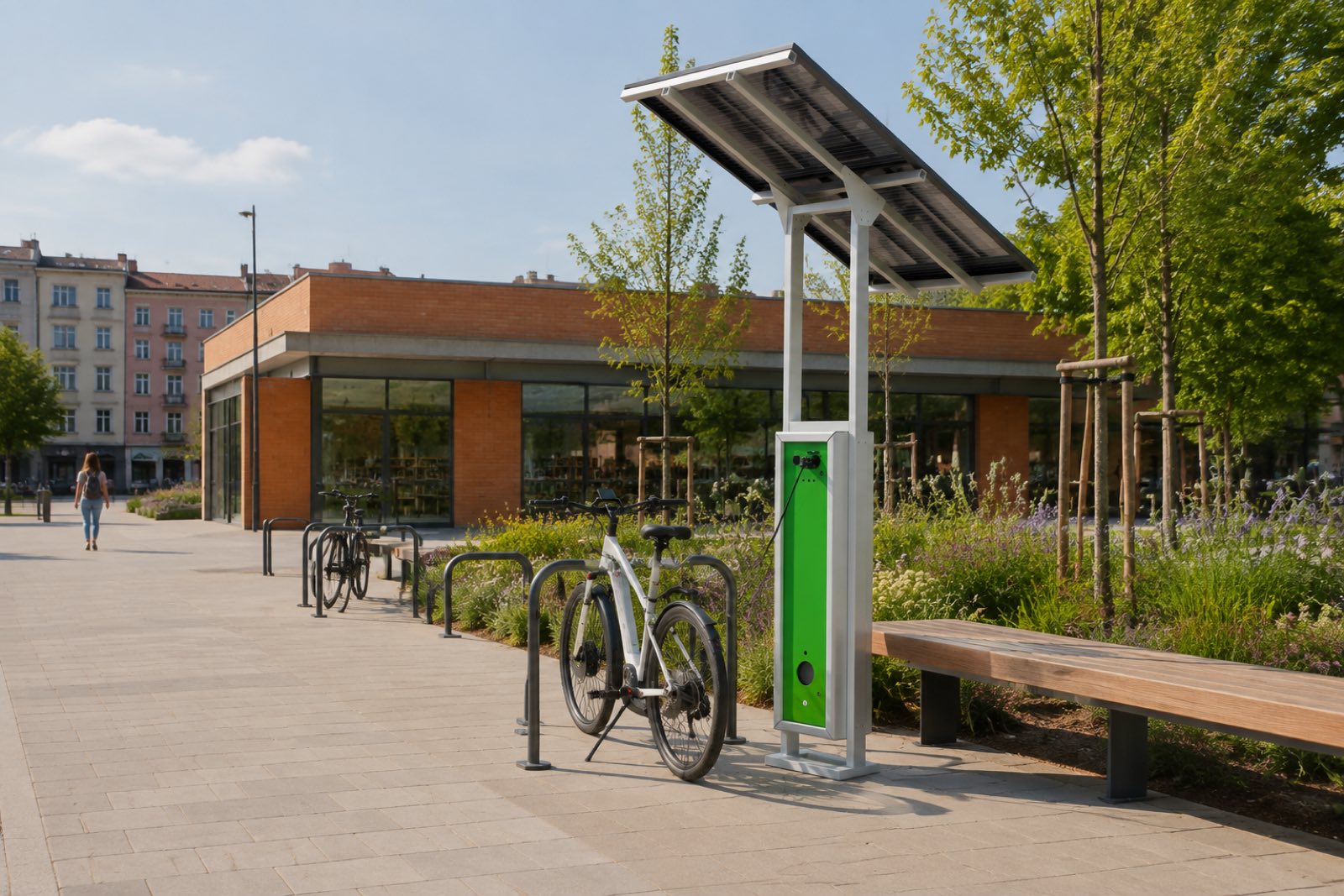
What the unit contains
A mast carrying the photovoltaic canopy and a body with a service door. All user-facing hardware sits on one face, at hand height.
A canopy of 1.80 × 0.97 m at 25 degrees, lower edge 2.03 m above ground. The panel also shelters the charging point beneath it.
Lithium iron phosphate cells, 12 V / 80 Ah, managed by a BMS. A lead-acid battery of the same nominal capacity safely gives up about half its charge; LiFePO₄ gives about 90 per cent.
Schuko with a hinged cover, IP44, at 1231 mm above ground. Up to 300 W per socket, which covers every bike charger including fast-charge mode.
Up to 3 A, at 1150 mm. Phones, navigation units, lights and power banks charge independently of the 230 V sockets.
Adjustable spanner, hex keys, Torx keys and screwdrivers. The cable keeps the set at the station and still reaches a bike parked alongside.
Built into the lower body, with the pressure gauge on the door face. Inflates road, trekking and city tyres from one source.
Three versions on one structure
The same frame, mast and electronics. They differ in what sits on the door face and in panel output.
- •Two charging points, two 230 V sockets
- •Four USB ports up to 3 A
- •600 Wp bifacial panel, 1 kWh battery
- •App, QR code and Bluetooth
- •Everything in Pole 2
- •Tool set on a steel cable
- •Electric compressor rated to 8 bar
- •Pressure gauge on the door face
- •One 230 V socket
- •Four USB ports and two 5 W Qi chargers
- •200 Wp panel, 1 kWh battery
- •Same structure and warranty
Prices are for the unit, excl. VAT. Foundation, installation, commissioning and labelling are quoted separately.
Sites that suit the station
Anywhere running a cable costs more than the unit itself, or where there is nothing to dig up.
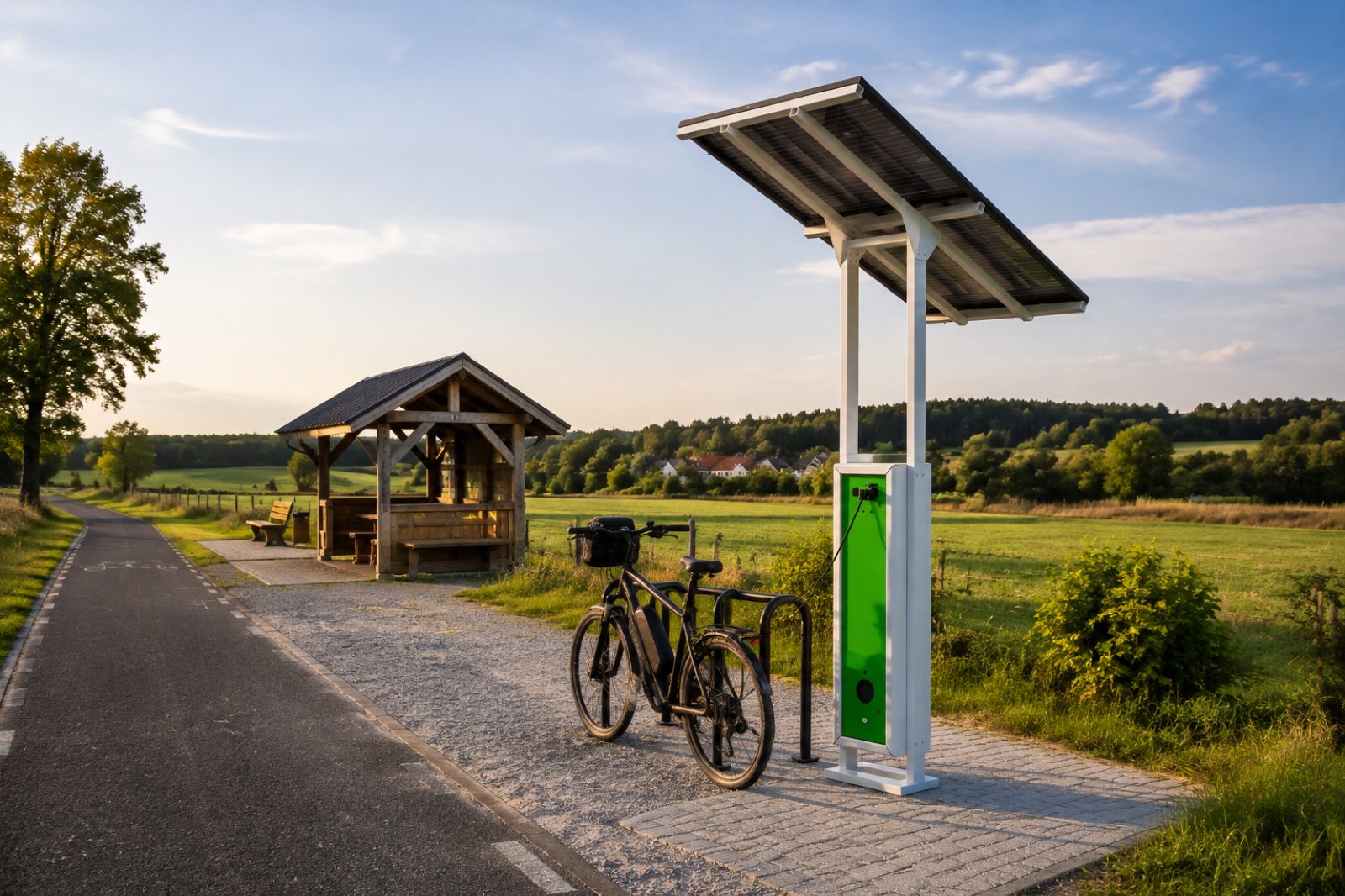
The furthest point from any grid connection. The service version combines charging, tyre inflation and minor repairs at one stop on the route.
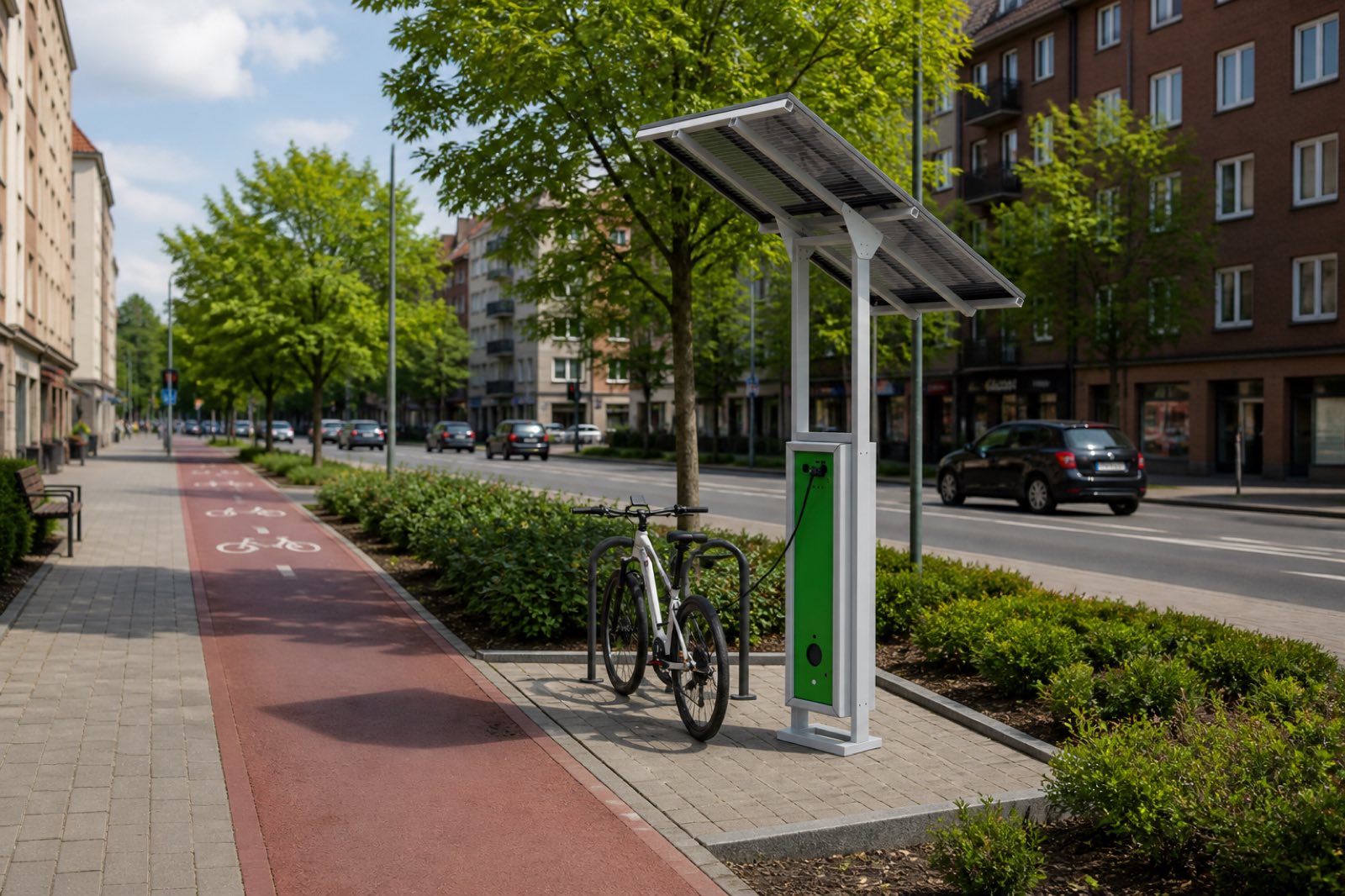
Anchored into the pavement, 1.03 m across in plan. It fits the planting strip beside the path without narrowing the cross-section.
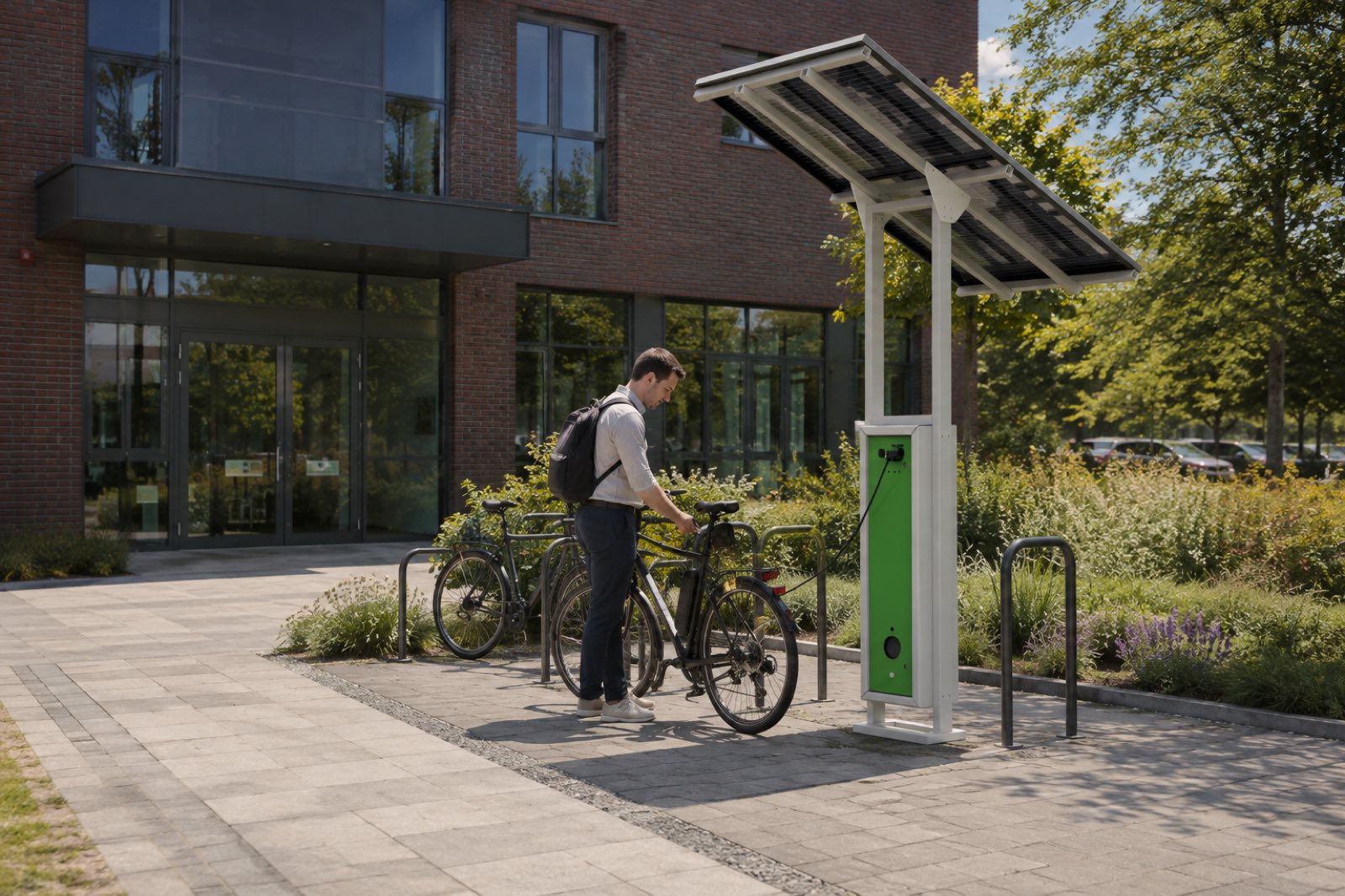
Placed by the racks, on the route from the gate to the entrance. The control panel shows who used a socket and for how long.
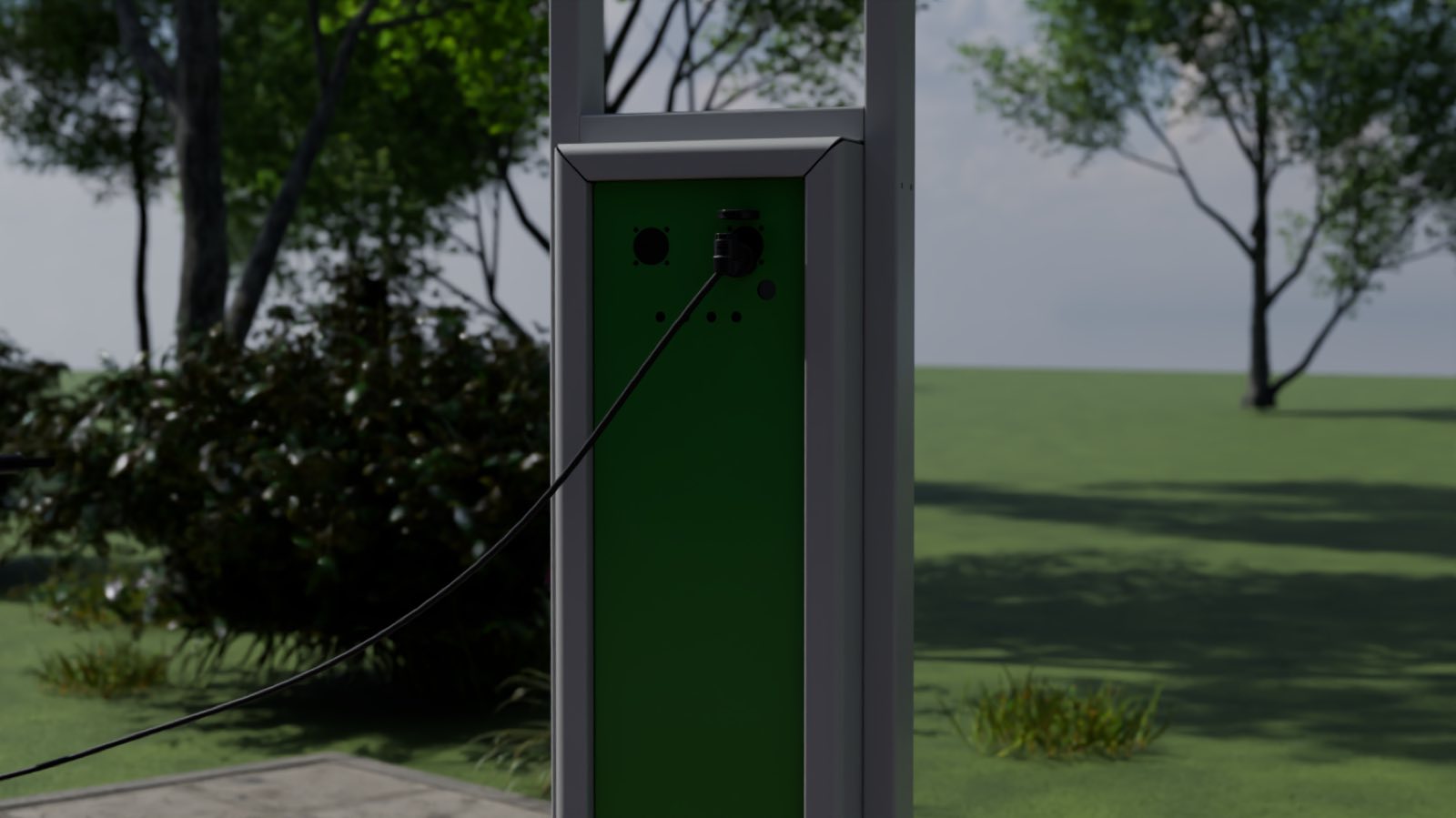
No excavation for a supply cable and no changes to existing lighting. Structure finished in a colour from the RAL palette.
Off-grid as standard, mains as an option
The station runs on its own panel and battery, which shortens the project to pouring a foundation and bolting the unit down.
A bifacjalny 600 Wp panel charges the 1 kWh battery. The electronics cap draw on each socket separately, so two bikes plugged in at once cannot empty the battery faster than the panel refills it in season.
No application to the distribution operator, no supply contract and no meter. The unit is not a consumer under a utility agreement.
Up to 300 W per charging point. An electric bike charger draws from 84 W in slow mode to roughly 250 W in fast mode, so the cap constrains neither.
Where traffic is heavy or the site runs through winter, the station accepts mains power and treats the panel as a supplementary source.
Five-year warranty to at least 80 per cent of capacity and over 4000 cycles. The same battery as in the ChargeGo Shelter.
Who may charge, and how that is recorded
The station can be open to everyone or restricted to named users. Administrators switch between the two in the control panel. It is the same platform that runs the ChargeGo Shelter and the ChargeGo Box.
iOS and Android. The user sees a free socket and starts a session.
A sticker on the door face. Works without creating an account.
Starts a session on site where the location has no mobile coverage.
The socket stays live with no authentication, if the owner chooses that.
What can be added
All options are factory-fitted. The choice follows the site and the way the station is meant to be billed.
Hybrid operation: mains tops up the battery in winter and under heavy use, the panel carries the rest of the year.
Two 600 Wp bifacial panels on a widened canopy, for sites in use all year.
2 kWh instead of 1 kWh, for a larger reserve on overcast days and evenings.
A luminaire under the canopy with a dusk sensor, lighting the door face and the space by the rack.
A meter on each socket, giving a basis for charging a tenant, an employee or a guest for the energy used.
Matched to street furniture on site or to conservation guidance.
Funding programme logos, manufacturer name, unit type, serial number and rating data.
For municipalities and contracting authorities
In Poland solar bike charging stations are bought mainly through public tender, often with EU funding. The tender documentation is ready.
In this category the warranty period is often the second award criterion after price, and 60 months is usually the top-scoring tier. For us that is the standard period, not a surcharge.
Chargers. Plus 34432000-4, bicycle parts and accessories, where the service module is in scope.
A ready passage for the description of the subject of the contract, written without naming a brand.
Datasheet, user manual, rating plate, commissioning report and operator training on site.
What the station costs
The two-point version costs from €4,600 excl. VAT. Below is the scope, so the quote compares like for like with competing offers.
- •Structure, mast, canopy and base plate
- •Photovoltaic panel and LiFePO₄ battery
- •230 V sockets, USB ports and control electronics
- •App, QR code, Bluetooth and control panel
- •Five-year warranty
- •Datasheet and user manual
- •Foundation and anchoring on site
- •Transport and installation
- •Commissioning, measurements and reports
- •Labelling and RAL colour finish
- •Options listed above
Data for the design
Dimensions come from the CAD model, not from catalogue rounding. Design offices receive the model and a technical description for the specification.
Questions we are asked most often
Three products
Shelter outdoors, Box in the garage, Pole by the path
Three different units, not three versions of one. The Shelter is a free-standing structure with photovoltaics and a battery, covering up to ten bikes. The Box mounts on a wall and draws power from the building. Pole stands on its own, serves two charging points and runs off its own panel. What they share is the software: the app, the control panel and the way access is granted.
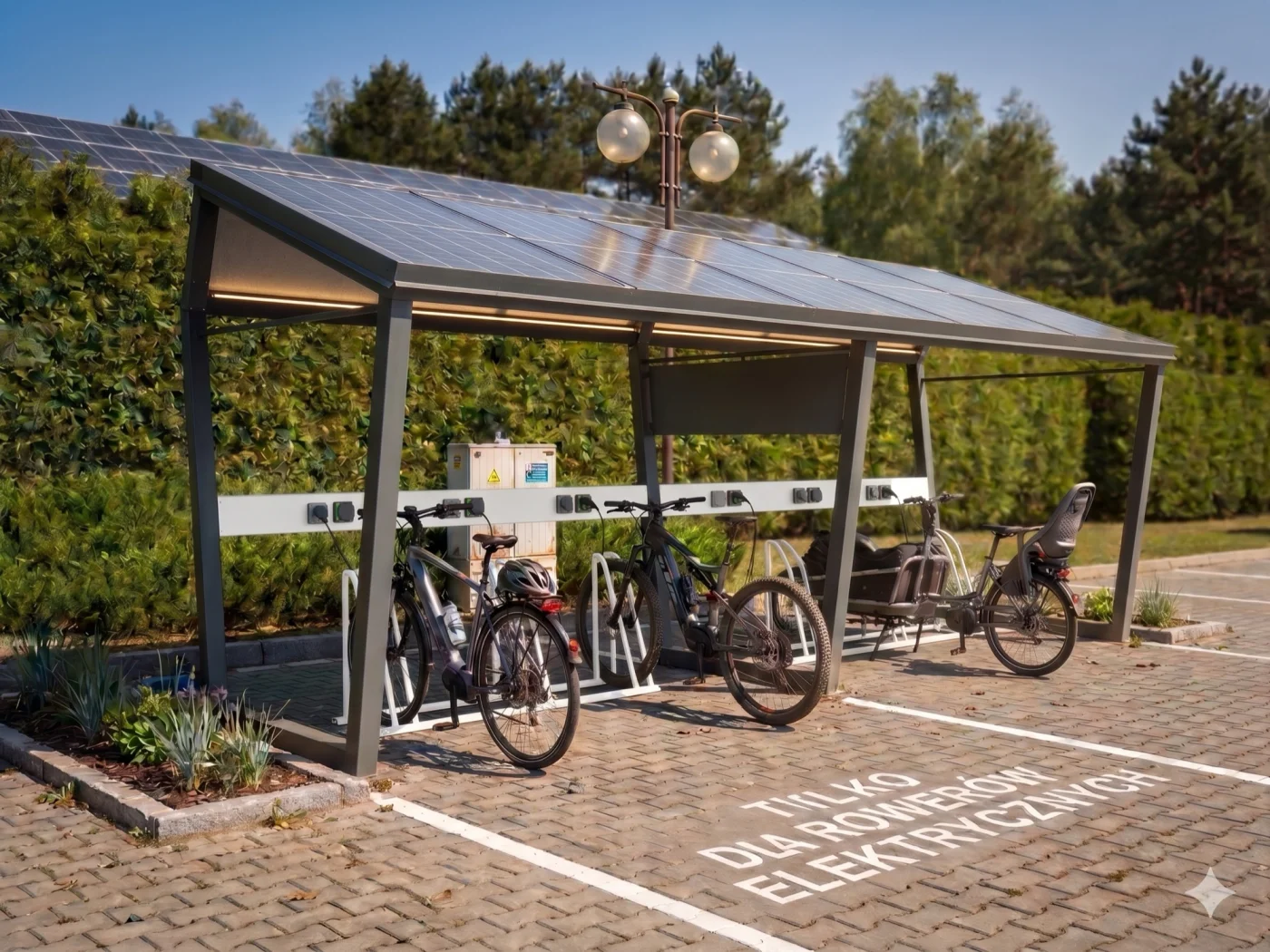
ChargeGo Shelter
A freestanding structure with rooftop solar and a battery. It runs with no grid connection: in a car park, in front of a hotel, on a housing estate or along a bike trail.
- 10 charging points (open), or a lockable Shelter with doors, locks and 3 or 6 charging points
- 1.74–3.48 kWp solar + LFP battery, 24/7 off-grid operation
- From €18,500 excl. VAT
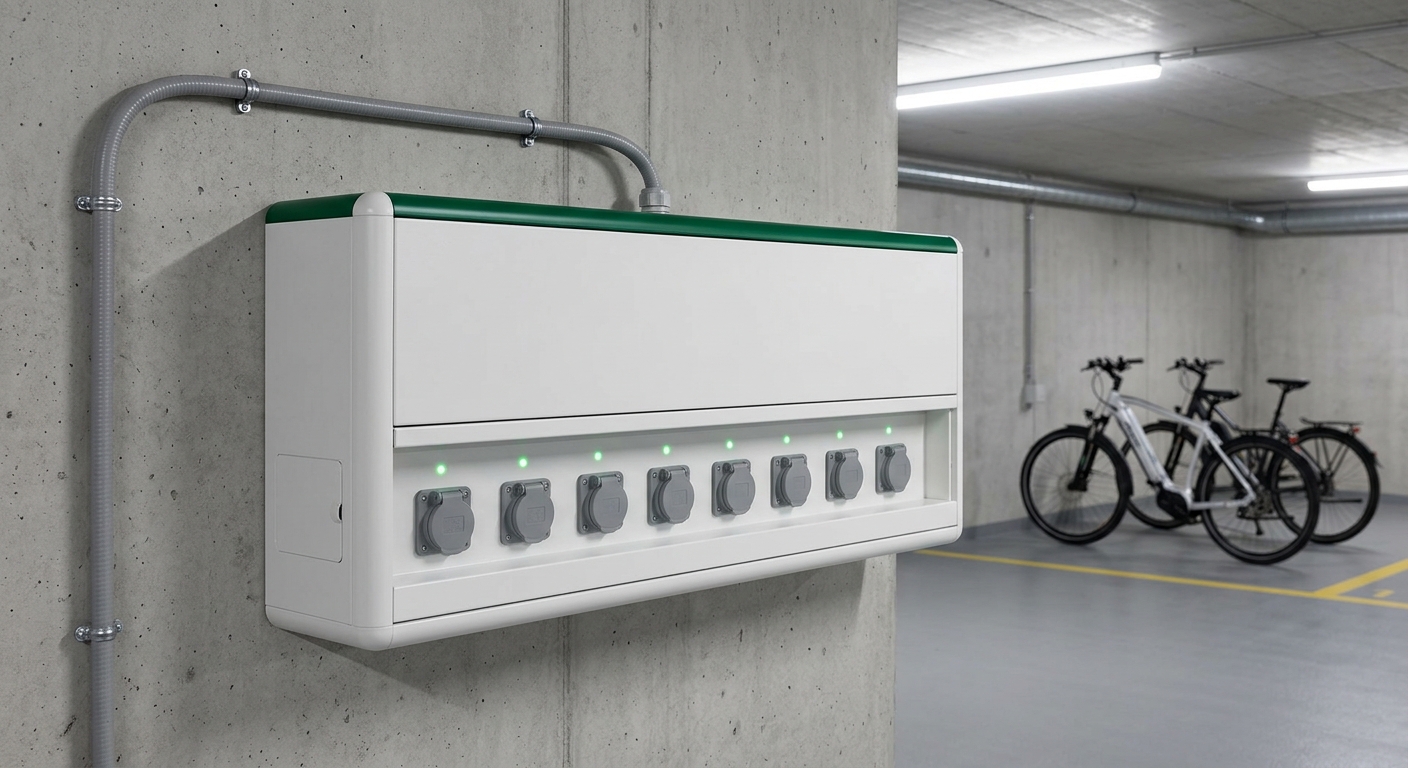
ChargeGo Box
A wall-mounted station for an underground garage, bike room or hall. No structure or foundation to build; the unit mounts on an existing building's wall, typically without a building permit or notification.
- 8 charging points powered from a single 230 V / 16 A circuit
- IP44 sockets with covers, energy metering on every charging point
- Started from the mobile app, or optionally a PIN code or RFID card
ChargeGo Pole
A free-standing solar station 2.8 m tall, anchored to a foundation. Panel on the mast, battery in the body, sockets on the door face. It goes beside a cycle path, on a square or out on a route, where there is nothing to dig up.
- Two 230 V sockets and four USB ports, up to 300 W per charging point
- 600 Wp bifacial panel and 1 kWh LiFePO₄ battery, runs with no grid connection
- Service version with tools and a compressor rated to 8 bar