Electric bike charging station
A place where several electric bikes charge from 230 V sockets, with power metering on every charging point, app-based access control and protection built into the equipment. ChargeGo builds this station in two versions: wall-mounted for indoors and freestanding for outdoors. Which one fits depends on where the bikes are kept, inside the building or outside.
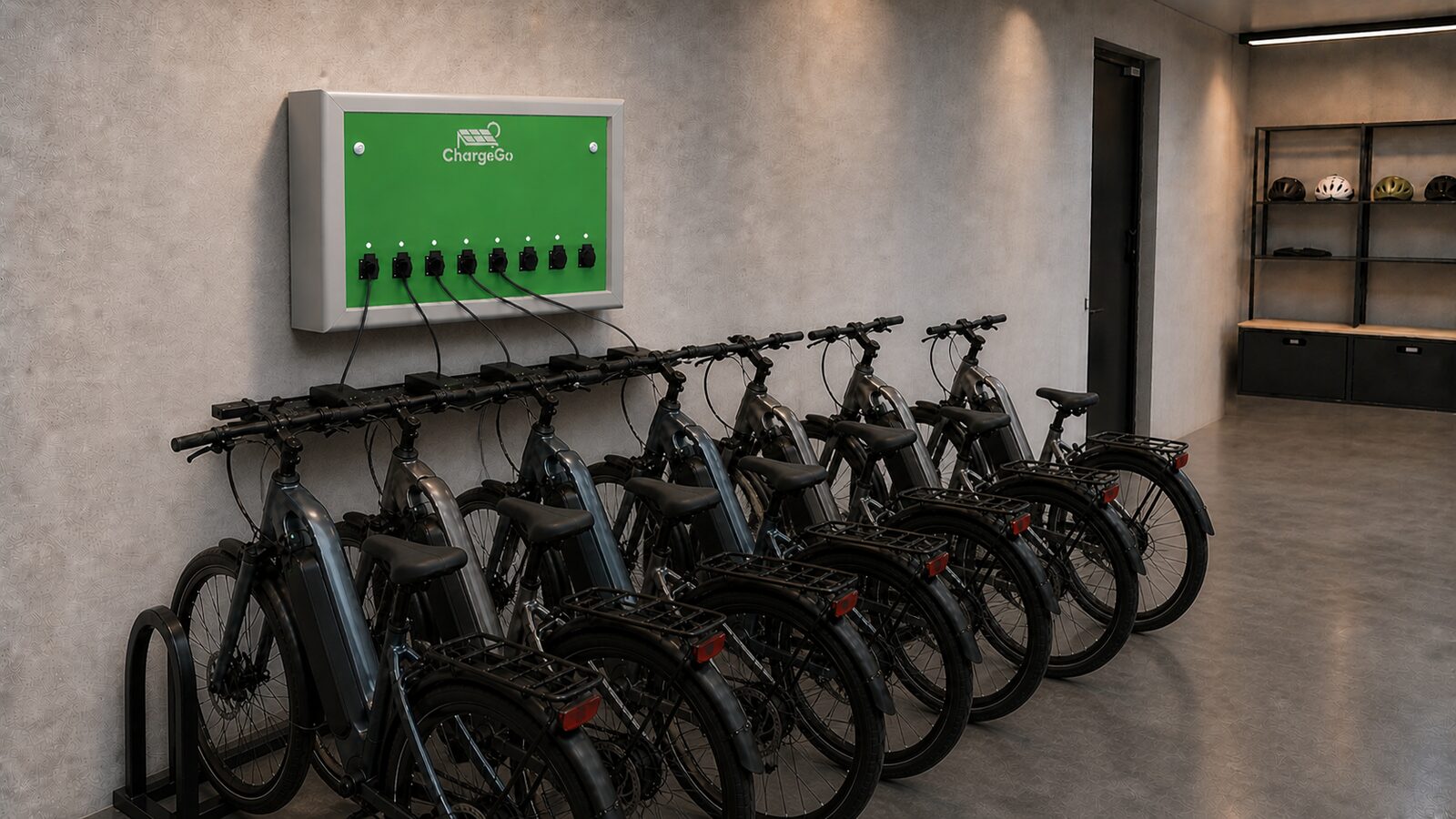
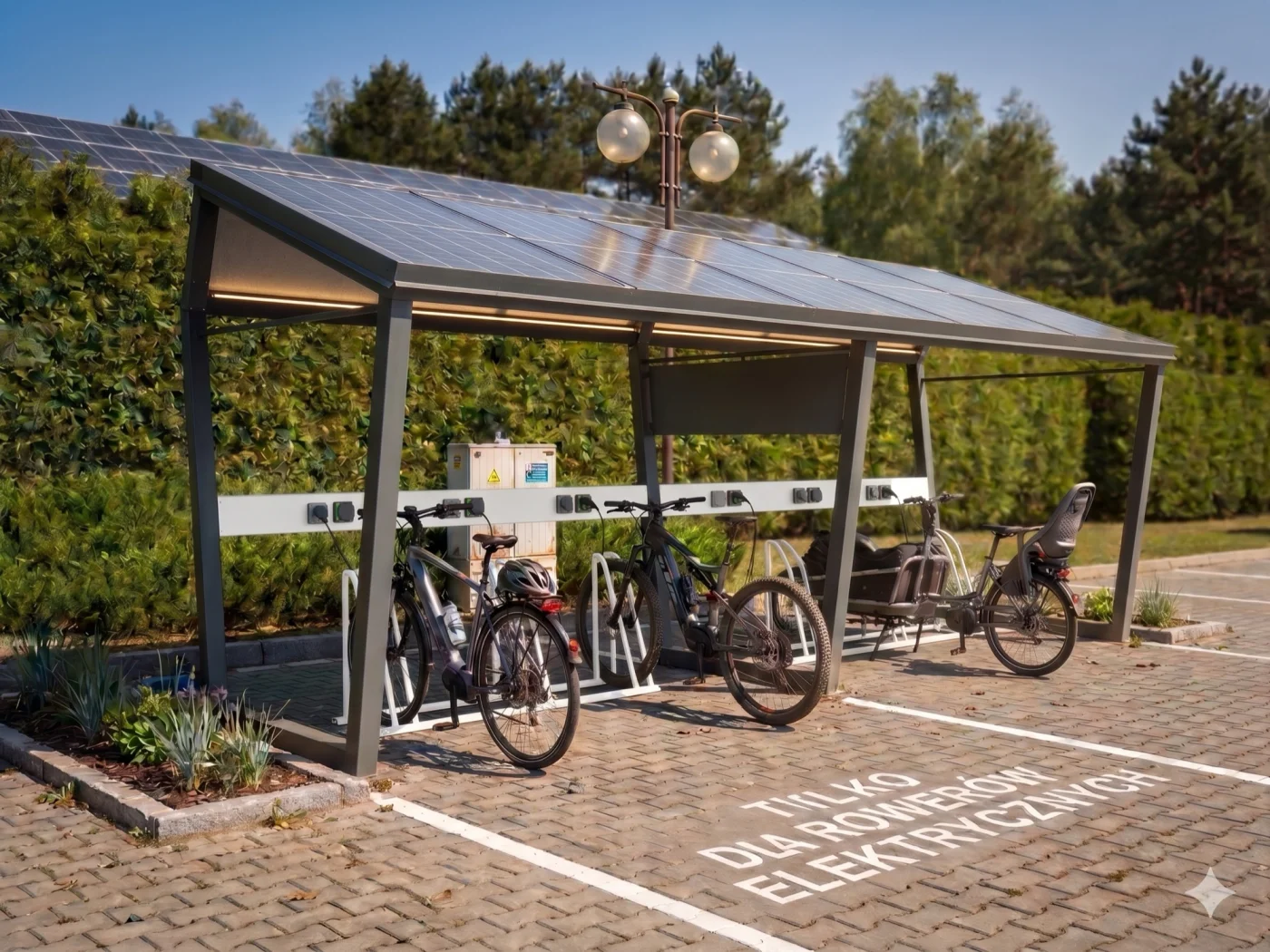
Two versions of the same station
Where are the bikes kept, inside or outside?
The app, QR code, per-charging point power metering and admin panel are the same in both versions. Mounting, power supply and the size of the investment differ.
ChargeGo Shelter
A freestanding structure with rooftop solar and a battery. It runs with no grid connection: in a car park, in front of a hotel, on a housing estate or along a bike trail.
- 10 charging points (open), or a lockable Shelter with doors, locks and 3 or 6 charging points
- 1.74–3.48 kWp solar + LFP battery, 24/7 off-grid operation
- From €18,500 excl. VAT
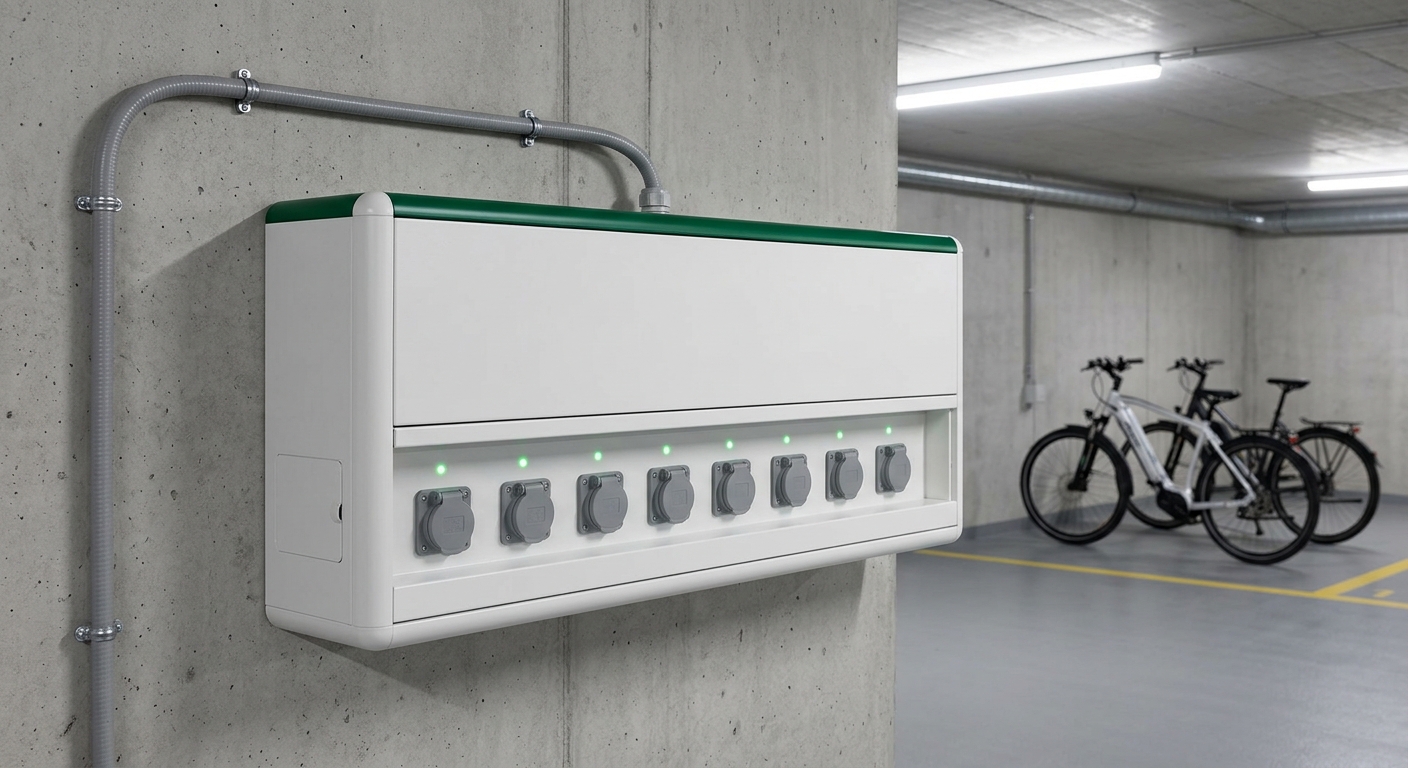
ChargeGo Box
A wall-mounted station for an underground garage, bike room or hall. No structure or foundation to build; the unit mounts on an existing building's wall, typically without a building permit or notification.
- 8 charging points powered from a single 230 V / 16 A circuit
- IP44 sockets with covers, energy metering on every charging point
- Started from the mobile app, or optionally a PIN code or RFID card
What an electric bike charging station is
An electric bike charging station is infrastructure for charging the batteries of electric bikes (e-bikes), electric scooters and other micromobility devices, built for multiple users. An individual bike charger is an accessory bought for one specific battery; a station gives you several 230 V sockets in one place, with power metering on every charging point, access control and protection suited to that use.
Those four things (sockets, metering, access, protection) define the category and are common to both ChargeGo versions. The rest follows from where the station is mounted. Indoors the power is already there, so the wall-mounted ChargeGo Box runs 8 charging points from a single 230 V / 16 A circuit. Outdoors there is often no grid connection, or running one costs more than the unit, so the Shelter brings its own solar panels and battery, and keeps the rain off the bikes.
What makes up a ChargeGo station
Both lines have the first four. The last three belong to the outdoor line, because indoors the power is already run in and the Box uses the existing installation.
ChargeGo Box or Shelter, parameter by parameter
Both versions solve the same problem: charging several electric bikes in one place, under control. Below is what sets them apart, from mounting to price.
| Parameter | ChargeGo BoxInside a building | ChargeGo ShelterOutdoors |
|---|---|---|
| Location | Inside a building: an underground garage, a bike room, a hall. Mounted on the wall. | Outdoors: a freestanding structure in a car park, in front of a building, or along a route. |
| Charging points | 8 charging points. | 10 charging points in the open version. The lockable Shelter with doors and locks: 3 or 6. |
| Power supply | A single 230 V / 16 A circuit, existing or run in by us. | Solar panels and a battery, running off-grid or hybrid with the grid. |
| Draw limit | A 2 A (about 460 W) limit per charging point, enforced electronically. Exceeding it disconnects that one charging point and flags it in the app; the rest keep charging. | Current metering on every socket; exceeding the set threshold disconnects that charging point. The inverter caps the combined draw of all charging points at 3,000 VA. |
| Solar and battery | None. The Box runs off the building's installation. | 1.74–3.48 kWp of solar, an LFP battery of ~1.8–6 kWh, operates from −20 °C to +45 °C (BMS-controlled heating). |
| Protection | A full set inside the unit's enclosure: a main disconnect, RCD and overcurrent protection, a surge arrester, an emergency stop. An electrician determines the scope of work on the building's own installation after a site visit. | A distribution board built into the Shelter's structure, current metering on every socket. |
| Permits | As a rule, needs no building permit or notification. Exceptions: heritage-listed buildings, conservation protection zones, and cases involving rework of the electrical installation. Confirm those with your local authority. | A building structure on the plot, usually just a notification. The exact requirement depends on the plot and the local zoning plan. |
| Access and app | Shared by both versions: a mobile app, a QR code at each charging point, an admin panel in Polish and English, session history, local operation if the connection drops. | Shared by both versions: the same app, the same panel and the same session history. |
| Power metering | An energy meter on every charging point. Serves reporting and limits. | Current metering on every socket. Serves reporting and limits. |
| Dimensions | 770 × 450 × 160 mm, white as standard (RAL optional). | 6.4 × 3.2 × 2.7 m, about 20 m² footprint. |
| Price excl. VAT | From €3,450 for the unit, including software, the panel and the app, with no subscription and no time limit. Installation is quoted separately at €420 and commissioning with training at €350. Delivery in 8 weeks. | From €18,500 (open, 10 charging points). The lockable shelter with 3 charging points is €23,500, with 6 charging points €32,500. |
| Installations | The unit, app and panel are available to see at our workshop in Dąbrowa Górnicza. We build the electronics and software ourselves. | Hotel Ostaniec, running since May 2026: 8 charging points, about 3 kWp of solar, about 5 kWh of battery. A pre-production variant, outside the current product line. |
Shelter warranty: 10 years on the structure, 25 years on the solar panels (≥ 80% output), 5 years on the LFP battery for ≥ 80% capacity (4,000+ cycles), 2 years on the electronics. For the ChargeGo Box, an extended 7-year warranty is available for €470 excl. VAT.
How a station differs from a charger, a socket or a plain rack
A bike charger, an extension cord in whatever socket is handy, and a rack with no charging each solve part of the problem. What a managed installation adds is a dedicated circuit, per-charging point power metering and access control.
Uses for an electric bike charging station
Each segment page has pricing, material to support the buying decision, and which version fits that type of property.
The question usually comes from a plant or office building where employees started commuting by bike. A company station serves a known, closed group, so tracking usage matters more than taking payment from an occasional visitor.
Bikes kept in an underground garage, a bike room or a hall call for the wall-mounted charging station for a garage, which fits eight charging points on a single 230 V / 16 A circuit. Bikes parked outdoors with no grid connection nearby call for the solar bike shelter.
Charging electric scooters from the same station
An electric scooter has a 230 V charger, just like a bike. From the station's point of view they're the same: the same socket, the same current limit per charging point, the same usage metering. Both ChargeGo lines handle either with no change to the configuration.
This matters in two places. In a residential building, scooters can outnumber bikes and more often end up in the stairwell. At a workplace, the question is where an employee leaves a scooter during a shift, and whether charging it at a desk is allowed.
One designated spot covers both cases, because the equipment doesn't distinguish what's plugged into the socket.
So the same station handles bikes and scooters, and the number of charging points follows from the number of vehicles.
Two different things called by the same name
A map of places to charge
Looking for somewhere to top up a bike on a route or in a city means looking for a map of public stations.
A unit to buy and install
Building a charging point on a property you manage is our part. We manufacture the stations that hotels, owners' associations, office buildings and plants install on their own site.
Where we install
We deliver, install and commission across Poland. The quote sets a site visit and an installation date, and if the site has no power run to it we quote that work too.
Guides about the electric bike charging station
Frequently asked questions about the charging station
Resources you might find useful
ChargeGo Box options
The station is complete without any of them: it charges, measures usage and recognises the user. The modules below are added when a site needs them, each at its own price.
Remote management from off-site: browser dashboard, session history, reports, fault notifications and remote updates. Without it the station keeps working locally.
Usage tracking per user and per tenant, billing reports, export to accounting.
An alarm control panel built into the station housing and a smoke detector in the charging room. Smoke triggers the alarm. Works locally, without internet.
An extra credential alongside the app and PIN code. You deactivate a lost card in the panel.
Controls entry to the bike room: electric strike or magnetic lock, reader and door contact. Priced after we have surveyed the site.
Add-on prices are per station, not per property. Hazard monitoring is an alarm control panel with a smoke detector in the charging room. Full pricing and configurator.
Ask for a charging station quote
Tell us where the bikes are kept and how many people the station has to serve. We'll pick the version, the number of charging points and the configuration, and reply within 1–2 business days.