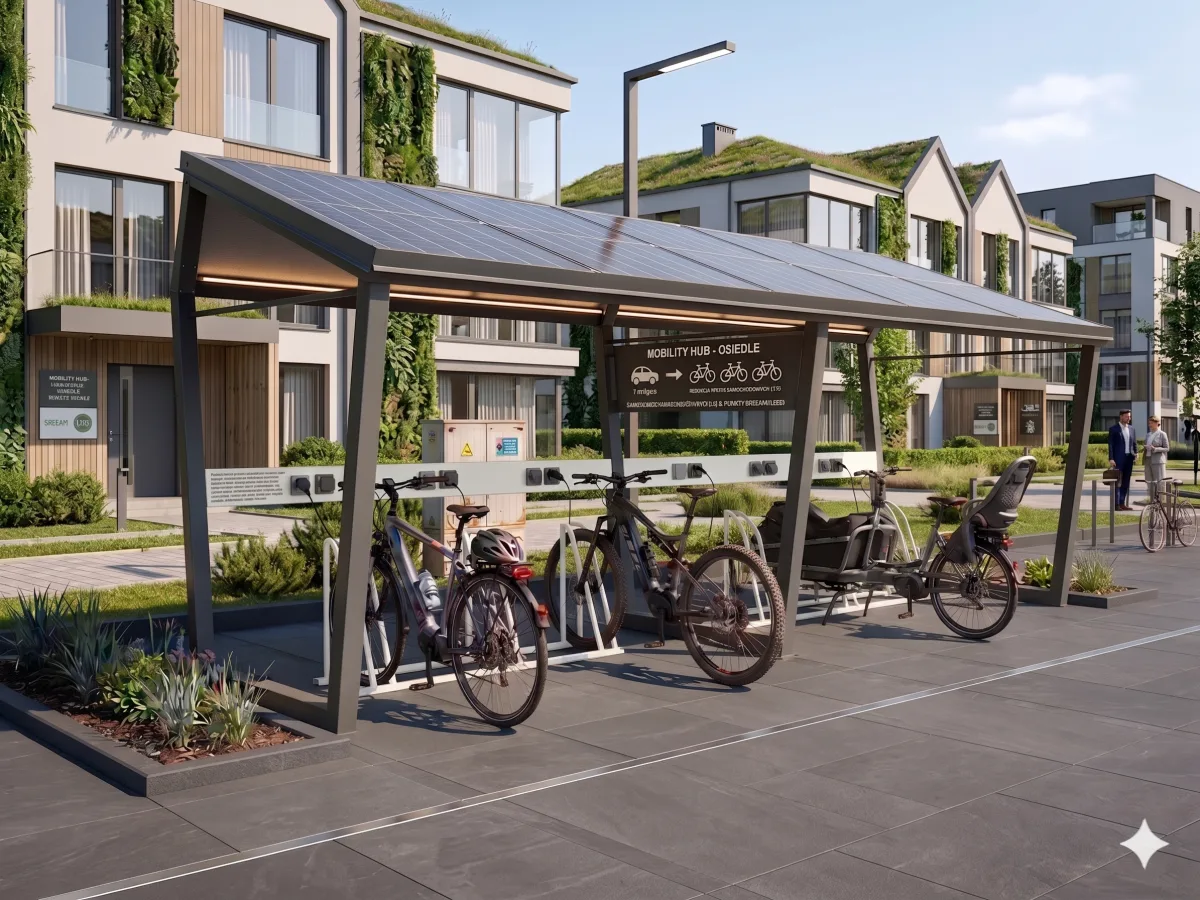
A bike shelter on a residential estate answers one question: where can residents safely leave and charge an electric bike if they do not want to, or cannot, do it in their flat. Most of the outcome is decided at the start, by three choices: location, access control and billing model.
Why estates need a dedicated shelter
Electric bikes on an estate create three organisational problems:
- Residents do not want to carry batteries into the flat — an e-bike battery weighs 2.5–4 kg, is awkward in a lift, and on the narrow stairs of older blocks is virtually impossible to carry up daily.
- Fear of fire — high-profile lithium-ion battery fires in residential spaces (2022–2025) made batteries something building managers want out of the building. Some owners' associations add a rule to their regulations: "charging electric bike batteries in flats and cellars is prohibited".
- No good place for the bike itself — a bike in a flat blocks the corridor, the cellar is inconvenient and often has no power, and underground parking often prohibits leaving bikes.
A dedicated shelter solves all three at once: space for the bike, charging on an installation designed for the purpose, and a designated place for it.
Who decides and when — developer, owners' association, board
Developer — before estate handover
The cheapest moment for a shelter is the estate design stage. The shelter goes into the site layout, foundations are part of the main groundworks (saving €1,200–2,350), the shelter is funded from the capital budget rather than operating costs, and it is ready on handover day. The developer sells it as an amenity that raises investment value.
Owners' association — after occupancy
The owners' association decides by board resolution for smaller investments, or by general meeting resolution for larger expenditure from the renovation fund. The usual path: the board prepares a design, 2–3 quotes and a resolution voted on by owners. The required majority follows the Act on Ownership of Premises.
Housing cooperative
The cooperative board decides within the renovation plan; larger expenditure requires a general meeting decision, with the supervisory board providing substantive support. Cooperatives have greater negotiating power for group orders covering several estates at once, and can access regional grants.
Estate location — what works, what to avoid
Works
- At the estate entrance — by the gate or guard post, visible, a natural place to leave a bike before entering the estate.
- By the service building — boiler room, waste area, estate store. The shelter fits the technical zone.
- Between buildings in a central square — easy access for residents of several stairwells at once.
- With access to a bike route — easy exit onto a cycle path.
Does not work
- Far from building entrances — the longer the walk with a battery, the lower the chance of daily use. A shelter at the far end of a large estate loses to carrying the battery upstairs.
- In a shaded location — PV produces 30–50% less energy in the shade of trees or buildings. On open ground, seek southern exposure.
- On the main access route to flats — shelter doors opening every 5 minutes cause disruption. Put it on a side path.
- In the car entry zone — without a separating barrier a cyclist heading to the shelter can collide with a reversing car.
Security — locking, monitoring, access control
A shelter open to everyone, with no access control, is hard to keep in its intended use. A locked shelter with access only for authorised users stays a place for residents' bikes. Three access control models:
Model 1: mobile app with resident authorisation
The resident downloads the ChargeGo app and registers with an email from the resident database, which the administrator verifies. That gives access to open the shelter doors and start charging. On move-out the access is revoked. Convenient for residents who already handle estate matters by phone.
Model 2: RFID card
Residents receive RFID cards on move-in, similar to parking zone access cards. The card opens the doors and authorises a charging session. Convenient for less technical residents (80+) and compatible with existing estate access control systems.
Model 3: numeric code
A single code changed quarterly. Simplest, cheapest, least controlled. Works for small owners' associations up to 20 flats where everyone knows each other. Not recommended for estates >50 flats.
Regardless of model, CCTV monitoring is worth considering: an IP camera with RTSP integrated with the estate system, e.g. 14-day recording, which helps identify perpetrators after an incident.
Replacing car parking spaces — ratios and procedures
One policy used by developers: replacing 1 parking space with 5–8 bike spaces with charging. The numbers:
- 1 parking space is typically 2.5 × 5 m = 12.5 m².
- 1 bike space with required spacing is approx. 1.5 × 2 m = 3 m². A shelter with 10 bike spaces takes approx. 30–36 m², including room for manoeuvring.
- In practice 1 car space = 6–8 bike spaces in a covered shelter.
The replacement must be confirmed in the local development plan, since most plans require a specific number of car spaces per unit. On estates with 1.5 spaces per flat, an architectural interpretation in the site layout project is usually enough, without a plan change.
Capital and operating costs
Sample cost model for a 50-flat estate with a ChargeGo lockable Shelter, 6 charging points (indicative amounts, to be confirmed with an individual quote):
| Item | Amount |
|---|---|
| One-off investment (shelter + installation) | approx. €39,000 excl. VAT |
| Cost per flat (one-off) | ~€780 |
| Instalment per flat (10-year amortisation) | ~€7 / month |
| Annual maintenance (PV cleaning, RCD check) | ~€140 / year = ~€1 / flat / month |
| Energy cost (each subsequent charging session) | No marginal cost in autonomous off-grid mode; PV and storage are in the one-off investment above |
| Insurance | ~€100 / year = ~€0.2 / flat / month |
| Total operating / flat / month | ~€8 |
For comparison, maintaining 1 parking space on an estate costs €4–7 per month in lighting, surface repairs and management. A shelter is expensive in year one, but over a 10-year cycle the cost per flat is comparable to typical renovation fund items.
Billing residents
Three billing models, from most to least recommended:
Free for all residents
Cost included in the service charge, e.g. an additional €7 per flat per month. Simplest, least friction, fastest to deploy; it requires a fee increase resolution. On estates with rental units it makes the rental offer more attractive.
Paid for users (kWh billing)
The app totals consumption per user, with monthly billing. Sample rate: €0.19–0.28 per kWh, indicative, with an operational margin over the energy price; the operator sets the actual rate. It requires deciding who operates the shelter (administrator or external company) and how they invoice. More complex, and fairer: those who use it pay.
Hybrid: first 5 kWh / flat / month free, paid above that
A compromise that covers typical daily use, around two charges per week, and applies fees only to exceptionally active cyclists.
Impact on certification and flat value
What this means for the developer and the owners' association:
- BREEAM transport criteria — covered bike spaces with charging may be taken into account; scoring is awarded by the assessor for the whole project (see BREEAM/LEED/WELL — which features).
- Argument in flat price lists — "free e-bike charging in PV shelter" appears in developer investment descriptions as an additional benefit.
- Argument in developer sales communication — good bike infrastructure is cited as a factor that raises offer attractiveness.
- Developer ESG branding — an investment with PV and e-bike charging appears in sustainability reports and investor presentations.
- Support for grant applications — bike infrastructure and renewable energy are eligible costs in programmes such as FEnIKS or regional operational programmes. The call regulations set the expenditure catalogue.
Most common questions from property managers
What if the shelter is full at peak hours?
The app shows live charging point status, and a finished session ends automatically, freeing the point without administrator involvement. The number of charging points is sized to the electric bikes actually on the estate rather than the number of flats. If after a season the panel shows constant occupancy, a second unit goes into another part of the estate.
What if a flat is sold?
In the app model the administrator deactivates the previous owner's account and activates the new one. In the RFID model, card replacement. In the code model, a quarterly code change, which is recommended anyway.
Is the shelter owned by the owners' association or the developer?
If it stands on common land it is part of common property, owned by all owners proportionally to their shares. If on developer land, for example during the warranty period, it is developer property until handover. Worth setting out in the notarial deed that establishes the owners' association.
What about liability for fire from a battery left in the shelter?
The shelter's own energy storage uses LFP cells, which have high thermal stability and lower risk of violent thermal runaway than many other popular lithium-ion chemistries. A resident's battery connected to a 230 V socket is under controller supervision, on a dedicated circuit with metering at each socket and automatic shut-off after full charge. Shelter insurance covers damage to residents' equipment; verify the scope in the specific policy.
Do residents pay tax on shelter access?
If the shelter is part of common property and access is included in the fee, it does not constitute a separate taxable benefit. A paid kWh model raises accounting questions on the building manager's side, depending on the billing form chosen, so confirm it with the accountant for the owners' association or cooperative before deployment.