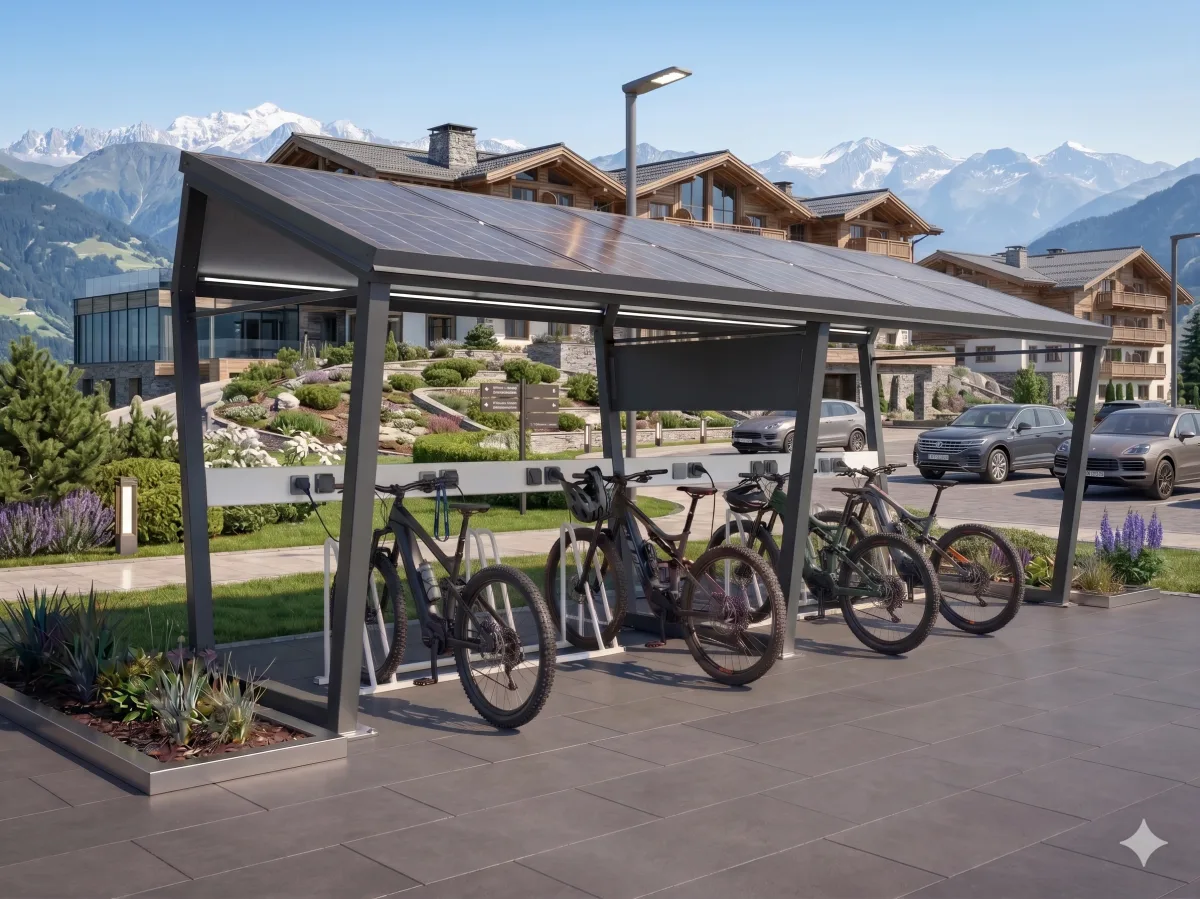
A guest travelling by e-bike needs to charge the battery overnight. With no designated place for it, charging happens wherever there is a free socket: in the room, in the corridor or at reception.
This applies to every accommodation format where cycling guests appear: hotels, guesthouses, agritourism farms, holiday resorts.
Why a shelter pays off for hotels
Most recreational hotels in Poland still lack dedicated e-bike charging. A shelter with dedicated points sets the property apart in the Beskids, Masuria, the lake districts and the Sudetes, where cycling traffic is highest.
The steel structure has a 10-year warranty, so the investment can be accounted for as a fixed asset amortised over that period.
E-bike guest profile — who arrives
The Polish e-bike market is growing at 30–40% per year (PSR 2024). From hotel enquiries, an indicative profile of guests asking about charging:
- Couple 45+ with higher income — 5–7 day holidays, trekking e-bikes.
- Group of friends 30–50 — weekend trips in Bieszczady/Beskidy/Masuria, e-MTB.
- Families with children — increasingly with a parent e-bike (parent on e-bike, child on regular bike) and child seats.
- German- and Czech-speaking guests — at border-region properties. A mature market (Germany has >10 million e-bikes) where charging is expected.
First enquiries appear 4–8 weeks before the stay. Typical email questions: "do you have somewhere to charge an electric bike?", "can the battery stay on charge overnight without fire risk?", "do you have a lockable shelter / monitoring?".
Safety — storage and charging
Safety is the main argument, and the reason hotels hesitate to allow charging in rooms.
Risks of charging without a dedicated shelter
- Charging outside property control — the guest plugs a charger into room or corridor wiring not designed for it, and nobody knows how many chargers run at once or on which circuit.
- Power outage — several 36/48 V chargers in one room socket overload the circuit and trip the breaker for the whole floor.
- Theft — batteries cost €470–1,200, an attractive target for thieves.
- Legal liability — if a fire starts in a guest room from their battery, the hotel insurer may refuse compensation.
What a dedicated shelter solves
- Charging on dedicated installation — separate circuit, metering at each point, automatic shut-off after charging.
- RCD and overcurrent breakers per socket — even a faulty charger will not trip power in the hotel.
- Monitoring and access control — camera, QR codes, app login, so you know who charged when.
- LFP storage instead of NMC in the shelter itself — LFP has high thermal stability and lower risk of thermal runaway than many other popular lithium-ion chemistries.
- Insurance — a dedicated station counts as technical infrastructure the insurer can assess.
Costs — the hotel bill
Example: 25-room hotel in a tourist region, 6-point lockable Shelter.
What makes up the cost
- Equipment: 6-point lockable Shelter — from €32,500 excl. VAT per price list, depending on chosen configuration.
- Foundation, transport and installation: quoted separately, depending on ground conditions and site access.
- Energy: in autonomous mode the shelter draws no grid power, so there is no electricity bill; PV and storage are in the equipment price.
- Inspection: approx. €116 per year (panel cleaning, protection check).
- Insurance: approx. €70 per year, as part of property infrastructure.
Ongoing costs after launch are low; the initial investment is the main expense. Breakdown by line item: how much a bike shelter costs.
How to calculate return for your property
Two figures from your booking system carry the calculation: how many bookings today come from cycling guests, and how their length of stay changes.
Operations — who manages, how to bill
Three organisational models for hotels:
Model 1: self-service shelter with app (recommended)
The guest scans a QR code at the point and starts charging. Reception does nothing. Session data is visible to the director in the ChargeGo app, with a monthly report for ESG/CSR.
Model 2: key-access shelter
Reception issues a key or RFID card at check-in (the RFID card is a paid add-on), and the guest has access throughout the stay. Flat-rate billing, e.g. €7 per stay. Simpler technically, but it requires reception contact.
Model 3: free shelter for guests
Included as standard: access code printed on the room card. The shelter is open to logged-in guests and the cost is absorbed in the room rate, so the guest arranges nothing at reception.
Ready-made Booking.com facility description
Booking.com lets you add custom facilities in the property panel. Here is a ready-to-paste description:
E-bike charging — we provide guests with a ChargeGo solar lockable Shelter with 6 × 230 V points dedicated to electric bikes. Operates 24/7 without contacting reception: scan QR, log in, and charge your battery fully overnight. Solar-powered, with no extra electricity charges. Monitoring, roof cover, surge protection.
Who it's for: all guests with electric bikes, scooters and other micromobility devices (up to 230 V with factory charger).
Access: access instructions are on the welcome card in the room and at the shelter entrance.
Booking also has "bike storage" and "bike rental" checkboxes. Tick both if you have the lockable Shelter variant; for the open Shelter tick only "bike rental".
Arguments for reception and guest surveys
Three places worth mentioning it:
- Booking confirmation email — a "practical information for cycling guests" section with a link to local trail maps and brief charging info.
- Welcome card in the room — access code or QR instructions.
- Checkout survey — question "did you use e-bike charging?" plus a comment field. Source of testimonials for the website.
The shelter exists so that it does not burden reception. If a guest asks: "we have a shelter with charging, instructions on the welcome card, access via the app, no extra charges". End of conversation.
Step-by-step hotel implementation plan
- Location decision — typically the courtyard, the end of the car park or a retaining wall. Approx. 20 m² needed, with crane access during installation.
- Authority notification — a shelter <35 m² and <5 m needs only notification (21 days for objection), with a sketch, description and property rights statement. Usually handled by the supplier at no extra cost.
- Configuration choice — open Shelter (10) or lockable Shelter with locks (3 or 6), RAL, options (camera, LED lighting, branded touchscreen).
- Production and delivery: 4–8 weeks for ChargeGo (Polish production). Foreign competitors: 10–16 weeks.
- Installation: 1–2 days, anchor or screw foundations, without concrete.
- App configuration: director admin panel, add property to Booking map, room card.
- Communication: update Booking descriptions, email regular guests with "new at the hotel", social media post.
- Measurement: after the first season check session count, cycling guest stay length and survey ratings.
Full case study of the first shelter at a hotel in the Kraków-Częstochowa Upland: case study: Hotel Ostaniec.
Frequently asked questions from property owners
Can I install a shelter on leased land?
Yes, with the owner's written consent and an entry in the land register for the authority notification. Some suppliers install on screw foundations without concrete, which are removable when the lease ends.
Does the shelter work in winter? My season is December–February (mountains).
Yes, down to –20 °C, thanks to active heating in the LFP storage. PV production is ~5–10× lower than in summer, and traffic usually is too, so the shelter balances itself. For intensive winter traffic consider hybrid mode with grid.
What if a guest leaves a bike overnight and checks out in the morning?
The app ends the session automatically when full charge is detected, typically after 4–6 hours. After 24 hours of inactivity the session closes and the system alerts reception, so nobody blocks a point permanently.
Is the shelter an eyesore?
The structure is painted in a chosen RAL, typically matched to the hotel brand: anthracite, dark green, wood-effect brown. From below the PV roof looks like a smooth metal roof, and side panels take wraps or branding.
Are there grants for hotels?
There are no direct "shelter grants for hotels" in 2026, but regional programmes (RPO) cover green tourism investments, NFOŚiGW covers ecotourism properties, and PARP funds innovation in tourism SMEs. Support is usually 30–50% of eligible costs. Worth asking a local funding broker.