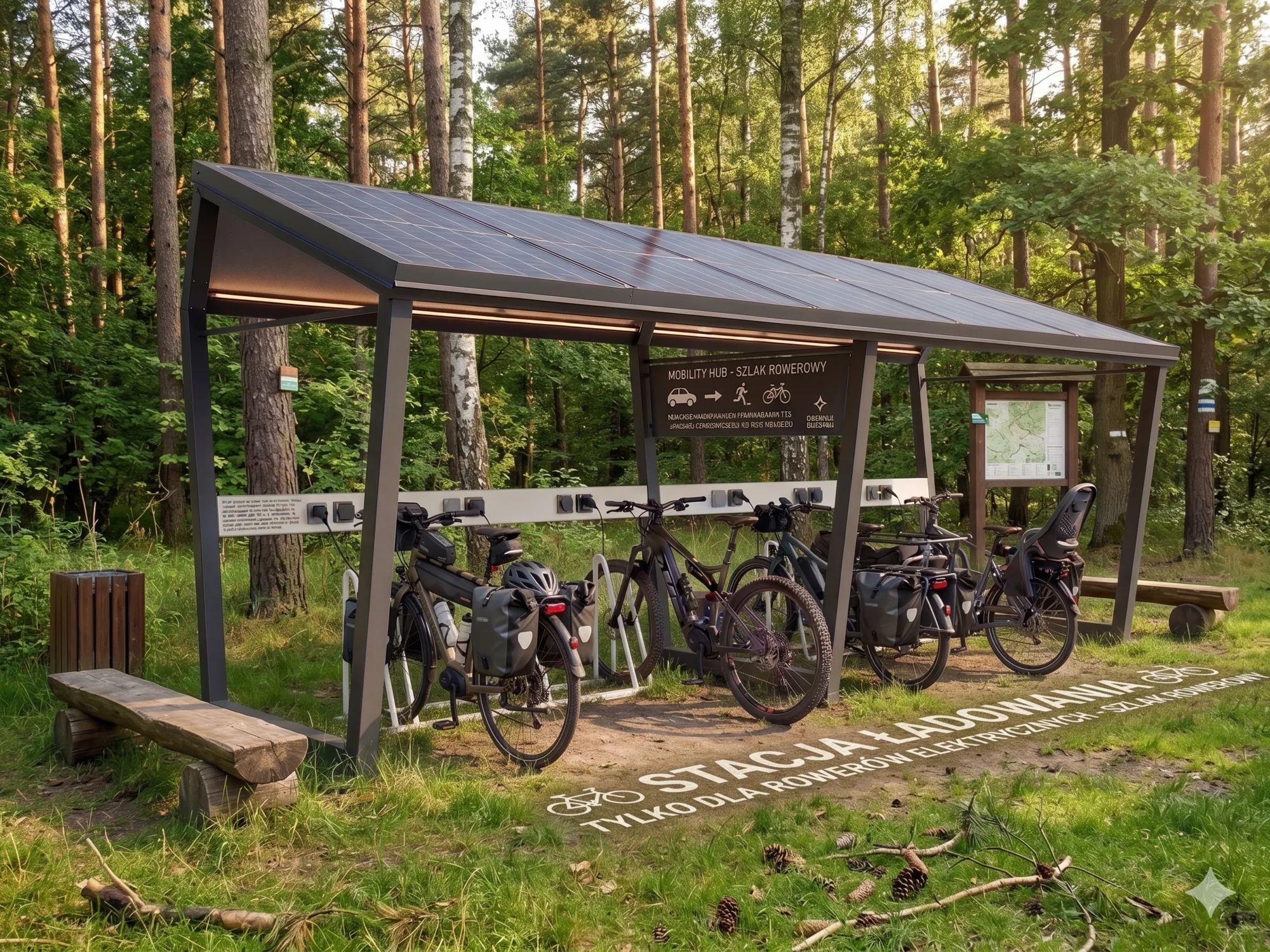
An electric bike charging station on a route faces a different set of conditions than one in the city: no grid connection, limited staffing, a more variable traffic profile, exposure to weather and sometimes difficult service access.
Why bike routes need charging
An electric bike has limited range, and on a route there is rarely anywhere to charge it.
A typical touring e-bike covers 60–120 km depending on assist level, terrain and luggage weight. Many Velo routes (Wiślana, Green Velo, R10) involve 100–200 km between attractions, so without a charging point halfway along, the cyclist plans the day around battery level instead of places to visit.
Station spacing of 50–80 km is cited as an indicative reference when planning bike charging networks in Western Europe, to be refined per route. In Poland this infrastructure is still rare.
What off-grid means for a station
Off-grid (autonomous) operation means the station is not connected to the electricity grid. All energy comes from on-site photovoltaics and storage. Consequences:
- No grid electricity bills in autonomous mode. PV and storage are a one-off capital investment; once installed, each subsequent charging session costs €0 at the margin.
- No grid connection — no cable trenching, no coordination with the distribution operator, no transformers. Often the only realistic option hundreds of metres from the nearest pole.
- No risk of power outage during grid failure.
- Limited power and capacity — the shelter runs on an energy balance designed for the route profile.
- LTE connectivity required for remote monitoring and user apps. Without coverage the shelter works offline, with reduced functions.
MORs, Velo routes, landscape parks — who installs
MOR — Cyclist Service Point
Part of urban and suburban infrastructure, most often funded by the bike route manager: city office, municipality or road authority. A classic MOR has a shelter, benches, racks, litter bin and information board; charging adds e-bike functionality to that set.
Velo routes (regional)
Routes such as "Wiślana" (W04), "Green Velo", "R10" along the Baltic and "Mała Pętla Tatrzańska". Funding usually comes from RPO and EU funds; location is decided by a consortium of municipalities or the regional authority.
Landscape and national parks
The park directorate manages the land and decides on infrastructure, often with climate funds (NFOŚiGW), nature protection funds or sustainable tourism plans. A shelter fits the "emission-free tourism in the park" narrative.
Recreation centres, agritourism, campsites
Private owners of tourist facilities along routes. For them a shelter is both a guest amenity and advertising on route maps, with a "bike charging available" marking, and charging is one of the factors in stop choice for long-distance cyclists.
Sizing PV and storage for route profile
A route shelter has more concentrated traffic over time than one at a hotel or office: typically a midday peak, when cyclists stop for lunch and charge during the meal.
Profile 1: lowland route, April–October season
Low intensity, 5–15 charges per day. A lockable Shelter with 3 charging points, safe unsupervised on the route, PV 1.74 kWp and ~1.8 kWh LFP storage is sufficient. Cost: from €23,500 excl. VAT (range €18,500–28,000 depending on preset).
Profile 2: main Velo route (Wiślana, Green Velo)
Medium intensity, 15–30 charges per day in season. Lockable Shelter with 6 charging points, PV 3.48 kWp, ~3.6 kWh LFP storage. Cost: from €32,500 excl. VAT (range €26,000–39,000).
Profile 3: mountain route (Bieszczady, Beskidy, Tatry)
Higher energy consumption, with more full batteries to replenish, and 10–25 charges per day in harsher conditions. Lockable Shelter with 6 charging points, PV 3.48 kWp, ~3.6 kWh LFP storage and reinforced structure. Cost: from €32,500 excl. VAT (range €26,000–39,000; structure reinforcement priced individually).
Choosing a location — what matters
Criteria for a good route shelter location, in order of importance:
- Natural stopping place — viewpoint, manor or inn, tourist car park, water spring, where the cyclist stops anyway.
- Southern exposure for PV — no tree shade, optimal angle to the sun.
- LTE coverage minimum 2 bars on a typical smartphone, checked on site rather than on operator coverage maps.
- Hard access surface for installation — the shelter arrives on a crane truck or lorry, 3.5 t with the heaviest element ~600 kg.
- Regularised plot — municipality, State Treasury, park, or regularised lease from a private owner.
- Distance from other infrastructure — approximately 50–100 km from the nearest other charging station.
- Safety — within sight of an adjacent road. A completely hidden shelter invites vandalism.
Formalities outside urban areas
A shelter on a plot outside the city falls under standard building law: <35 m² and <5 m requires notification only. Additionally check:
- Landscape / national park protection plan — structures are prohibited in some zones (reserves, buffer zone), and a decision of the regional nature conservator or park directorate is required.
- Road corridor — a shelter by a public road requires road manager consent (Art. 39(3) of the Public Roads Act).
- Conservation protection zone — near monuments and historic routes the conservator may require a colour change or PV not visible from a heritage viewpoint.
- Natura 2000 areas — within habitat and bird protection a structure requires impact assessment; a simplified assessment usually suffices without a grid connection.
- Forest zone — within state forests, State Forests consent is required. For private plots in forest: exclusion from forestry production.
Realistic timeline for a route shelter: 2–4 months from idea to commissioning, of which 4–8 weeks of shelter production run in parallel with formalities.
Maintenance in the field without permanent staff
The shelter stands in the field with nobody watching it. Three things cover that:
Remote monitoring 24/7
The controller sends data to the cloud every minute: storage SoC, temperatures, socket status, LTE signal RSSI and service door opening as a vandalism alarm. Every anomaly reaches the operator's phone as an alert.
Annual periodic inspection
Service visit: PV panel cleaning, RCD and breaker check, earthing connection check, physical security audit. Cost: ~€350–600 depending on distance from the service base.
Ad hoc repairs
Service comes within 7 business days for catalogue components and 21 days for imported parts. An operator stock of the most common parts, usually a vandalised socket, shortens that to 1–3 days.
Anti-vandal measures
Steel structure painted in a RAL colour that is hard to sticker, e.g. RAL 7016 anthracite, popular in public infrastructure. Service doors with a hardened lock and opening alarm, no elements demountable by hand, IP camera in a visible place.
Funding — grants for routes
Route shelters are most often funded from public funds:
- FEnIKS 2021–2027 — climate and transport actions. For road managers and local authorities.
- RPO — regional operational programmes, axes "sustainable tourism" and "bike infrastructure".
- NFOŚiGW — programmes for protected areas, landscape parks and national parks.
- PROW — Rural Development Programme, for rural municipalities with a tourism element.
- European route funds — within the EuroVelo Federation and national support programmes for international routes.
- Participatory budget — for shelters near cities, on local routes. Ready application template: participatory budget — template.
Typical co-funding level: 50–85% of eligible costs, with the manager's own contribution usually 15–50% depending on programme and region.
Most common questions
What if there is no LTE coverage at the location?
The shelter works offline: sockets operate, metering is stored locally, and the user logs in and starts charging via Bluetooth from the app. Data synchronises when LTE returns. For locations completely without coverage, a directional LTE antenna or satellite connectivity is possible.
Does the route shelter work in winter? The route season is May–September after all.
Yes, all year, including winter when traffic is minimal. The controller enters low-power mode, storage is heated (3–5% of daily energy) and waits for the first users in spring. One service visit per year is enough.
What if someone steals PV panels from the roof?
Panels are bolted to the roof structure, so removal requires tools and time. The optional camera and cabinet opening alarm signal interference. Insurance scope is set by the facility owner with their insurer.
Can the station be part of a nature reserve facility?
Within a strict reserve, usually not. In a reserve buffer zone or landscape park, yes, after a directorate decision. LFP cells contain no cobalt or nickel, and the shelter generates no noise or emissions in operation. Required agreements and environmental decisions come from the land manager and regional environmental authority.
Can I install a shelter on a plot leased from State Forests?
Yes, with State Forests consent for supplementary construction; the plot stays forest land, so exclusion from forestry production is not involved. Procedure: application to the forest district, opinion, decision of the State Forests Director General, 2–4 months. For shelters <35 m² a simplified procedure applies.