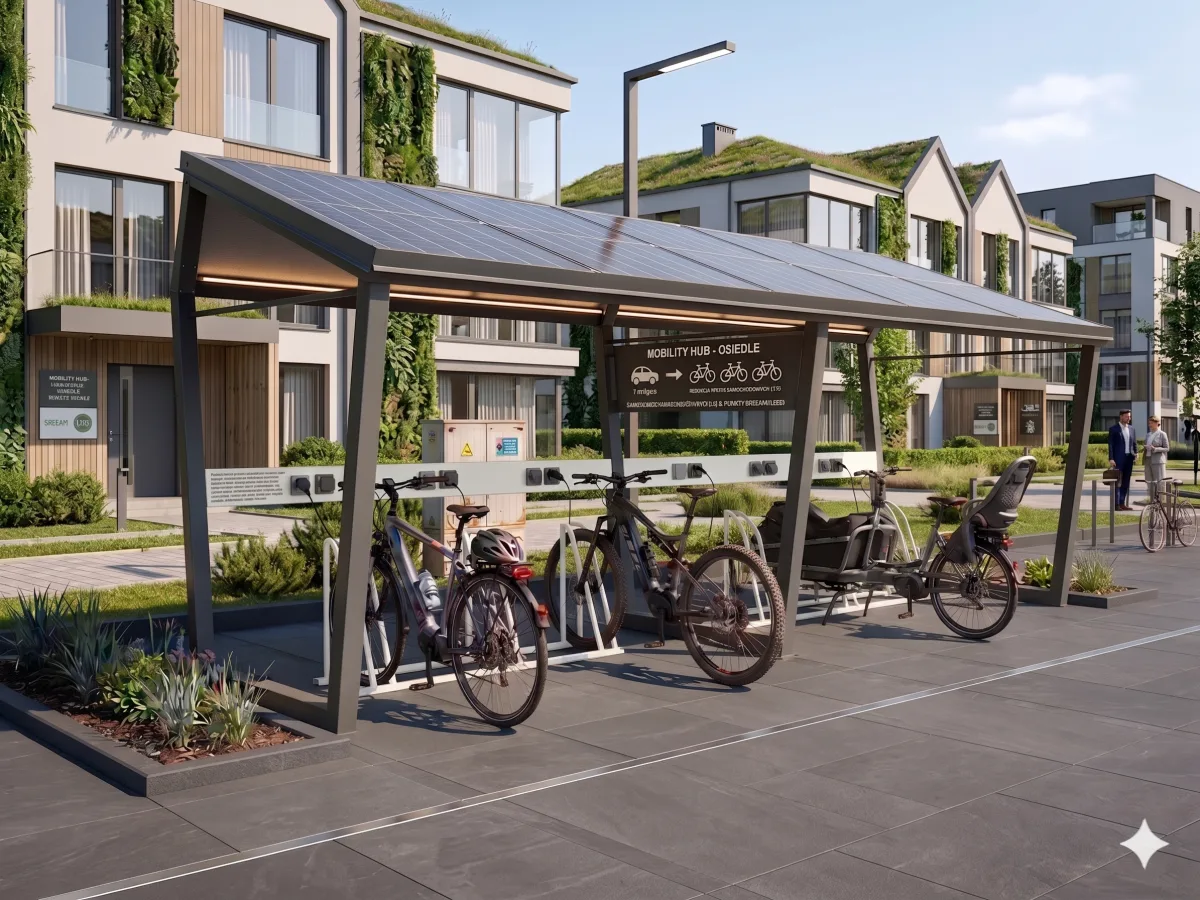
A bike shelter with electric bike charging earns credits in several places at once in green building certifications, and is also easy to misinterpret. BREEAM, LEED and WELL assessors use precise definitions: "cycle facility" is not the same as "bicycle storage", "long-term parking" requires accessibility, and "EV-ready" in LEED also covers micromobility devices.
Below: requirements of the three main systems, the ChargeGo features that address them, criterion names and evidence documents — for project managers, architects and ESG coordinators preparing certification.
Full product page with sales arguments: /wiata-rowerowa-breeam-leed.
How certifications count bike infrastructure
All three systems reward the same thing: encouraging cycling instead of driving. They differ in methodology:
- BREEAM (International New Construction 2021) — criterion Tra 03 Alternative Modes of Transport. Credits depend on the number of bike spaces relative to employees or residents, and on showers, lockers and charging infrastructure.
- LEED v4 BD+C / O+M — Bicycle Facilities credit in the Location and Transportation category. Credits for racks close to the entrance (within 200 m), showers and bike route accessibility.
- WELL Building Standard v2 — Movement V01 Active Buildings feature. Points for encouraging movement, including bike infrastructure for building users.
BREEAM and WELL weigh infrastructure quality (cover, charging, security), while LEED focuses more on rack count and distances.
BREEAM — Tra 03, Tra 03a, Tra 03b
BREEAM International New Construction 2021 has three sub-criteria relevant to bike infrastructure.
Tra 03 — Alternative Modes of Transport (up to 4 credits)
The main criterion. It requires bike spaces at a ratio of 1:10 to the number of users (1 credit), 1:7 (2 credits), 1:5 (3 credits), 1:3 with additional amenities (4 credits). Bike spaces must be:
- Covered and protected from weather.
- Within ≤200 m of the building entrance.
- With frame + wheel securing capability — typically an inverted-U rack.
- For premium scoring: with electric charging and monitoring.
A ChargeGo shelter meets the qualitative requirements: cover, frame and wheel securing, 230 V charging with monitoring and 24/7 access. Distance ≤200 m depends on site location, and the number of credits (1–4) follows from the ratio of bike spaces to users. Final scoring is confirmed by the BREEAM assessor.
Tra 03a — Long Term Cyclist Facilities (up to 2 credits)
Rewarded items include clothing containers, lockers, showers near the shelter, clothes dryers and bike service space. These sit outside the shelter itself, but the shelter must be physically linked to them, usually in the same service building.
Tra 03b — Bicycle and Other Vehicle Charging (1 credit)
Directly concerns charging: "provision of charging infrastructure for electric bicycles and other electric micromobility vehicles, accessible to building users". It requires a minimum of 1 charging point per 10 bike spaces. In a ChargeGo shelter every bike space has its own socket, so the ratio is 1:1. The criterion counts for the whole building rather than a single device, so the assessor judges whether that suffices.
LEED — Bicycle Facilities, EV-ready
Bicycle Facilities (1 point)
Requires a minimum of 2.5% of racks relative to the number of employees (BD+C: Commercial Interiors) or residents (BD+C: Multifamily Midrise). Racks must be within ≤200 m of the entrance for at least 30% of users; showers and lockers for at least 5% of full-time employees.
Electric Vehicle Supply Equipment — EV-ready (1–2 points)
In LEED v4.1 (from 2023) the EV-ready credit was extended to micromobility vehicles. It requires installed or prepared cabling for a minimum of 2% of car parking spaces. An electric bike charging station may count towards that limit as an EV-ready equivalent — one ChargeGo shelter or garage gives 3 to 10 EV-ready charging points, depending on variant — provided the LEED assessor accepts the interpretation.
This is a new and still undervalued aspect — many LEED assessors default to thinking only of car wallboxes. State the "EV-ready for micromobility" interpretation explicitly in project documentation.
WELL — Movement V01 Active Buildings
Feature V01 rewards projects that facilitate active travel: stairs, walking, cycling. The cycling part is Section 1 — Active Commuting:
- Bike racks within ≤90 m of the entrance (up to 6 m² per 100 users).
- Covered and secured racks (quality criterion).
- At least 1 electric bike charging point per 100 users.
- Showers and lockers for cyclists (Section 2 — Active Furnishings).
ChargeGo addresses both Section 1 elements: charging points (min. 1 per 100 users) and infrastructure quality (cover plus securing). The award is confirmed by the WELL assessor (WELL AP). Showers and lockers sit on the building project side.
System → criterion → ChargeGo feature → document → assessor
For each system: standard version, the role confirming scoring, and a table of criterion → feature → additional conditions → evidence document.
BREEAM (International New Construction 2021) — assessor: project BREEAM Assessor
| Criterion | ChargeGo feature | Required additional conditions | Evidence document |
|---|---|---|---|
| Tra 03 — covered bike spaces | Open Shelter / lockable Shelter with PV roof 1.74–3.48 kWp | Scoring depends on ratio of bike spaces to users (1:10 to 1:3) | Technical data sheet § Structure |
| Tra 03 — secure locking | Inverted-U racks inside, plus option of a fully enclosed lockable Shelter with locks | Requires securing both frame and wheel | Shelter/garage layout with rack description |
| Tra 03b — e-bike charging | 3 to 10 × 230 V sockets with per-point metering | Min. 1 charging point per 10 bike spaces | Electrical installation schematic |
| Mat 01 — responsible materials | Hot-dip galvanised steel + PZH-certified paints | Also depends on other project materials — scope confirmed by assessor | Material data sheet + PZH certificate |
| Ene 23 — On-site Renewable Energy | Photovoltaics 1.74–3.48 kWp on roof | Contribution counts towards total development renewable share — threshold confirmed by assessor | PV product sheet + PVGIS report |
LEED (v4 BD+C / O+M; EV-ready per v4.1 from 2023) — assessor: project LEED Assessor (LEED AP)
| Criterion | ChargeGo feature | Required additional conditions | Evidence document |
|---|---|---|---|
| LT — Bicycle Facilities | Racks in shelter/garage ≤200 m from entrance | Min. 2.5% of bike spaces relative to users; distance ≤200 m for min. 30% of users | Site layout plan with location |
| LT — EV-ready (micromobility) | 3 to 10 × 230 V charging points | Min. 2% of car parking spaces with cabling; requires micromobility interpretation stated in documentation | Electrical schematic + purpose description |
| EA — Renewable Energy Production | PV 1.74–3.48 kWp + LFP storage ~1.8–6 kWh | Depends on whole project — threshold confirmed by assessor | Annual production report + storage data sheet |
WELL (Building Standard v2) — assessor: project WELL Assessor (WELL AP)
| Criterion | ChargeGo feature | Required additional conditions | Evidence document |
|---|---|---|---|
| V01 — e-bike charging | 3 to 10 charging points per facility | Min. 1 charging point per 100 users | ChargeGo technical data sheet |
| V01 — infrastructure quality | Covered shelter, IP67 external components, monitoring | Also requires covered and secured racks | Technical specification + photos |
Criteria for typical developments
200-person office building, BREEAM
A shelter with 10 bike spaces serves 200 users, a 1:20 ratio, below the Tra 03 entry threshold of 1:10. Reaching the lowest Tra 03 threshold therefore takes more bike spaces than one shelter provides. Tra 03b (e-bike charging) and Ene 23 (PV) are addressed regardless of that threshold.
50-unit residential development, BREEAM
A shelter with 10 bike spaces serves 50 units, a 1:5 ratio, the threshold corresponding to 3 credits in Tra 03. It also addresses Tra 03b (charging) and Ene 23 (PV); its contribution to Mat 01 (materials) depends on other project materials.
30,000 m² shopping centre, LEED
A shelter with 10 bike spaces addresses three LEED credits: LT Bicycle Facilities (racks ≤200 m from entrance, min. 2.5% of bike spaces relative to users), LT EV-ready (cabling for micromobility, min. 2% of car parking spaces) and EA Renewable Energy Production (PV contribution to the building energy balance). Each credit has its own threshold and weight depending on LEED version; scoring is confirmed by the LEED assessor (LEED AP).
What to prepare for the assessor
Minimum certification documentation:
- Station technical data sheet — number of charging points, PV capacity, storage capacity, electrical parameters. ChargeGo provides this sheet in the standard package (PDF, EN/PL).
- Site layout plan with shelter location and measured distance to main building entrances (for LEED and WELL — distance criterion).
- Electrical installation schematic showing 3 to 10 charging points and their connection to PV/storage.
- Material data sheet (steel, paints) + PZH certificate for paints (BREEAM Mat 01).
- PVGIS report with estimated annual PV production (BREEAM Ene 23, LEED EA).
- Station management plan — who operates it, how data is collected, how indicators are reported (for operational-phase certification).
Interpretation pitfalls
- "Bicycle storage" ≠ "bicycle parking" — in LEED these are two different concepts. Storage is long-term (e.g. an employee bike store), parking is short-term (for visitors). A ChargeGo shelter, with typical 4–8 h charging sessions, usually qualifies as long-term storage for employees; final classification is set by the LEED assessor.
- Distance from entrance measured in a straight line? No — along actual access paths. The BREEAM/LEED assessor may require a pavement and path plan with actual distance.
- How many BREEAM credits fit in one shelter? Max. 4 from Tra 03 + 2 from Tra 03a (if showers are present) + 1 from Tra 03b. Read the BREEAM documentation for your standard version before summing them, as weightings change between editions.
- Does energy storage count towards certification? Not directly, since BREEAM has no separate credit for storage, but indirectly: storage enables the station's energy self-sufficiency, which supports other credits such as Pol 04 — Low NOx Emissions.
Most common questions from project managers
Do I need BREEAM, LEED and WELL simultaneously?
No. Choose one system per development. BREEAM is commonly used in Poland for offices and residential developments. LEED is the American standard, common with international investors. WELL is specialised for wellbeing and usually complements BREEAM/LEED.
Does a shelter earn BREEAM credits for an existing building (in-use)?
It can. BREEAM In-Use has a credit similar to Tra 03 in BREEAM NC. Adding a shelter to an existing office can raise the score at the next annual certification review; the number of credits is confirmed by the BREEAM In-Use assessor based on the ratio of bike spaces to building users.
Does the shelter have to be built to count credits?
Not always. In BREEAM Design Stage a designed shelter included in the site layout is sufficient. In Post Construction (PCR) the shelter must be built and accepted.
Can I commission assessor documentation only without buying the shelter?
ChargeGo provides the technical data sheet and PVGIS report template free of charge, downloadable from the website. An individual credit calculation for your development takes 2–3 business days as a paid consulting service, approx. €350–700 depending on scale.
Does the shelter affect the building's energy certification?
Indirectly. As external infrastructure the shelter falls outside the building's own energy performance certificate (EP certificate). Its PV production can, however, count towards the renewable share of the whole development in ESG and climate reporting (CSRD, EU Taxonomy).