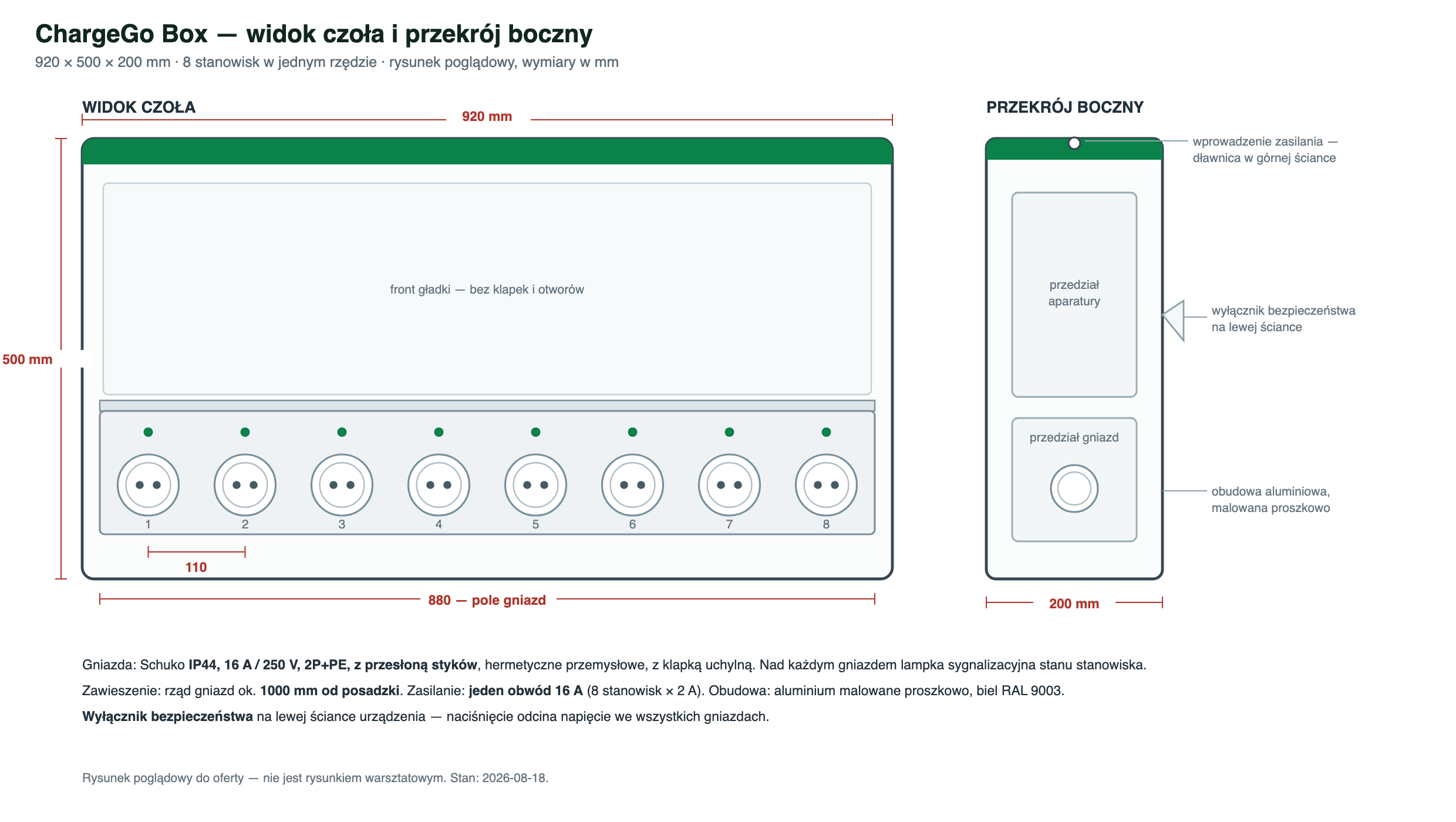
A bike room in a residential or office building is usually already built: card-access doors, racks, motion-sensor lighting, a washable floor. What it does not have is sockets. That is the whole gap between "we have a bike room" and "we have a bike room where you can charge an electric bike".
Installation: one 230 V / 16 A circuit, existing or run by us. From it operate eight charging points, 2 A (~460 W) each.
Wall: row of sockets at approx. 1000 mm from the floor. Housing 770 × 450 × 160 mm — the critical dimension is 160 mm depth plus space where the user stands.
Building distribution board: nothing to add or upgrade, because the full set of protections is in the unit housing.
Schedule: delivery 8 weeks. That sets the critical path, not the electrical work.
The bike room has racks, not sockets
Power in the bike room is usually there in another role: it feeds lighting, sometimes the gate or a reader. There may be one service socket by the door, put there for a vacuum cleaner rather than several chargers hanging on it for five hours a day.
When electric bikes appear in a building, residents and employees solve it themselves, usually in one of the same ways:
- an extension lead from the service socket, run through the circulation area;
- a power strip on the floor or hung on a rack;
- chargers locked in a box with a padlock so "nobody steals them";
- charging in a flat or storage locker, because there is no way in the bike room.
What these solutions lack is three things: a dedicated circuit designed for continuous operation of multiple loads, assignment of a charging point to a person and knowledge of how much energy went where and to whose account. An extension lead answers none of these questions, and the administrator gets all of them as soon as someone reports a problem.
Preparing a bike room therefore comes down to three technical decisions: where the circuit comes from, which wall and how it relates to the racks. The rest is scheduling.
Installation — one 230 V / 16 A circuit
The starting point: one 230 V / 16 A circuit must reach the mounting location. The building manager's electrician, the building service company or we can run it. From that one circuit operate eight charging points.
The arithmetic, worth knowing before talking to the electrician: each charging point gets a 2 A limit, i.e. approx. 460 W, and eight × 2 A = 16 A, exactly what the circuit has. The limit is enforced electronically: if a load exceeds the threshold, the unit disconnects that one charging point and reports it in the app. The other seven keep charging.
That has an operational consequence: the circuit does not trip because of one user who plugged in the wrong thing. Instead of the whole bike room going dark and a call to the administrator, you get one marked charging point with information about what happened.
What is in the unit housing
The full set of protections is inside the unit housing:
- main disconnector,
- 30 mA type A residual-current devices and charging point circuit breakers,
- surge protector,
- safety switch.
The scope of work on the building installation side is determined by the electrician after inspection; the job is to run the circuit and terminate it. That shortens the agreements: no distribution board expansion design, no device selection, no discussion of whether existing selectivity is correct.
Sockets in the unit are Schuko 16 A / 250 V in IP44 with shutter contacts, and each charging point has an energy meter.
Where to get that circuit
Most often from the common-area distribution board, the same one that feeds garage or bike room lighting. That raises the question of who pays: from common areas, cost is spread across everyone by default, including residents without an electric bike. Metering per charging point allows charging whoever charged. The manager picks the billing model, described in the article on energy metering and billing.
How power is split between charging points
Limits are static, assigned to the channel. They do not move between charging points: if six sockets are empty, the seventh still gets its 2 A. That is deliberate, because the whole design rests on eight charging points fitting in one 16 A circuit regardless of how many are working. The unit does not divide available power dynamically.
Formalities
Mounting a unit on the wall of an existing room as a rule does not require a building permit or notification. Exceptions to check before ordering: properties listed in the heritage register, properties in conservation protection zones, and cases where running the circuit means actual reconstruction of the electrical installation. In each of those situations confirm the scope of formalities with the competent authority.
Wall, mounting height, position in plan
The unit is designed for wall mounting: it hangs on a room wall, without a support structure and without altering the plan. In bike rooms in underground garages with reinforced concrete walls there is nothing to decide here. For unusual substrates the installation team selects the fixing method.
Dimensions are 770 × 450 × 160 mm. The most important of these numbers is 160 mm depth, because it decides collisions. The unit projects from the wall enough that in a narrow passage between rack rows you have to count it in the clear passage width.
Recommended mounting height is approx. 1000 mm from the floor, which solves several things at once:
- above handlebar and pedal zone — a bike parked against the wall does not catch on the housing or on plugged-in plugs;
- at hand height — socket, QR code and charging point marking are readable without crouching or reaching overhead;
- above floor washing level — bike rooms are cleaned with water, and the zone by the floor is the worst possible place for electrical equipment.
Beyond the wall itself, reserve space in front of the unit: the user stands there with a charger in hand, scans the code and plugs in. If a bike is parked in that space, operating the charging point means moving someone else's equipment, and after two weeks people go back to the extension lead.
Standard housing colour is white. If the bike room has its own colour scheme, a RAL palette colour is available as a paid option.
Eight charging points and rack layout
The most common planning misunderstanding: a charging point is not a rack. A rack holds the bike. A charging point is a socket in the unit where the user plugs in their own charger, the one that came with the bike. The bike stays where it was, and the charger cable runs between it and the wall.
The planning rule follows from that: how many racks one unit realistically serves is decided by the reach of the user's charger cable rather than power. It is a geometry problem:
- mounting on the wall along which a row of racks stands works best, because distances to all eight charging points are then similar;
- with double-sided or tiered racks, measure from the farthest charging point to be served;
- if the bike room is long and narrow, assume the unit serves one section rather than that someone will drag a charger across the whole room.
How many charging points you actually need
Not one-to-one with the number of bikes. A rack is occupied for the whole parking time, while charging is a periodic event, so the two numbers differ.
The method: start with one unit, and after the first season check session history in the panel — how many charging points were occupied simultaneously, at what times, how often all eight. That number is the basis for a decision on a second unit. Note that a second unit means a second 16 A circuit, so if you expect expansion, check spare capacity in the distribution board at the first installation.
Installation, commissioning and what is included
The public unit price is from €3,450 excl. VAT, including software, management panel and app, with no subscription and indefinitely. For budgeting in an association or cooperative it is a one-off item.
Services and options are priced separately:
| Item | Price excl. VAT | When needed |
|---|---|---|
| Installation | €420 | When the manager has no own team to anchor and connect the unit |
| Commissioning with training | €350 | Charging point and panel configuration, plus training the person who will run it |
| Charging point signage | €140 | Charging point numbering and QR codes — almost always worth it |
| RAL palette colour | €140 | When white housing does not suit the interior |
| 7-year warranty instead of 5 | €470 | For investments accounted over a longer renovation cycle |
Optionally available: Cloud €10 / month and Billing +€7 / month. Without a subscription the unit keeps working; the subscription is an extension.
Delivery: 8 weeks. That number sets the whole schedule, and it is the most common source of disappointment when someone plans installation for May while ordering in April.
Order of work — what comes when
- Choosing the location. Wall, height approx. 1000 mm, clear passage in front of the unit, distance to the farthest rack to be served calculated.
- Consultation with the building electrician. Where the 230 V / 16 A circuit comes from, what route, whether it can be done without reconstructing the installation. If reconstruction is needed, this is the moment to confirm formalities with the authority.
- Ordering the unit. Eight weeks count from this point. Order early: installation without a unit is useless, and so is a unit without installation.
- Work in the bike room while waiting. Running and terminating the circuit, possible lighting adjustment in the unit zone, reorganising rack layout, preparing usage rules and deciding who grants access.
- Installation. Anchoring and connection to the prepared circuit.
- Commissioning and training. Charging point configuration, panel, accounts, handover to the administrator.
- Signage and message to users. Charging point numbers, QR codes and one message to residents or employees on how to create an account. Without this step the unit stands unused and chargers stay on the floor.
The most common order mistake: installation planned before building work in the room is finished. If the wall is still to be painted or the floor poured, the unit hangs in the middle of a building site. Second in frequency: ordering after the electrical work is done, which leaves the ready circuit waiting eight weeks.
What stays with the manager day to day
After commissioning the administrator's work comes down to three things.
Granting access
The user starts charging in the mobile app, with no separate passwords to remember. There is a QR code at the charging point, and scanning it links the session to that socket. The administrator manages access from the management panel in Polish and English: one window, not a separate system to deploy.
Overview and history
The panel shows which charging points are active and holds session history. That is the same history used when planning a second unit, and the source of answers to the typical report "someone has been blocking a charging point for three days".
Energy reports and basis for charging fees
A meter at each charging point gives consumption broken down by sockets and sessions: material for a report and for charging a fee. The property sets the rate and billing method; the three working models are in the article on energy billing.
What if the internet goes down
LTE coverage in an underground garage can be poor, and Wi-Fi ends at the stairwell. The unit operates locally even with a broken connection: sessions run normally and sync when the connection returns. In this type of room that difference matters.
Typical mistakes in bike rooms
Chargers in a locked box without ventilation
Seen in bike rooms where someone tried to impose order on their own: a metal box with a padlock, a power strip and several chargers inside. A box without airflow traps working power supplies in conditions their manuals do not foresee. And the box has no assignment to a person: one key circulates, nobody knows who used it or how much energy went, and when something stops working there is not even an address for a report.
Extension lead from a service socket
A socket by the door for cleaning was not designed for continuous operation of several loads. Add a cable through the circulation area and zero knowledge of consumption. A dedicated circuit addresses all three issues.
No charging point signage
Without a number on the wall and a QR code at the socket, a report of "socket not working" has no address and the administrator has to go down to the bike room and guess. Signage costs €140 excl. VAT once. No signage costs that at every report.
Motion-sensor lighting with short hold time
A classic. The user enters, the light comes on, and after a moment standing at the unit it goes off because the sensor sees no movement. Scanning the QR code and plugging in then happens with a phone as a torch. Extending the hold time or lighting the unit zone is cheap work, but it needs planning with the installation.
Mounting "where there was free space"
A wall without racks looks like a natural candidate because nothing needs moving. Result: the unit hangs on the opposite side of the room from the bikes and no factory charger reaches. Racks first, then wall.
Which properties it suits
Situations worth checking before deciding on the number of charging points.
Too few electric bikes
With two or three e-bikes in the building, eight charging points for €3,450 excl. VAT look like buying ahead of need. The other side of the calculation: doing the alternative properly — dedicated circuit, sockets with the right protection rating, protections, access rules — also costs money and gives no metering per charging point or session assignment to a person. The difference is often smaller than it first looks.
Bike room where running a circuit means reconstructing the installation
In some rooms the nearest distribution board is far away or the route goes through parts that cannot be touched without a larger scope of work. The installation cost alone can then exceed the unit cost, and another location in the building makes more sense — or an outdoor line, if bikes partly stand outside anyway.
Bikes parked outside
ChargeGo Box is a unit for indoor use only. If bikes are parked under a canopy, by the entrance or in a car park, the answer is a shelter with charging, which has a different structure and scope of work.
What Box brings to a bike room
- Power for eight charging points from one 230 V / 16 A circuit, existing or run by us.
- Fixed limit on each charging point, so full occupancy loads the installation the same as one charging point.
- Named access and consumption metering per user, i.e. a basis for billing or for records alone.
- Wall mounting, without a foundation and without taking bike parking space.
What you can see before deciding
We show the station, app and administrator panel at our workshop in Dąbrowa Górnicza, where we design and assemble the electronics. You can start a session from your phone on site, see access being granted and consumption being read. A shelter at Hotel Ostaniec has been in operation since May 2026, and the software is the same in both product lines.
Frequently asked questions
Does the user need their own charger?
Yes. A charging point provides a Schuko 230 V socket, and the charger is the one the user received with the bike. The unit does not include bike chargers and does not interfere with battery charging.
What happens if someone plugs in a load with higher draw?
After exceeding the 2 A limit the unit disconnects that one charging point and reports it in the app. The other charging points keep working. The threshold cannot be raised from the panel: it is the condition on which fitting eight charging points on one 16 A circuit rests.
Will the unit fit in a narrow bike room?
The housing is 770 × 450 × 160 mm and projects from the wall by those 160 mm. In a narrow passage count it in the clear passage width and add space where the user stands with a charger. The 770 mm width is rarely the problem; depth in a tight plan often is.
Do I need approval from the owners' association or a permit?
Approval from the association or cooperative body is a matter of internal spending rules, so the answer depends on the statute and the amount. Under building law, mounting on the wall of an existing room as a rule does not require a permit or notification, except for the cases described above (heritage register, conservation zone, reconstruction of the electrical installation), which are confirmed with the authority.
Does it work the same in an underground garage?
Yes. An underground garage is the most common location for this type of unit, with the added question of coverage and which part of the garage is the bike zone. We describe that separately: charging electric bikes in an underground garage.
Can I mount two units in one bike room?
Yes, but each needs its own 230 V / 16 A circuit. Check that in the distribution board if expansion is planned: easier to foresee a second circuit at the first installation than to return to the work a year later.
How long from decision to working charging point?
The critical path is delivery: 8 weeks from order. Electrical work in the bike room fits in that time if the decision on location and circuit route was made at the start.