An underground garage almost never has sockets designed for charging bikes. It has lighting, a gate, ventilation, sometimes one service socket by the plant room. Electric bikes are already in the building, so charging happens anyway: in flats, in offices, and in the garage from an extension lead plugged into a socket that was never designed for it.
Short answer
Charging electric bikes in an underground garage is organised on one dedicated installation: a separate 230 V / 16 A circuit and a wall-mounted unit that splits it into eight charging points with a 2 A (~460 W) limit each.
The limit is enforced electronically. Exceeding it disconnects that one charging point and reports it in the app; the others keep charging.
Each charging point has its own energy meter, so you know how much was drawn and by whom. Access is granted by the administrator; the user starts charging with a QR code and the app.
Cost: from €3,450 excl. VAT for the unit with software, panel and app, with no subscription, indefinitely. Installation and commissioning are priced separately.
Why one socket in a garage is not a solution
The most common first reaction to a resident's request is: "but there is a socket there". Sometimes there really is, by the plant room, the gate or the pump room. A service socket, however, is not charging infrastructure.
Nobody knows how much energy was drawn or who drew it
A service socket hangs on the common-area circuit. Energy used by five bikes goes into the association's bill or the office building's maintenance costs and dissolves into a line item nobody can break down. As long as two people charge, nobody complains. When fifteen do, the question "why are we all paying" appears, and without metering there is no answer.
The circuit is shared by accident
An extension lead goes to one service socket, a power strip to the extension lead, three chargers to the strip, and someone next door plugs in a vacuum cleaner. The layout grew by adding loads to whatever point was free, and nobody knows how much flows through that circuit until a protection trips and something else on the same phase goes dark.
There is no control over it
The socket is either live or it is not. You cannot grant specific people access, limit consumption, check history or see what is connected right now. The manager has two options: leave it as it is, or switch off the socket and start a conflict with residents who will go back to charging in their flats.
A precise definition helps at this point. The installation has to be dedicated, meaning separated and intended for this one purpose, and managed, meaning you know who uses it, how much they draw and what happens when something goes beyond assumptions.
What a "dedicated and managed installation" means
The term breaks down into four features, each answering one of the objections to a service socket.
| Feature | What it means in practice | What it addresses |
|---|---|---|
| Dedicated circuit | One 230 V / 16 A circuit run exclusively to the station, not shared with lighting, the gate or service sockets | Accidental circuit sharing |
| Limit per charging point | 2 A (~460 W) on each of eight charging points, enforced electronically by the device itself | Connecting loads outside assumptions |
| Metering per charging point | Energy meter at each of eight charging points — consumption visible per charging point and per session | Lack of data for billing |
| Access control | Access granted by the administrator in the panel; user starts charging via the app or QR code at the charging point | Lack of control over who uses it |
On top of that comes what matters most to the manager at handover: the full set of protections is in the unit housing. Main disconnector, 30 mA type A residual-current devices, charging point circuit breakers, surge protector and safety switch are part of the station, so the electrician does not add them at the building distribution board.
The result is one circuit, eight charging points with a limit and metering, named access and protections in a single housing.
How many charging points you actually need
The reference point is the number of electric bikes actually in the building. Counting flats or employees produces figures detached from real use.
Start from the number of bikes
In most buildings this can be established within a week: a survey question to residents, a walk through the bike room, a conversation with security. An electric bike is recognisable at a glance, so it is countable without any tools.
One charging point serves more than one bike a day
A charging session lasts several hours, not the whole day, and nobody charges every day. In a residential building the peak is in the evening and at night; in an office building, during working hours. One charging point therefore serves several bikes, as long as users can see in the app when a point is free and the session ends automatically after charging.
The practical rule: start from the number of bikes, assume they do not all charge on the same day, and after the first few weeks check in session history how many charging points were occupied simultaneously at peak. Data from the panel answers that better than any indicator assumed upfront.
Eight charging points is the expansion unit
One station is eight charging points, because eight comes from splitting one 16 A circuit. If calculated needs are smaller, that is still the starting point; if larger, additional stations mean additional circuits. Expansion is stepwise and predictable.
How the circuit works — 230 V / 16 A and 2 A per charging point
All the electrics outside the unit come down to one sentence: one 230 V / 16 A circuit is needed at the mounting location. That is the building electrician's scope, standard work, with no execution design and no agreements with the grid operator.
Splitting that circuit into eight charging points happens inside the unit:
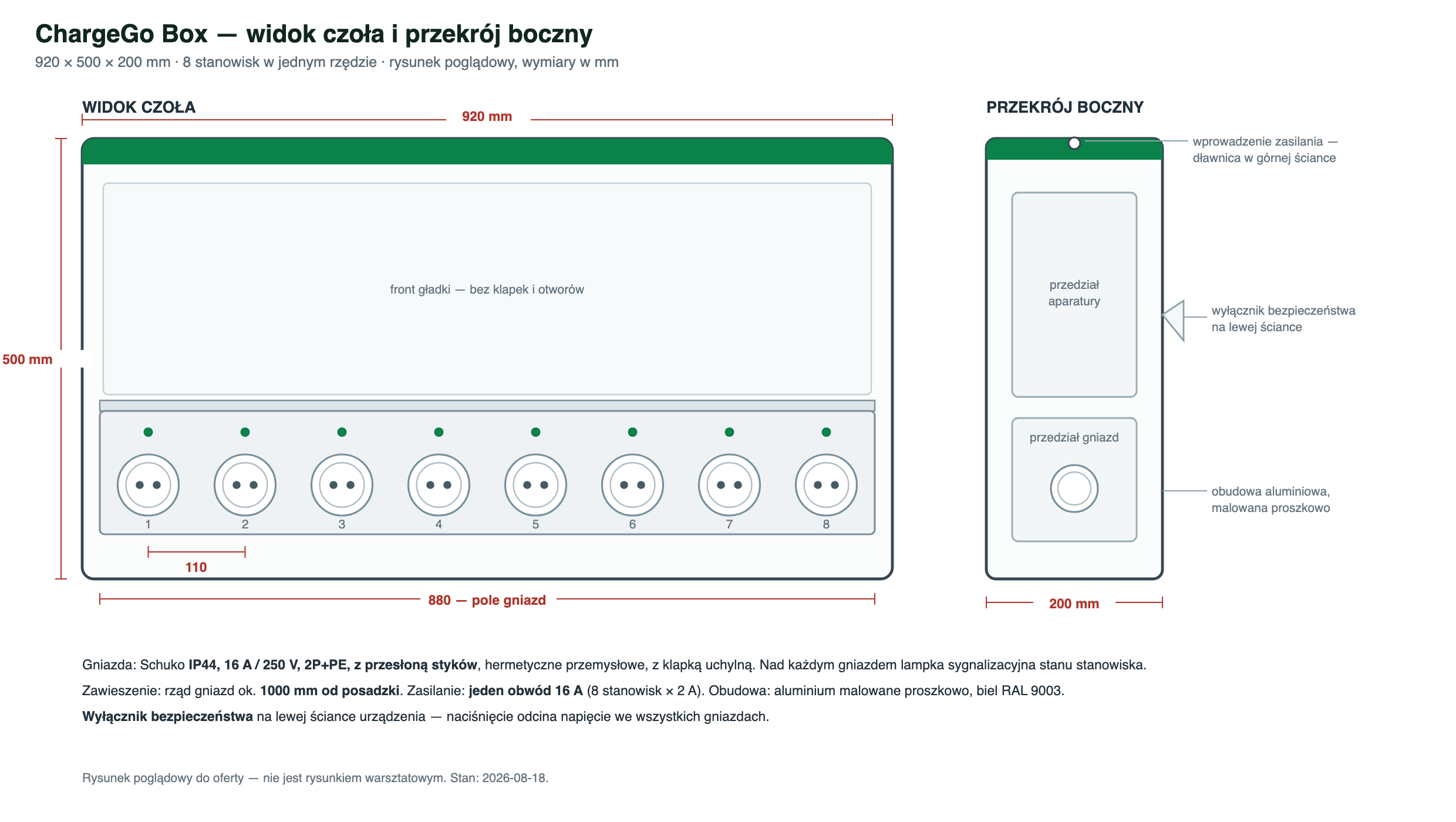
- 8 Schuko sockets 16 A / 250 V, IP44, with shutter contacts — the user connects their own factory bike charger
- 2 A limit per charging point, i.e. approx. 460 W, enforced electronically
- Energy meter at each charging point — consumption visible per charging point and per session
- Protections in the housing — main disconnector, 30 mA type A RCD, charging point circuit breakers, surge protector, safety switch
Where the number eight comes from
Eight charging points at 2 A gives 16 A, exactly what the supply circuit has. Per-point limits are set so that even with all eight working at maximum allowed draw the sum stays within circuit capacity. The installation does not rely on the assumption that nobody ever charges at once.
What happens when the limit is exceeded
Exceeding 2 A on a charging point disconnects that one charging point and reports it in the app. The other seven keep charging. On a normal circuit with one protection, tripping kills everything on it and the cause is found by unplugging one device at a time.
The limit has one more effect worth stating plainly to the administrator: it prevents using the station as an ordinary garage socket. A factory bike charger fits within the limit with margin; a vacuum cleaner, heater or workshop tool does not. The charging point disconnects and the event appears in the panel.
These are static limits assigned to channels, set permanently. The unit does not allocate power dynamically between charging points and does not raise the limit on one point because others are idle. Dynamic power allocation, if another supplier's offer mentions it, is a different function.
What is in the unit and what is on the building side
The expensive scenario with any installation in an existing building is when, after quoting the unit, it turns out you still need to add devices in the distribution board, replace protections or change the building's power allocation. The investment then grows by a line item nobody planned, and the decision goes back to square one.
Here that line item does not exist, because protections are in the station housing: main disconnector, 30 mA type A RCD, charging point circuit breakers, surge protector and safety switch are supplied with the unit. The scope of work on the building installation side is determined by the electrician after inspection. Beyond the unit itself, one thing remains: a 230 V / 16 A circuit at the mounting location. If the property has none, we run it as part of the order, including from the meter.
Practical consequence for planning: the cost on the building side is cable plus electrician labour over the distance from the distribution board to the wall where the station will hang. Establish that distance before choosing the mounting location, because it is usually the only cost item that differs significantly between two garages.
What else the mounting location requires
- Wall — the station is designed for wall mounting; it hangs on a room wall, without a support structure
- Indoors — the unit is for indoor use only: underground garage, bike room, hall
- Space in front of the station — eight sockets are in one row in the lower part of the 770 × 450 × 160 mm unit; parked bikes and a passage must fit in front of it
Who has access and how it is granted
Access is granted by the administrator in the management panel. There is a QR code at each charging point: the user scans it, starts their session and sees it in the app. No cards, key fobs or separate management passwords.
For the building manager that changes how support works. There is no issuing and collecting tokens, no "who lost the card", and revoking access for someone who moved out or left the company is an operation in the panel.
The management panel is available in Polish and English, and session history is available to the administrator. That is where the answers come from to "how many charging points were occupied at peak" and "how much energy was drawn last month".
What happens when the connection drops
An underground garage is a bad place to assume the internet always works. The station operates locally when the connection is down: started sessions continue, and the unit keeps working without contact with the cloud.
Who pays for electricity and how to bill it
Energy is drawn from the building installation, so on the supplier's invoice it goes to the owners' association, housing cooperative or office building owner. The open question is whether and how that cost is passed on to users.
In practice we see three models:
- Common-area cost — energy stays in maintenance costs, like garage lighting. Simple, and sensible when there are few users and the amount is symbolic. The difference from a service socket is that this time you know how much it is, because each charging point has a meter.
- Flat rate for users — a fixed monthly fee for access, adopted by the association or written into building rules. Metering here checks whether the flat rate matches actual consumption.
- Consumption-based billing — cost assigned to the user from readings for their charging points and sessions. Requires the optional billing module in the subscription.
The form and legal basis of a resolution introducing a fee, especially a flat rate, is a question for the lawyer serving the association or cooperative. Regulations treat covering cost from the common fund differently from introducing a new fee for an additional service.
Energy metering in the station gives consumption broken down by charging points and sessions, assigned to the account that started charging. That is the basis for charging residents or tenants. The property sets the rate and records it in the station usage rules, and billing is cost allocation according to the unit's readings.
What can be done with metering data is covered in a separate article: energy metering and billing for bike charging. The order of magnitude of the energy cost itself is broken down in how much electricity electric bike charging uses.
Formalities and the association's decision
Mounting a wall unit in an existing garage as a rule does not require a building permit or notification. No building structure is created, the way the garage is used does not change, and the structure is not altered.
There are exceptions to know about before setting a schedule:
- Properties listed in the heritage register
- Properties in conservation protection zones
- Cases where electrical installation reconstruction takes place — beyond running a circuit to an existing distribution board
In each of these cases the scope of formalities must be confirmed with the authority responsible for the location. That is one question to the architecture department or the conservator, and it has to be asked rather than assumed.
The corporate side of the decision
In an owners' association the bottleneck is internal formalities far more often than official ones. Installation in a common area and expenditure from the renovation fund usually require a resolution, and a resolution has its own calendar. A sensible order:
- Count electric bikes in the building and collect declarations of interest
- Agree mounting location and distance from the distribution board — that determines cost on the building side
- Quote: unit plus installation plus electrical work on the building side
- Decide the billing model before the resolution, because that is the most common source of dispute at a meeting
- Resolution, order, installation
In an office building or commercial property the path is shorter: the decision lies with the manager or owner, and the topic usually appears when reviewing amenities for tenants.
What it costs
The unit price is from €3,450 excl. VAT, including software, management panel and app, with no subscription, indefinitely. That matters for long-term maintenance cost: basic functionality does not expire after a year and needs no licence renewal.
| Item | Price excl. VAT | Type |
|---|---|---|
| ChargeGo Box — unit, 8 charging points | from €3,450 | one-off |
| Installation | €420 | one-off |
| Commissioning with training | €350 | one-off |
| Signage | €140 | one-off |
| RAL colour (standard: white) | €140 | one-off |
| 7-year warranty instead of 5 | €470 | one-off |
| Cloud subscription | €10 / month | optional |
| Billing module | +€7 / month | optional |
One item is missing from this table and belongs in the budget: running a 230 V / 16 A circuit. That is the building electrician's work, and its cost depends on distance from the distribution board and how the route is run. Choose the mounting location together with the electrician, before the decision is made.
Delivery time is 8 weeks. For an owners' association deciding by resolution that is rarely the critical item, because the meeting calendar is longer than the delivery time.
Scope of application
Two product lines answer two situations, and the choice between them is decided by where the bikes are parked.
Inside the building: Box on the wall
A wall-mounted station uses the building installation, so it needs no land, foundation or separate connection. It hangs on the wall of an underground garage, bike room or hall and connects to one 230 V / 16 A circuit. If the property has land and wants to produce energy on site, the right choice is a shelter with photovoltaics and storage.
How the power limit per charging point works
Each charging point has a fixed limit assigned to its channel. Eight bikes charging simultaneously fit on one circuit and none takes power from the others, so full occupancy loads the building installation the same as one charging point. For bike charging that works, because charging time is measured in hours.
Station vs parking space
The station handles power, access and metering. Bikes stay on what the property already has: racks, lockers or the bike room wall. If there is no parking space yet, we arrange it together with the installation, described in how to prepare a bike room for e-bike charging.
When it makes sense to install
The threshold is where several electric bikes appear and the first complaints about extension leads. Eight charging points then give headroom for several years, since the number of e-bikes in a building grows and expansion means a second station with its own circuit.
Most common questions from property managers
Can the unit be mounted in an underground garage without windows and gravity ventilation?
The unit is designed for indoor use and mounts on a wall; those are its two location requirements. Conditions the garage itself must meet as a room come from building regulations and the building design, and do not change because a station is installed. Any doubt about that status is a question for the building's technical manager.
Is one station enough for the whole building?
That depends on the number of electric bikes rather than the number of flats. One station is eight charging points on one 16 A circuit. Expansion means another station with its own circuit, so the scale decision can be taken in stages.
Does the user need their own charger?
Yes. The station provides a Schuko 16 A / 250 V socket with shutter contacts, and the user connects the factory charger supplied with the bike. We do not supply chargers and do not interfere with charging on the bike side.
What happens if someone connects something other than a bike charger to a charging point?
If the device exceeds the 2 A limit, the charging point disconnects and the event appears in the app. The other charging points keep working, and the administrator sees which point it concerned.
Do we have to buy a subscription?
No. Software, panel and app are included in the unit price, with no subscription and indefinitely. The cloud subscription (€10 per month) and billing module (a further €7 per month) are optional; the latter makes sense when you plan to pass energy cost on to users based on consumption.
What can we see before deciding?
We show the station, app and administrator panel at our workshop in Dąbrowa Górnicza, where we design and assemble the electronics. In operation, a shelter at Hotel Ostaniec has been running since May 2026: 8 charging points, approx. 3 kWp photovoltaics and approx. 5 kWh storage. Both product lines share the same software: the same app, panel and session history.
How long does the whole process take from decision to working installation?
Unit delivery time is 8 weeks. Add time for the building electrician to run the circuit and, in an association, the resolution calendar, which is usually longer than both combined.