The sentence this topic starts with is: "someone is charging a bike from a socket in the bike room and nobody knows who pays for it". A full charge of a typical battery is about 0.5 kWh, i.e. €0.07–0.12. What the administrator lacks is an answer to "how much" and "who", and therefore any basis for a decision beyond two bad ones: pretend the topic does not exist, or ban charging in rules nobody will enforce.
Short answer
Metering per charging point gives two things: energy consumption in kWh assigned to a specific socket, and a session record (when, how long, and — if the session was started in the app or with a QR code — by whom).
There are three billing models: free access for authorised users, consumption records with cost on the property or passed to the user, and payment per session or per kWh.
Scale is small: a full 500 Wh charge is ~0.5 kWh, i.e. €0.07–0.12. Eight charging points charged once a day all year is ~1,460 kWh, roughly €204–350 per year for energy.
The model is changed in the panel and requires no changes to the unit. A property can start with records without fees and enable billing later.
Why this is an accounting problem
When a resident plugs a bike charger into a socket in the bike room, basement or corridor, the energy drawn goes into one pot: the common-area meter. That pot is then divided among everyone by shares or floor area, so charging cost is spread across people who do not have an electric bike and do not intend to get one.
The amount is small, but accounting needs a title for every expense. An expense without assignment cannot be defended at a meeting, even at €70 per year. That is why the topic keeps coming back in the same form: someone asks who pays for the electricity, and nobody can answer.
The consequences of having no answer are predictable and all bad:
- Complaint about "subsidising a neighbour" — a recurring dispute point at meetings, disproportionate to the rate, but effective at blocking any investment in bike infrastructure.
- No way to introduce a fee — even if the association wants a flat rate, there is nothing to justify its level or show who uses it.
- Defensive reflex: a ban — the rules get a clause forbidding charging in common areas. Charging does not disappear; it moves to flats and cellars, extension leads and random sockets, exactly where nobody controls it.
- Gap between rules and reality — the worst variant: the building manager has formally banned it, tolerates it in practice, and if something goes wrong has neither records nor a dedicated installation.
The answer is a dedicated and managed installation: a separate circuit that charging is brought to, metering assigned to the charging point, and knowledge of who used it. That gives the administrator material for any billing model, including "we do not bill, but we know".
How metering per charging point works
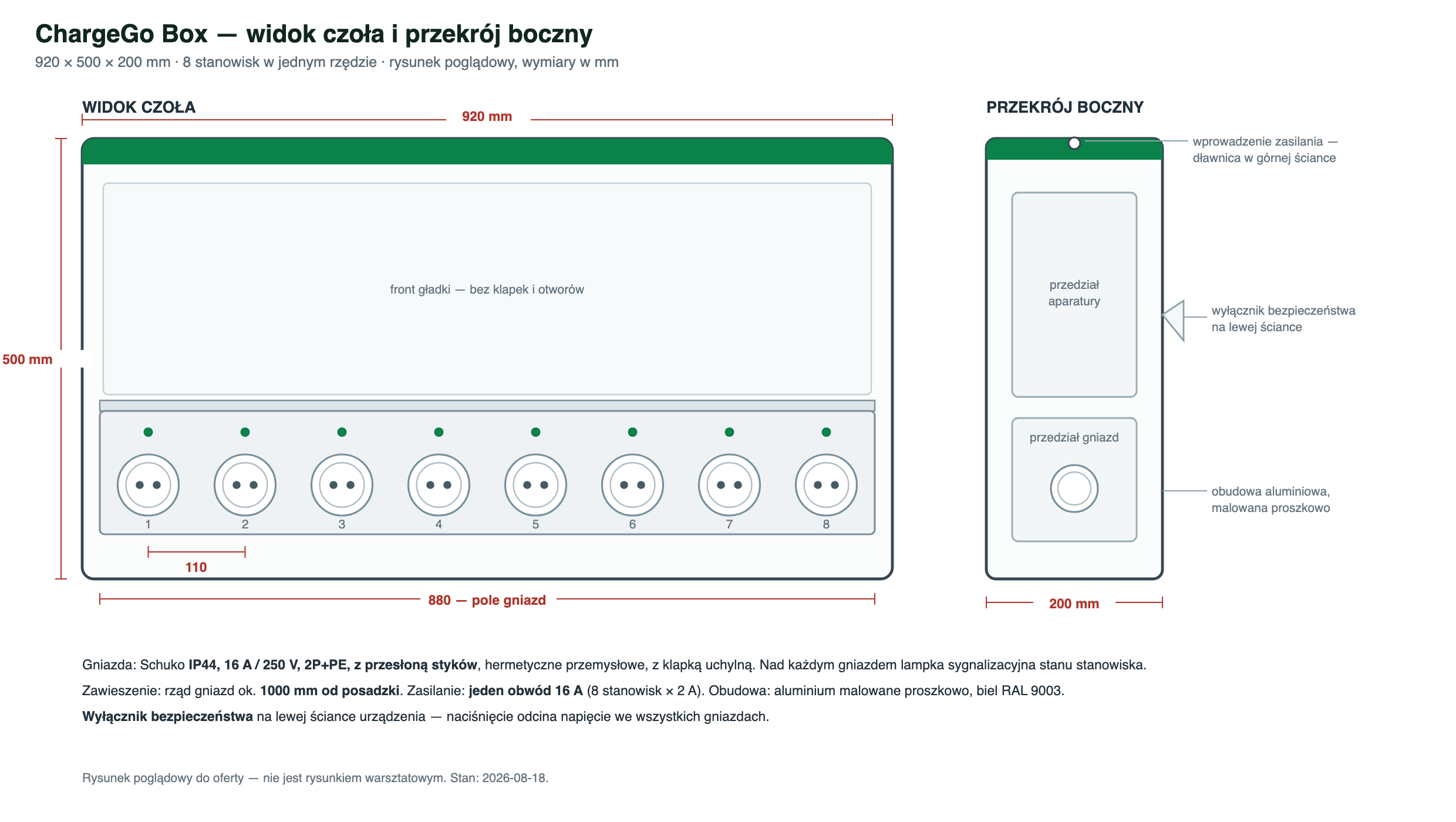
In a ChargeGo Box wall-mounted station, one 230 V / 16 A circuit is brought to the unit, existing or run by the building electrician or by us. Inside the housing that circuit is split into eight charging points. Each charging point is:
- a Schuko 16 A / 250 V socket in IP44 with shutter contacts,
- an energy meter — consumption counted separately for that one socket,
- a 2 A (~460 W) limit enforced electronically. Exceeding it disconnects that one charging point and reports it in the app; the other seven keep charging.
The full set of protections is inside the housing: main disconnector, residual-current and overcurrent protection, surge protector and safety switch. From the building installation's perspective, charging eight bikes is one identifiable circuit rather than eight sockets scattered around the bike room.
That matters for accounting. If the administrator wants a formal cost basis on the building side, the electrician can meter that one circuit in the distribution board, on the same principles as any other dedicated load. Metering inside the station then shows how that cost splits across charging points and sessions.
How metering assigns energy to a person
The meter assigns energy to the charging point. Assignment to a person appears when a session is started in the mobile app or with a QR code at the charging point: session history then records who started charging, when, and how much energy that charging point drew.
With open access, where sockets work for anyone who walks up, metering still runs but answers only "how much did charging point number 3 draw". Without identification there is no per-user billing model, only technical records.
The management panel is available in Polish and English, and session history is available to the administrator. With a broken connection the station keeps working locally: charging does not stop, and session records catch up when the connection returns.
How the power limit per charging point works
- The limit is fixed for each charging point. Each socket gets the same amount, regardless of how many charging points are active. Eight bikes charging simultaneously fit on one circuit and none takes power from the others.
- Exceeding the limit disconnects one charging point, not the station. The event goes to the app and the other seven keep charging. On a socket in a common area, tripping protection kills the whole circuit.
- Charging is controlled by the bike's system. The station supplies 230 V and measures how much energy went to the charging point. The battery charges as its manufacturer intended.
How to name metering in documents
The charging fee is levied on the basis of the station usage rules, and the reading from the unit is the number the fee rests on. In property documents call it consumption records or informational metering rather than a sub-meter, because that word refers to an instrument with a different status and pulls the topic into a metrology discussion.
Beyond that one word, fee handling looks like this:
- The fee rests on the usage rules. Station usage rules, accepted by the user at first charge, set the rate and method of calculation — the same as a parking fee, laundry or drying room in a building.
- The station supplies the number the fee rests on. Consumption per charging point and per session, assigned to the account that started charging. A statement for any period comes from the panel for accounting.
- Choose the calculation method for your property. Flat rate for access, fee per session, or rate per kilowatt-hour. All three work on the same metering and are switched in the panel.
The scale of any dispute is small, because a full charge costs €0.07–0.12. A few percent difference on a reading is pennies, so billing rests on what the parties agreed.
Three billing models
All three models use the same metering. They differ in what the property does with the number it gets.
Model 1 — free access for authorised users
Charging is free for a defined group: the administrator grants access to specific people — residents, employees, hotel guests for the duration of their stay. Energy cost stays with the property and goes into operating costs, like garage lighting or the lift.
Metering here does two things: it shows that the amount is known and small, which cuts discussion at a meeting, and it catches unusual situations, since one charging point with consumption many times higher than the others signals that something other than a bike is charging.
For whom: owners' associations and housing cooperatives, offices treating charging as a benefit, hotels including it in the room rate. Administrative cost: lowest, since the only task is granting and revoking access.
Model 2 — consumption records
The property records consumption per charging point and per session, then either keeps the cost, with full knowledge of how much it is and who generated it, or passes it to the user as a flat rate calculated from collected history.
This intermediate model resists dispute over a single reading, because the flat rate is set once a year from real data from the previous year, and it answers the "we are subsidising a neighbour" complaint.
For whom: owners' associations with a clear user group, offices billing tenants for utilities, properties where cost must be assigned somewhere. Administrative cost: medium — once a year someone reviews data and recalculates the rate.
Model 3 — payment per session or per kWh
The user pays for using a charging point: a rate per session, or a rate depending on energy drawn. It requires starting sessions in the app or with a QR code, since without identification there is nobody to charge, and rules that set the rate and how it is calculated.
In the ChargeGo offer, billing support is a separate optional subscription (€7 / month on top of the cloud subscription €10 / month); the unit with software, panel and app works without subscription and indefinitely. Do that arithmetic before deciding: €84 per year for the billing module against annual energy cost of roughly €70–93 needs a justification other than energy.
For whom: properties selling a service — paid bike parking, points on routes, hotels billing extras beyond room rate. Administrative cost: highest, because complaints, corrections and questions about bills appear.
| Model | What metering is for | Requires user identification | Administrative effort |
|---|---|---|---|
| Free access for authorised users | Scale control and catching anomalies | Yes — for granting access | Low |
| Consumption records | Basis for flat rate calculation and discussion at a meeting | Recommended | Medium |
| Payment per session or kWh | Calculating the charge — with caveat on nature of metering | Yes, mandatory | High |
What one charge actually costs
The reference point worth returning to in every discussion about billing:
- typical electric bike battery: 500 Wh,
- full charge: ≈ 0.5 kWh,
- cost of that energy: €0.07–0.12.
Three annual scenarios from the same numbers. Frequency of use is an assumption, so substitute your own:
| Scenario (assumption) | Charges per year | Energy | Annual energy cost |
|---|---|---|---|
| Bike room with 8 charging points, ~30% utilisation (2–3 charges per day) | ~900 | ~450 kWh | ~€63–108 |
| 8 charging points, one full charge per charging point on working days | ~2,000 | ~1,000 kWh | ~€140–240 |
| 8 charging points, one full charge per charging point every day (upper bound) | ~2,900 | ~1,460 kWh | ~€204–350 |
For anyone who has to defend this to the board: even the upper scenario in this table is on the order of €350 per year for the whole building, and the third row assumes full occupancy of eight charging points every day of the year.
That answers the objection that comes earliest: electricity for bike charging will not burden the property budget. The board gets a line of roughly €350 per year and full knowledge of who drew how much, instead of unknown consumption from a socket in a common area.
Which model to choose for your property
Four situations decide the choice, so that nothing goes into a resolution that cannot then be operated.
- A few users charging irregularly. Records without a fee, i.e. model 1 or 2. The board knows who uses it and how much they draw, straight from the panel, with no monthly handling.
- Someone in the property handles resident support. A paid model then works and pays for that work, because questions about access and limits go to the person who has them in the panel.
- Utilities billed as a flat rate. Records without a fee fit better, because they show consumption without changing rent billing rules.
- Charging is meant to be an incentive. In a hotel, office or shopping centre, free charging is a sales argument, and metering stays anyway: it shows charging point utilisation and goes into the report.
The model is changed in the panel and requires no changes to the unit, so a property can start with records and enable fees later when the number of users grows.
What to decide before go-live
What decides whether the system works after six months or stands idle:
- Who grants and revokes access — by name. Administrator, reception or manager: one task, but it must have an owner.
- Who responds to an app report when a charging point disconnects after exceeding the 2 A limit. Disconnection affects one charging point and the others work, but someone has to know to go there.
- Content of the rules: who may use it, the limit per charging point, the fee if any, and a sentence on the nature of metering from the section above.
- Report format for accounting — who exports session history, how often and in what form. Without an agreed rhythm the data exists but nobody uses it.
- Circuit preparation — a 230 V / 16 A circuit run by the building electrician. The unit is 770 × 450 × 160 mm and designed for wall mounting.
- Formalities — mounting a wall-mounted station as a rule does not require a permit or notification. Exceptions: properties in the heritage register, conservation protection zones and cases involving reconstruction of the electrical installation, which are confirmed with the authority.
- Time — delivery 8 weeks; commissioning with operator training is a separate item (€350), worth scheduling for a day when the people who will manage it are present.
If bikes cannot be kept inside the building at all, the whole conversation moves outside: different costs, formalities and energy source. The answer is then a shelter, and the criteria for choosing between the two are in the article on charging bikes in an underground garage.
Most common questions from administrators
Can I charge a resident an amount calculated from the station reading?
Yes, on the basis of the rules or an agreement accepted by the user. A reading from the station gives consumption per person and per session, material that does not exist at all with a socket in a common area. How to record that in property documents is described above.
Does metering show who was charging?
Only when the session was started in the mobile app or with a QR code at the charging point. With open access, metering shows charging point consumption without assignment to a person.
What happens when someone connects a device with too high draw?
The 2 A (~460 W) limit per charging point is enforced electronically. Exceeding it disconnects that one charging point and reports it in the app; the other charging points keep charging.
Does metering work without internet?
The station operates locally even with a broken connection: charging works, and session records sync when the connection returns.
What is on the unit side and what on the building side?
Inside the unit housing is the full set of protections: main disconnector, residual-current and overcurrent protection, surge protector and safety switch. On the building side remains a 230 V / 16 A circuit brought to the mounting location. If there is none, we run it as part of the order, including from the meter.
Does the 2 A limit change depending on how many are charging?
No. Limits are static: 2 A per charging point, regardless of the number of active sessions. Eight charging points operate from one 16 A circuit.
Does metering make sense if charging is to be free?
Yes. Metering without a fee answers "how much does it cost us", allows detecting unusual consumption on a charging point, and is the material to work from if the association ever wants a flat rate. It costs nothing extra: session history and panel are included in the unit price.